- Title
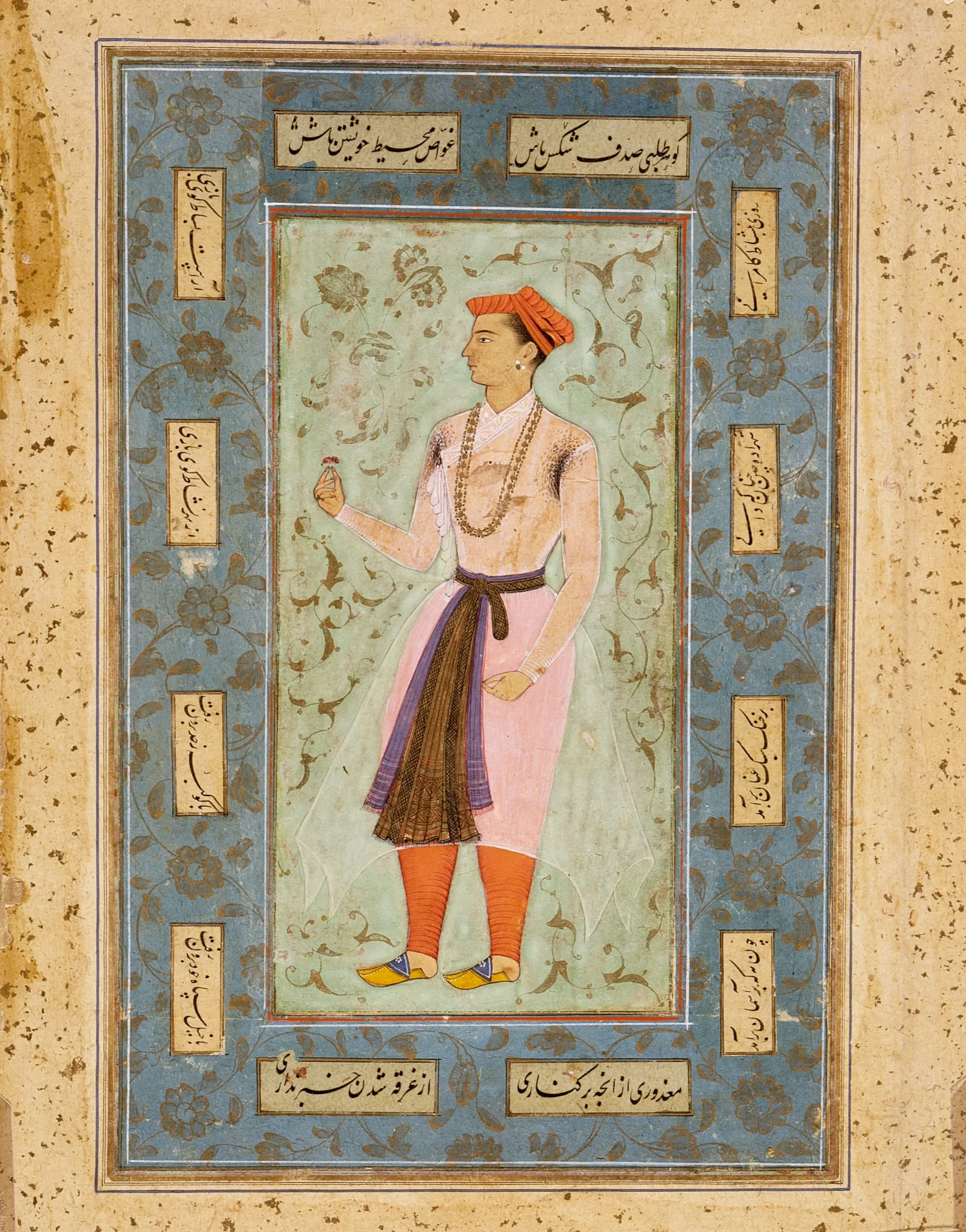
- A Prince (Recto); Page of Calligraphy (Verso)
- Date Made
- circa 1600-1625
- Medium
- Opaque watercolor, gold, and ink on paper
- Dimensions
- Sheet: 9 x 7 in. (22.86 x 17.78 cm); Image (recto): 5 3/4 x 2 7/8 in. (14.61 x 7.3 cm); Image (verso): 5 3/8 x 4 1/2 in. (13.65 x 11.43 cm)
- Accession Number
- AC1999.127.9
- Curatorial Notes
This portrait of an unidentified prince is a conventionalized representation of a young nobleman. Standing in profile, he has fine features and a sharp outline delineating his visage. His sparse ornaments consist of an earring with two pearls flanking an emerald and a multi-strand golden necklace. He wears a flat orange turban, a transparent muslin four-pointed coat (jama) tied with two waist sashes, orange pants, and pointed shoes. His jama is tied under the right shoulder, indicating he is a Muslim, and has conspicuous armpit shading. In his right hand he holds a flower symbolic of his cultural refinement. Handheld flowers or gems were standard attributes of idealized representations of princely figures. He stands against a pale green background commonly found in Mughal and early Rajput portraits of this period. Gold arabesques and floral sprays enliven the background. The portrait is framed with a broad blue border embellished with gold flowering vines and panels of calligraphy containing incomplete Persian verses in the mathnavi form. (Translated by Z. A. Desai.) On the verso is a large panel of ornamental calligraphy written in the nastaliq script containing fragments of two verses of Persian poetry. The name “Jahangir” is written in Devanagari script in the lower margin, but it is likely a spurious later identification.
Stylistically, this portrait is an excellent example of early Bikaner painting that was heavily influenced by the prevailing Mughal artistic conventions.
- Selected Bibliography
- Pal, Pratapaditya; Markel, Stephen; Leoshko, Janice. Pleasure Gardens of the Mind: Indian Paintings from the Jane Greenough Green Collection. Los Angeles County Museum of Art; Mapin Publishing Pvt. Ltd.: Los Angeles, 1993.