LACMA

ShopMembershipMyLACMATickets
LACMA
Los Angeles County Museum of Art
5905 Wilshire Blvd.
Los Angeles, CA 90036
info@lacma.org
(323) 857-6000
Sign up to receive emails
Subscribe
© Museum Associates 2025

Museum Hours

Monday

11 am–6 pm

Tuesday

11 am–6 pm

Wednesday

Closed

Thursday

11 am–6 pm

Friday

11 am–8 pm

Saturday

10 am–7 pm

Sunday

10 am–7 pm


  • About LACMA
  • Jobs
  • Building LACMA
  • Host An Event
  • Unframed
  • Press
  • FAQs
  • Log in to MyLACMA
  • Privacy Policy
© Museum Associates 2025
Collections

Unknown
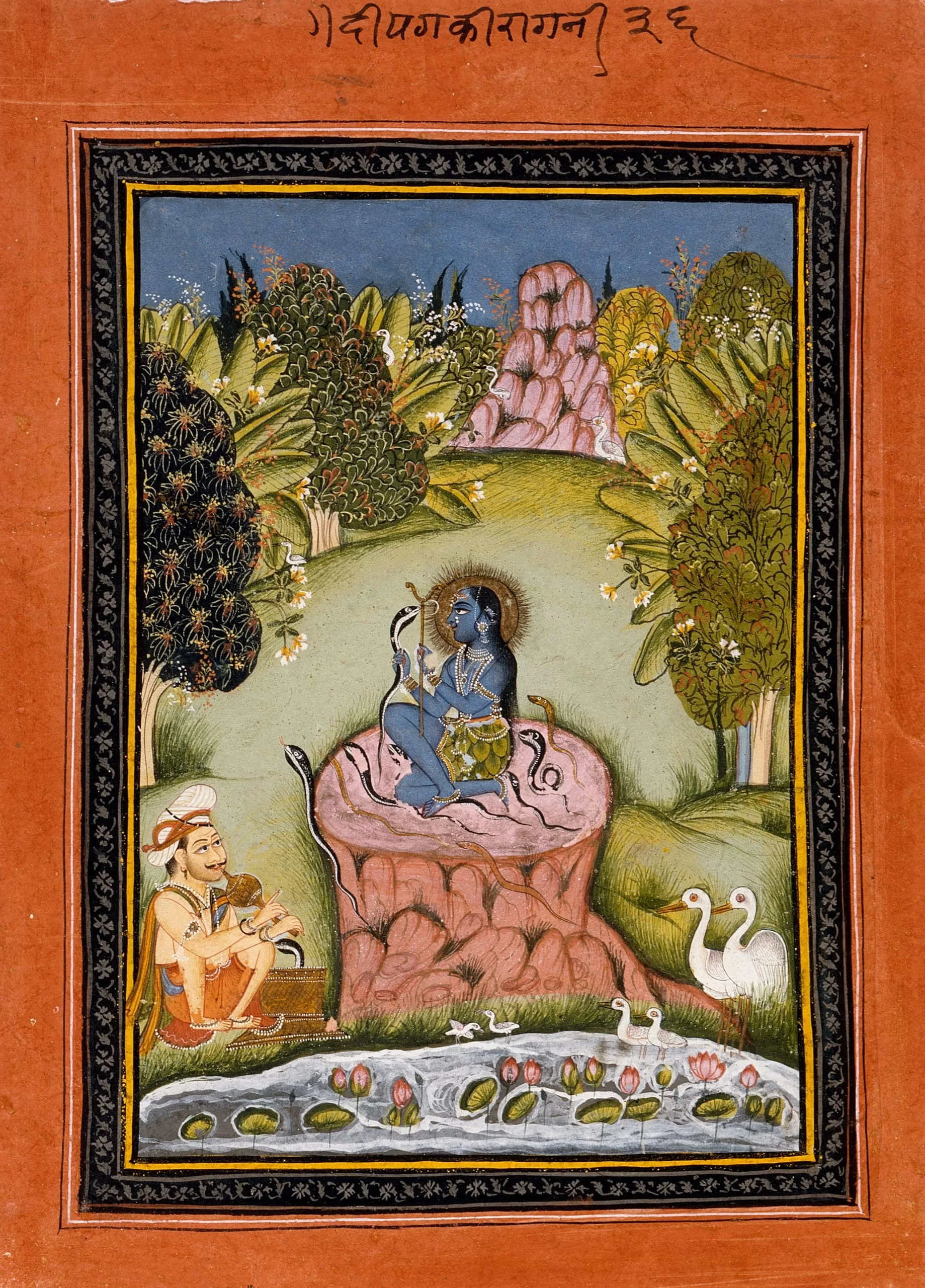
Asavari Ragini, Fourth Wife of Shri Raga, Folio from a Ragamala (Garland of Melodies)circa 1790

Not on view
Indian miniature painting in opaque watercolor, blue-skinned deity playing flute seated on a pink rock amid a lush landscape, flanked by cobras, with a musician to the left and lotus-filled stream below
Artist or Maker
Unknown
Title
Asavari Ragini, Fourth Wife of Shri Raga, Folio from a Ragamala (Garland of Melodies)
Place Made
India, Rajasthan, Bundi
Date Made
circa 1790
Medium
Opaque watercolor, gold, and silver on paper
Dimensions
Sheet: 11 x 7 7/8 in. (27.94 x 20 cm); Image: 8 1/16 x 5 7/8 in. (20.48 x 14.92 cm)
Credit Line
Gift of Jane Greenough Green in memory of Edward Pelton Green
Accession Number
AC1999.127.30
Classification
Drawings
Collecting Area
South and Southeast Asian Art
Curatorial Notes

Asavari Ragini is most commonly represented by a solitary woman wearing a leaf-skirt and communing with cobras in the forest. The name Asavari comes from Savaras, an ancient jungle tribe known for its snake-charming skills, and the ragini is based on its melodies. In keeping with these origins, the heroine is shown teaching or taming the snakes in various ways: with her hands, a small stick, or a wind instrument. The emphasis on gestures of the hands, stick, and flute reflects the South Asian belief that these movements—rather than the sounds of the flute—hypnotize the cobras. Usually played during the first quarter of the day, this ragini is described as tender and full of melancholy.

The ragini portrayed here has been transformed into the goddess Savari, the tutelary deity of the Savaras associated with the god Shiva. Her identity and divinity are indicated by her blue skin denoting her tribal origins, sectarian forehead markings, golden nimbus, and copious jewelry. Her crescent moon is emblematic of Shiva. In place of a simple stick, the goddess tames a cobra by waiving an ascetic's crutch. The painting includes a male snake-charmer playing a pungi or bulbous flute. The lush blooming trees are stylistic trademarks of Bundi painting.

Curiously, this illustration of Asavari Ragini is inscribed in the upper border as “the ragini of Dipak Raga, no. 36” instead of being the more customary wife of Shri Raga. See also M.85.139.3, AC1999.127.28, and AC1999.127.29.
Selected Bibliography
  • Pal, Pratapaditya; Markel, Stephen; Leoshko, Janice. Pleasure Gardens of the Mind: Indian Paintings from the Jane Greenough Green Collection. Los Angeles County Museum of Art; Mapin Publishing Pvt. Ltd.: Los Angeles, 1993.
  • Pal, Pratapaditya. Indian Paintings from Staff Collections. Los Angeles: Los Angeles County Museum of Art, 1973.