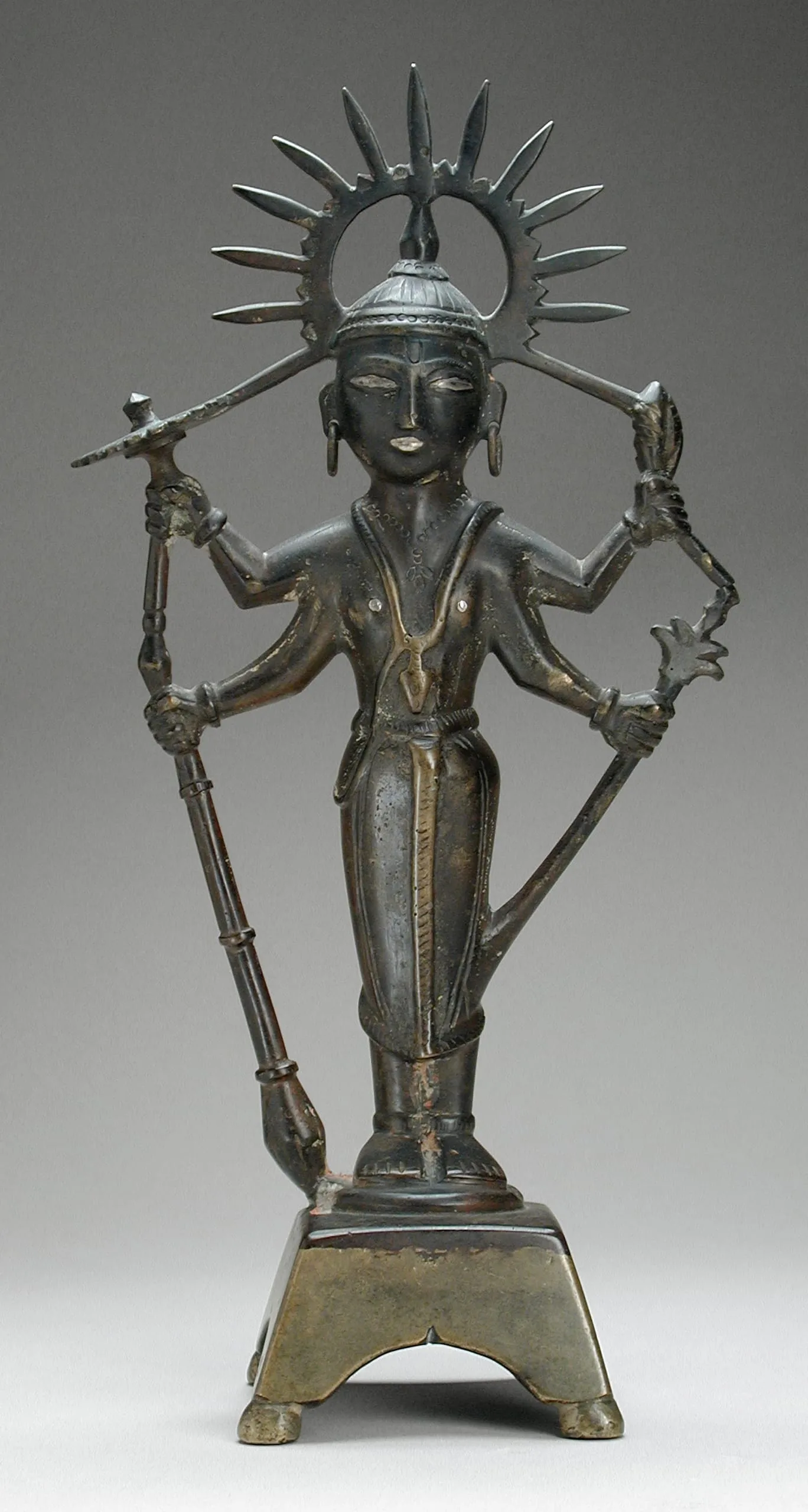
This slender, somewhat folkish four-armed representation of Vishnu, the Hindu god of preservation, is stylistically attributed to Chamba, Himachal Pradesh, from the mid-20th century. Vishnu wears a woolen cap rather than a metal crown, and is deified by a large circular nimbus of light or solar rays (prabha-mandala). He has silver-inlaid eyes, lips, and nipples, and has a vertical sectarian forehead marking (tilaka) called the ‘elevated mark’ (urdhva pundra). In his upper right hand, he holds a discus (chakra). His lower right hand grasps the hilt of a mace (gada) held upside down. In his upper left hand, he holds a conch (shankha). His lower left hand carries a lotus (padma) with a long stalk that may have also served originally as a casting sprue, as did several other attribute connectors. He wears two necklaces with pendants and a long dhoti, and stands in a stiff, frontal pose (samapada sthanaka) on a plain footed pedestal.
For a closely comparable image of Brahma from Chamba, see M. Postel, A. Neven, and K. Mankodi, Antiquities of Himachal, Project for Indian Cultural Studies, Vol. 1 (Bombay: Franco-Indian Pharmaceuticals Prv Ltd, 1985), p. 119, fig. 155.