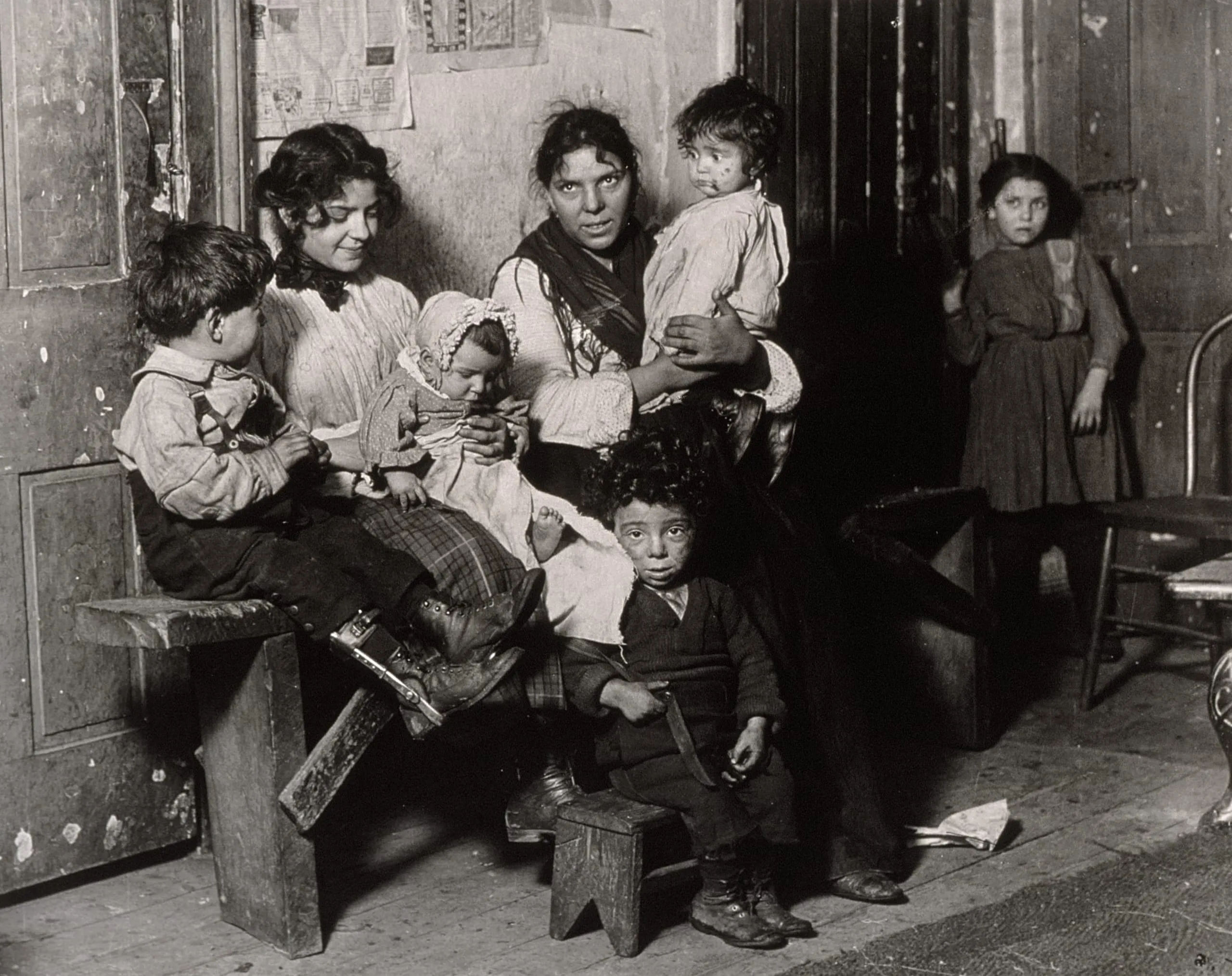
Among the most influential artist-activists in photographic history, Lewis Hine deployed the camera as an instrument of social change. Commissioned by social welfare agencies, he traveled the country to record the harsh conditions under which immigrants lived and labored. Starting in 1904, while teaching sociology at the Ethical Culture School in Manhattan, he documented the waves of immigrants passing through Ellis Island. The Italian family pictured here went on to Chicago, where, as part of a project to illustrate the work of Hull House, Hine photographed them in their crumbling tenement flat located in the neighborhood of the settlement house. Meanwhile, he had been hired by the National Child Labor Committee to document children working in mills, factories, canneries, mines, and agricultural fields across America. His compelling images ultimately helped to establish child labor laws in the United States. One can assume that most of the children in this image were already working long hours in factories or doing piecework—rolling cigars, making paper flowers, sewing garments—from home.
Hine coined the term “photo-story,” precursor of the photo-essay, to describe his work as an investigative photographer, in which he combined image and text. A keen observer, he captioned his images with detailed information about the subject’s context. “The average person believes implicitly that the photograph cannot falsify,” Hine explained. “Of course, you and I know that this unbounded faith in the integrity of the photograph is often rudely shaken, for, while photographs may not lie, liars may photograph.” Hine left a resounding impact on the worlds of journalism and art, pioneering a new form of storytelling that today we call photojournalism.
Eve Schillo
2024
Bibliography
Cerku, Ashley. “Applied Visual Anthropology in the Progressive Era: The Influence of Lewis Hine’s Child Labor Photographs.” Visual Anthropology 32, nos. 3–4 (2019): 221–39.
Nemerov, Alexander. Soulmaker: The Times of Lewis Hine, 185–90. Princeton: Princeton University Press, 2016.
Steinorth, Karl, Marianne Fulton, Anthony Bannon, International Museum of Photography at George Eastman House, and International Photo- and Cine Exhibition. Lewis Hine: Passionate Journey, Photographs 1905−1937. Zurich: Edition Stemmle, 1