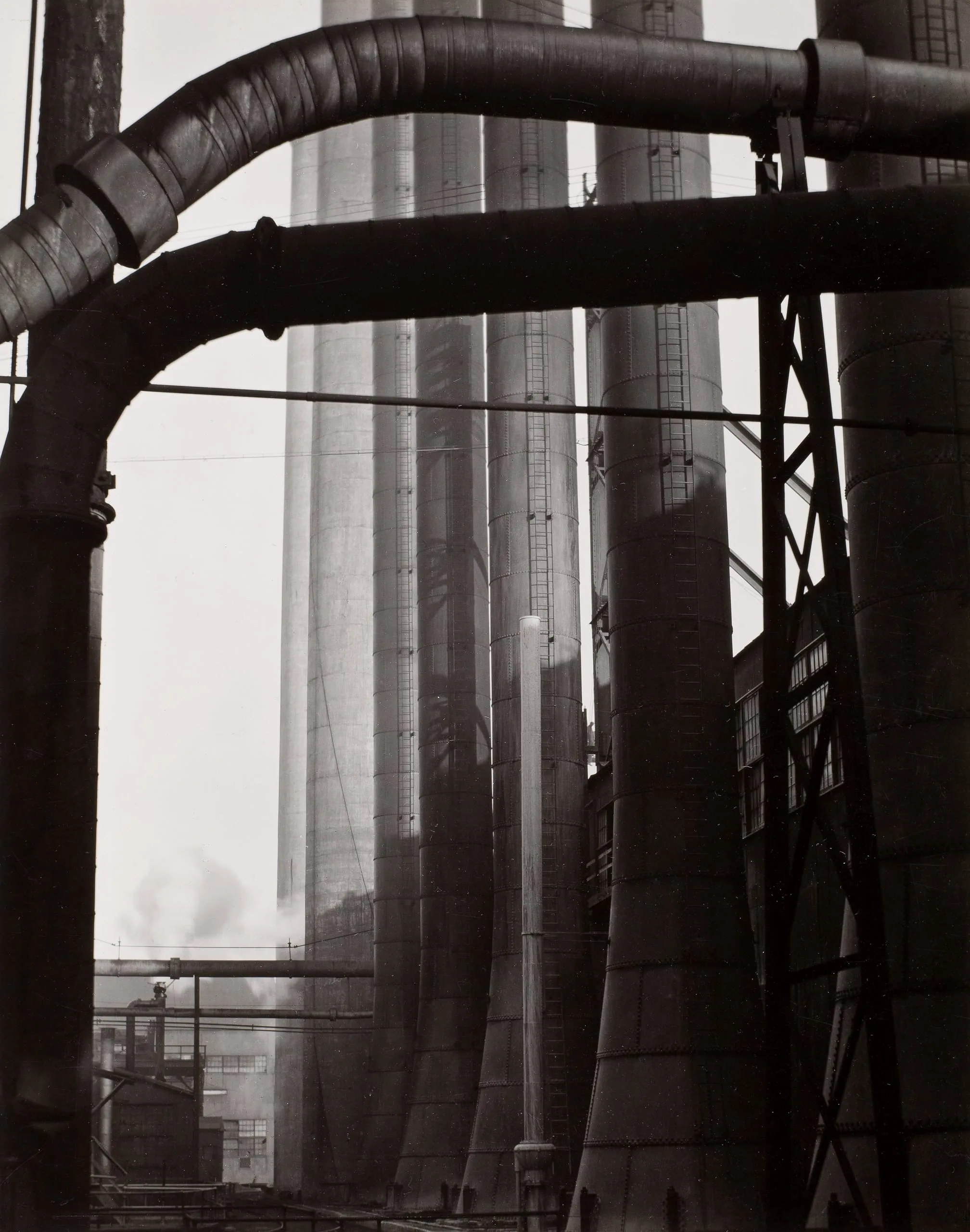
Among the most original and innovative photographers of the twentieth century, Edward Weston had solid footing in both the Pictorialist and modern movements. Born in Chicago in 1886, he took up the camera professionally when he moved to Tropico (today Glendale), California, at the age of twenty-one, opening his own portrait studio. His personal work at this time was defined by Pictorialism, in which theatrical, soft-focus lighting yielded painterly effects. Weston used shadows and screens to create otherworldly atmospheres that, together with evocative titles, suggest a narrative. Just before relocating to Mexico in 1922, he visited Middletown, Ohio, where his brother-in-law worked in the steel industry. Taken by the stark beauty of the American Rolling Mills Company (ARMCO), he made a series of photographs, including the one seen here, that were unlike anything he had done previously. Abstracted images of pipes, smokestacks, and utility poles against the white winter sky marked the beginning of Weston’s photographic shift to modernism.
Weston’s aims, as recorded in a “daybook” he began keeping in 1923, explain this transition: “To see the Thing Itself is essential: the quintessence revealed direct . . . to photograph a rock and have it look like a rock, but be more than a rock.” For Weston, a photograph was not merely a factual record or formally attractive composition; it communicated the essence of the object or scene before the camera. In the early 1930s, Weston cofounded the f/64 group, stating that, “as an art form, [photography] must develop along lines defined by the actualities and limitations of the photographic medium, and must always remain independent of ideological conventions of art and aesthetics that are reminiscent of a period and culture antedating the growth of the medium itself.”
Rebecca Morse, Curator, Wallis Annenberg Photography Department
2024
Bibliography
Mora, Gilles, ed. Edward Weston: Forms of Passion. New York: Harry N. Abrams, 1995.