LACMA

ShopMembershipMyLACMATickets
LACMA
Los Angeles County Museum of Art
5905 Wilshire Blvd.
Los Angeles, CA 90036
info@lacma.org
(323) 857-6000
Sign up to receive emails
Subscribe
© Museum Associates 2026
  • About LACMA
  • Jobs
  • Building LACMA
  • Host An Event
  • Unframed
  • Press
  • FAQs
  • Log in to MyLACMA
  • Privacy Policy
© Museum Associates 2026
Collections

Kaigyokusai Masatsugu
Buddhist Jewel of Wisdom Carved with the Isle of the Immortalsmid- to late 19th century

Not on view
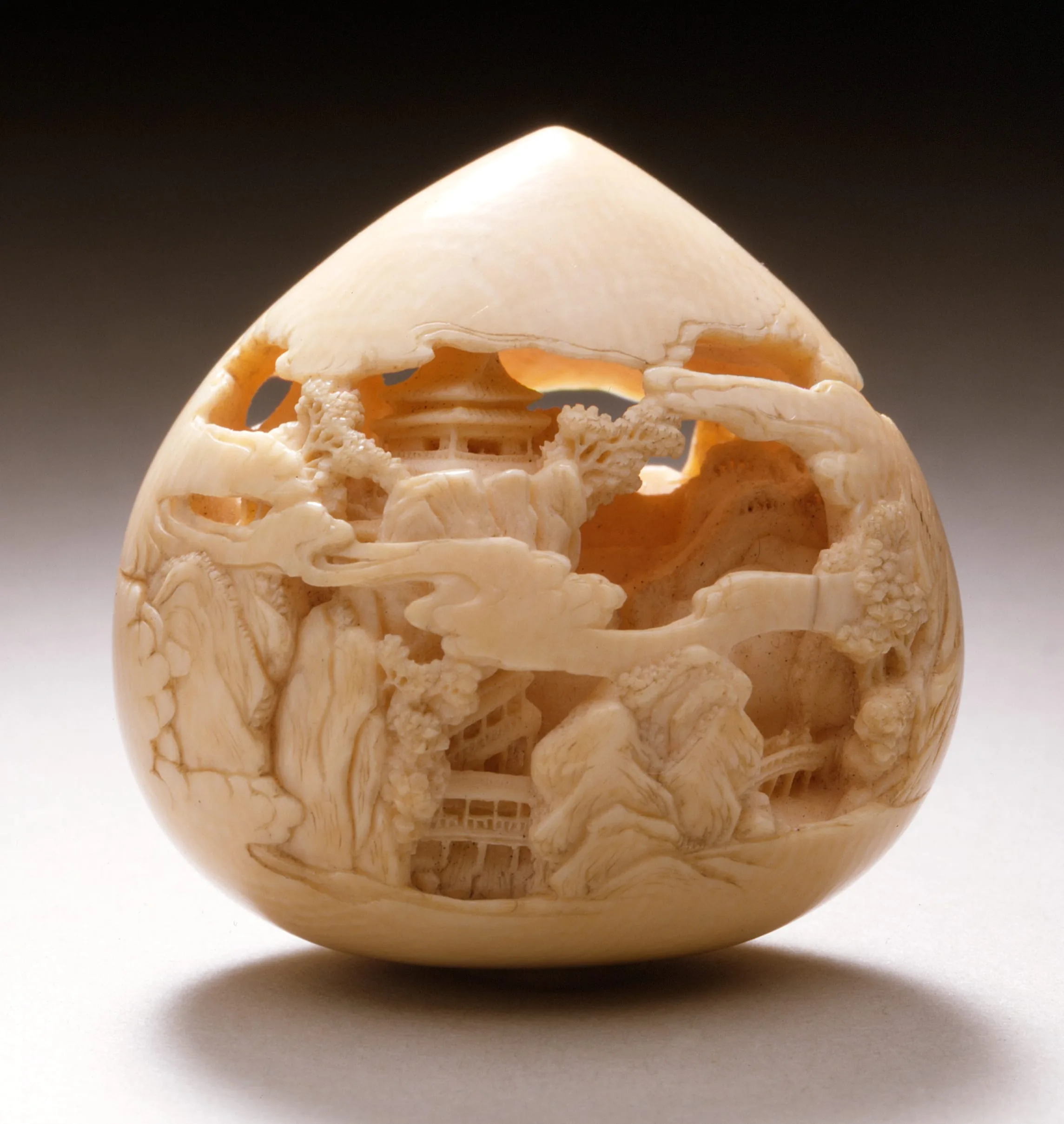
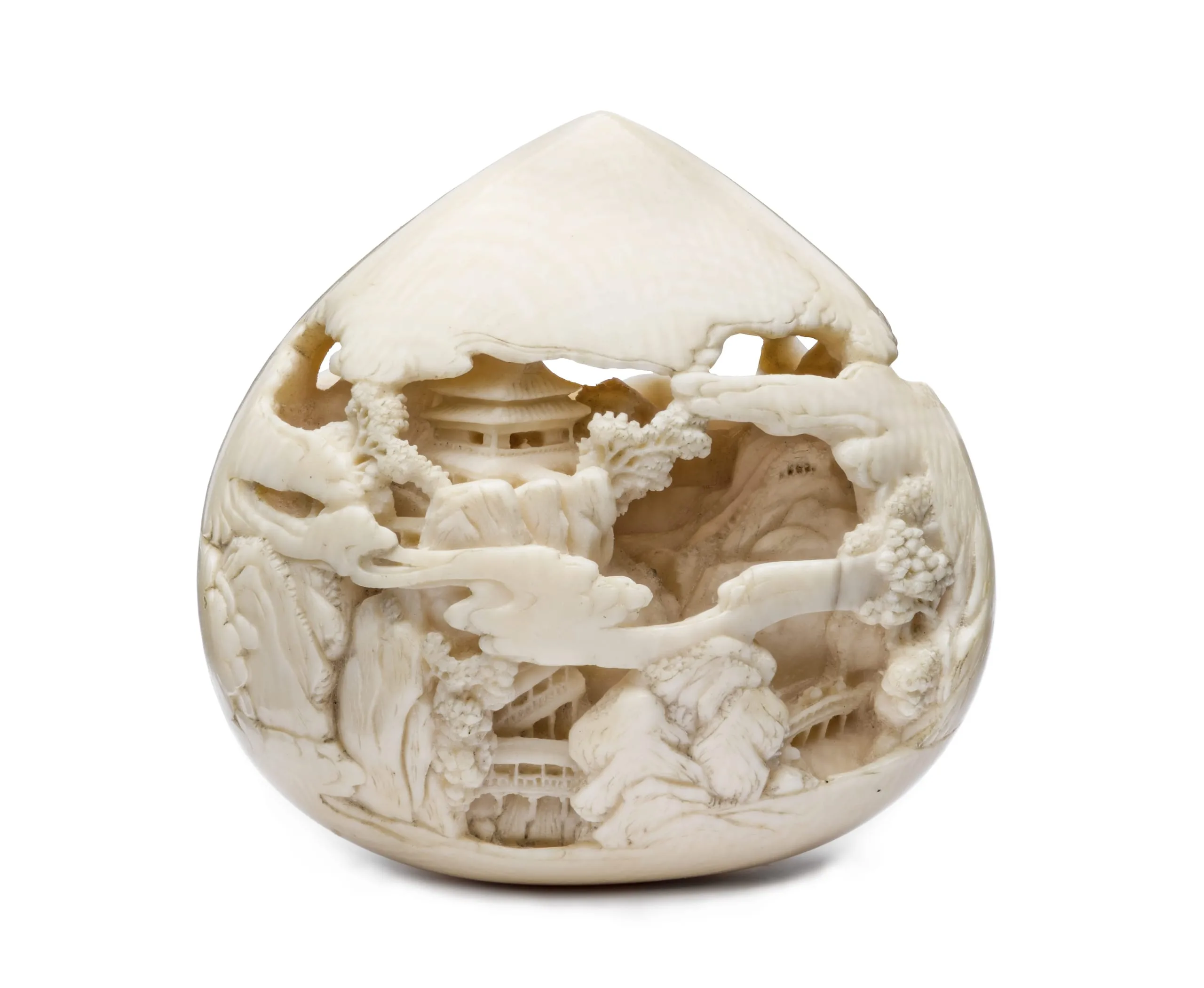
Peach-shaped ivory or stone carving with deeply carved and pierced landscape scene featuring a pagoda, gnarled trees, rocky cliffs, and an arched bridge
Ivory carving in peach form with reticulated openwork, depicting a mountainous landscape with pavilions, rocky outcroppings, and trees in layered relief; warm amber tones visible through the pierced interior.

Kaigyokusai Masatsugu, Buddhist Jewel of Wisdom Carved with the Isle of the Immortals, mid- to late 19th century, Los Angeles County Museum of Art, Raymond and Frances Bushell Collection, photo © Museum Associates/LACMA

Artist or Maker
Kaigyokusai Masatsugu
Japan, 1813-1892
Title
Buddhist Jewel of Wisdom Carved with the Isle of the Immortals
Place Made
Japan
Date Made
mid- to late 19th century
Period
Edo period (1603-1868) or Meiji period (1868-1912)
Medium
Ivory with staining
Dimensions
1 5/16 x 1 3/8 x 15/16 in. (3.4 x 3.5 x 2.4 cm)
Credit Line
Raymond and Frances Bushell Collection
Accession Number
M.91.250.224
Classification
Costumes
Collecting Area
Japanese Art
Curatorial Notes

Netsuke artists employed various techniques to produce a wide range of designs, effects, and surface textures. Anabori is a technique that goes well beyond a material’s surface. Ana means hole, cavern, or cave, and bori means carving. Anabori-type netsuke have deeply recessed interior carving, such as seen here in this tiny rendition of Mount Hōrai (Isle of the Immortals). The artist used the finest quality ivory of uniform bright white color and dense composition; the tight grain held the crisp edge of each cut, enabling him to carve very intricate details. Within this piece of ivory is a mountainous scene with trees scattered throughout and wisps of clouds. A long, winding bridge leads to a tall pavilion, where a person stands at a balcony overlooking the scene. Two individuals cross another bridge in the right foreground. Enveloped in clouds, the overall carving takes the form of the Buddhist Jewel of Wisdom (J. hōju or hōju-no-tama), which is typically represented as a sphere with a pointed top. Referred to as the sacred wish-fulfilling jewel or pearl, it is said to grant wishes and to bestow good health and prosperity. In Buddhism, it is a symbol of spiritual wealth.

Mount Hōrai is a legendary island off the coast of China inhabited by immortals along with other creatures and plants emblematic of longevity, including tortoises, cranes, stags, pine, peach, plum, and mushrooms. Long an auspicious symbol in Japan, Mount Hōrai was a favorite subject of Edo-period (1615−1868) painters (see M.88.186).

2024
Selected Bibliography
  • Phillips, Phoebe, ed. The Collectors' Encyclopedia of Antiques. New York: Crown Publishers, Inc., 1973.
  • Bushell, Raymond. Netsuke: Japanese Sculpture in Miniature from the Collection of Raymond and Frances Bushell, Part IV. Los Angeles: Los Angeles County Museum of Art, 1987.
  • Goodall, Hollis, Virginia G. Atchley, Neil K. Davey, Christine Drosse, Sebastian Izzard, Odile Madden, and Robert T. Singer. The Raymond and Frances Bushell Collection of Netsuke: A Legacy at the Los Angeles County Museum of Art. Chicago: Art Media Resources, Inc.; Los Angeles: Los Angeles County Museum of Art, 2003.
  • Drosse, Christine. "Netsuke Basics from A to Z: A." International Netsuke Society Journal 27, no.3 (2007): 58-63.
  • Bushell, Raymond. "To Donate or Not to Donate." Impressions: the Journal of the Japanese Art Society of America 42, pt.2 (2021): 100-121.