- Title
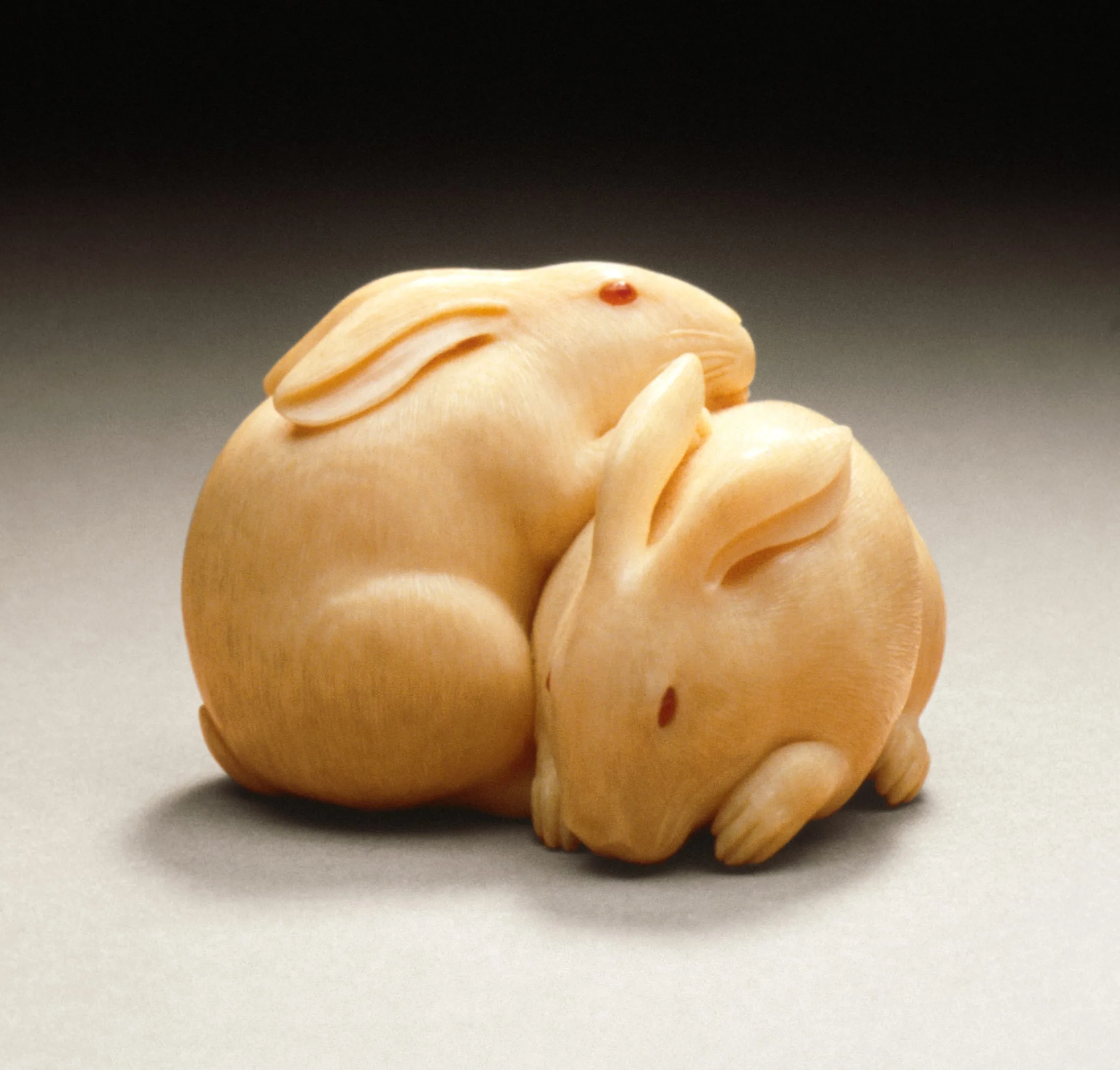
- Rabbit Pair
- Date Made
- mid- to late 19th century
- Medium
- Ivory with inlays
- Dimensions
- 1 9/16 x 1 1/4 x 1 1/16 in. (4.0 x 3.1 x 2.7 cm)
- Accession Number
- M.91.250.217
- Curatorial Notes
Kaigyokusai Masatsugu, a carver who lived in Osaka, worked primarily in the finest quality ivory known as tōkata, a dense but pliable material with a uniform white color. He thus ensured that his netsuke required no staining—the natural color and sheen of the ivory being his preferred finish. In his animal subjects, such as this pair of rabbits, the ivory’s whiteness is often accented with tiny inlays for the eyes. Here, they are double inlaid. Use of tōkata also enabled Kaigyokusai to achieve a level of fine surface texturing that transformed the most mundane subjects into exquisite artworks. His accurate renderings reflected the growing interest in naturalism. Painters and print artists took their materials to the source, sketching animals from life and examining insects and plants up close. This trend is also evident in netsuke production. Kaigyokusai and other carvers selected simple subjects from nature or from daily life which they executed to the tiniest detail. In early netsuke of rabbits, the long ears commonly stand stiffly upright. Here, they relax along the body’s curves. The soft ears, defined musculature, and detailed feet indicate that Kaigyokusai closely studied the animal.
2024
- Selected Bibliography
- Bushell, Raymond. An Exhibition of Netsuke from the Raymond Bushell Collection. Tokyo: Mikimoto World Jewelers, 1979.
- Atchley, Virginia G. "Kaigyokusai: An Appreciation." Netsuke Kenkyukai Study Journal 12, no.4 (1992): 10-21.
- Bushell, Raymond. Netsuke: Japanese Sculpture in Miniature from the Collection of Raymond and Frances Bushell, Part IV. Los Angeles: Los Angeles County Museum of Art, 1987.
- Goodall, Hollis, Virginia G. Atchley, Neil K. Davey, Christine Drosse, Sebastian Izzard, Odile Madden, and Robert T. Singer. The Raymond and Frances Bushell Collection of Netsuke: A Legacy at the Los Angeles County Museum of Art. Chicago: Art Media Resources, Inc.; Los Angeles: Los Angeles County Museum of Art, 2003.
- Bushell, Raymond. Collector's Netsuke. New York: Walker/Weatherhill, 1971.
- Bushell, Raymond. "To Donate or Not to Donate." Impressions: the Journal of the Japanese Art Society of America 42, pt.2 (2021): 100-121.