LACMA

ShopMembershipMyLACMATickets
LACMA
Los Angeles County Museum of Art
5905 Wilshire Blvd.
Los Angeles, CA 90036
info@lacma.org
(323) 857-6000
Sign up to receive emails
Subscribe
© Museum Associates 2025

Museum Hours

Monday

11 am–6 pm

Tuesday

11 am–6 pm

Wednesday

Closed

Thursday

11 am–6 pm

Friday

11 am–8 pm

Saturday

10 am–7 pm

Sunday

10 am–7 pm


  • About LACMA
  • Jobs
  • Building LACMA
  • Host An Event
  • Unframed
  • Press
  • FAQs
  • Log in to MyLACMA
  • Privacy Policy
© Museum Associates 2025
Collections

Kawanabe Kyōsai
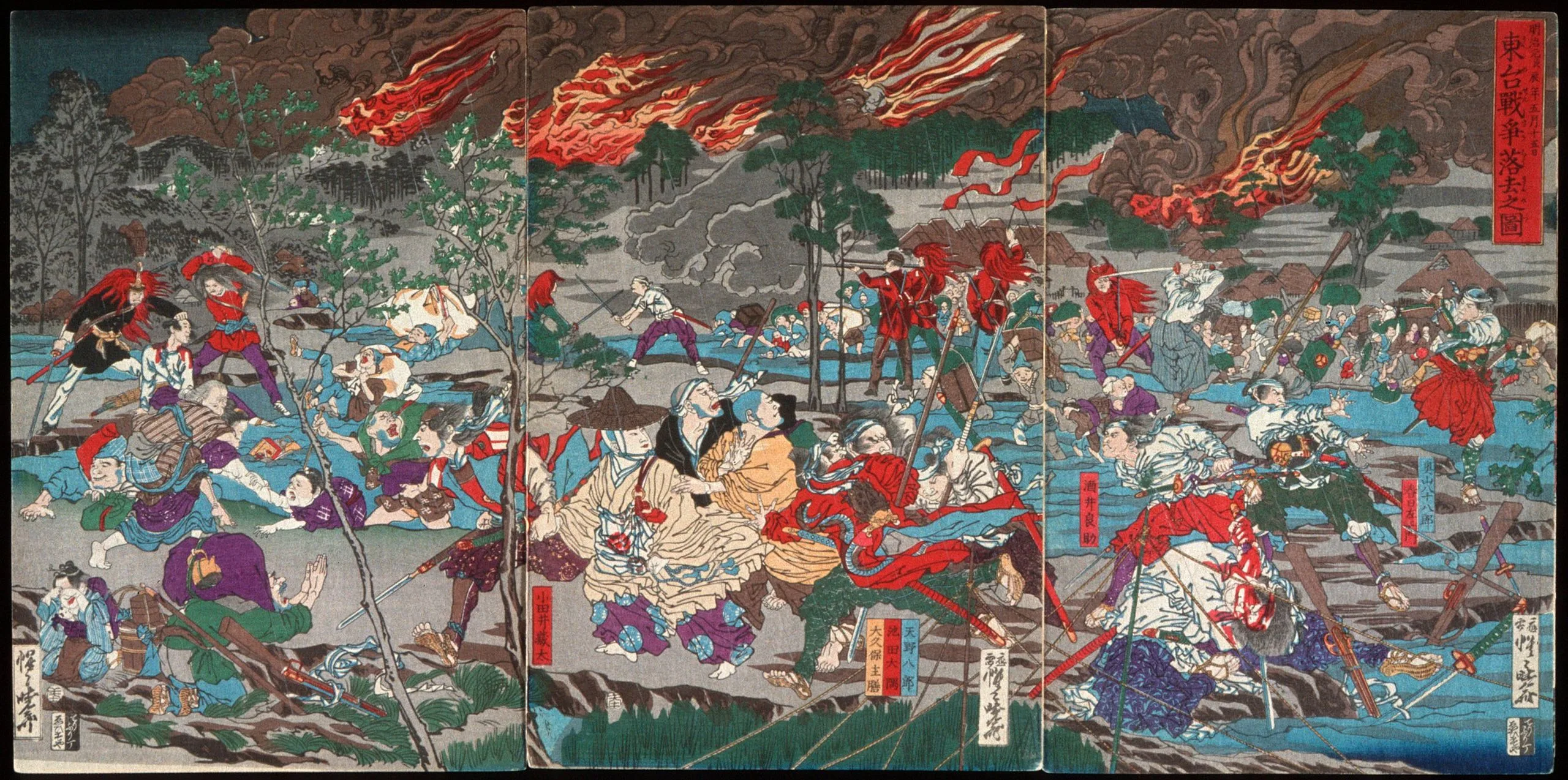
Defeat at the Battle of Ueno, on the fifteenth day of the fifth month of Meiji 1.(1868)November, 1874

Not on view
Japanese woodblock triptych print depicting a crowded battle scene with dozens of figures in brightly colored robes, flames and smoke filling the sky above
Artist or Maker
Kawanabe Kyōsai
Title
Defeat at the Battle of Ueno, on the fifteenth day of the fifth month of Meiji 1.(1868)
Place Made
Japan
Date Made
November, 1874
Medium
Triptych; color woodblock prints
Dimensions
(a) Image: 14 x 9 3/8 in. (35.6 x 23.9 cm); Paper: 14 x 9 3/8 in. (35.6 x 23.9 cm); (b) Image: 14 x 9 3/8 in. (35.6 x 23.9 cm); Paper: 14 x 9 3/8 in. (35.6 x 23.9 cm); (c) Image: 14 x 9 3/8 in. (35.6 x 23.9 cm); Paper: 14 x 9 3/8 in. (35.6 x 23.9 cm)
Credit Line
Herbert R. Cole Collection
Accession Number
M.84.31.534a-c
Classification
Prints
Collecting Area
Japanese Art
Curatorial Notes
Although not as graphically violent as Yoshitoshi's prints of the same subject, Kawanabe Kyōsai's "Battle of Ueno" captures the chaos of battle with similar energy and flair. Action-filled backgrounds upstaged by frenzied soldiers in the foreground lend a sense of confusion and complexity to the battlefield; figures run in all directions, and spent arrows and swords are stuck into the earth at every angle, frustrating any sense of directionality or order. In the center, samurai loyalists run frantically in disarray. One of them, Amano Hachirō, (1831-1868) died during the battle while helping his comrades escape; some of the others, including the general Ikeda Ōsumi, would later commit ritual suicide (seppuku). By placing these tragic figures in a scene of absolute tumult, Kyōsai has crafted a poignant image of a rapidly changing Japan.