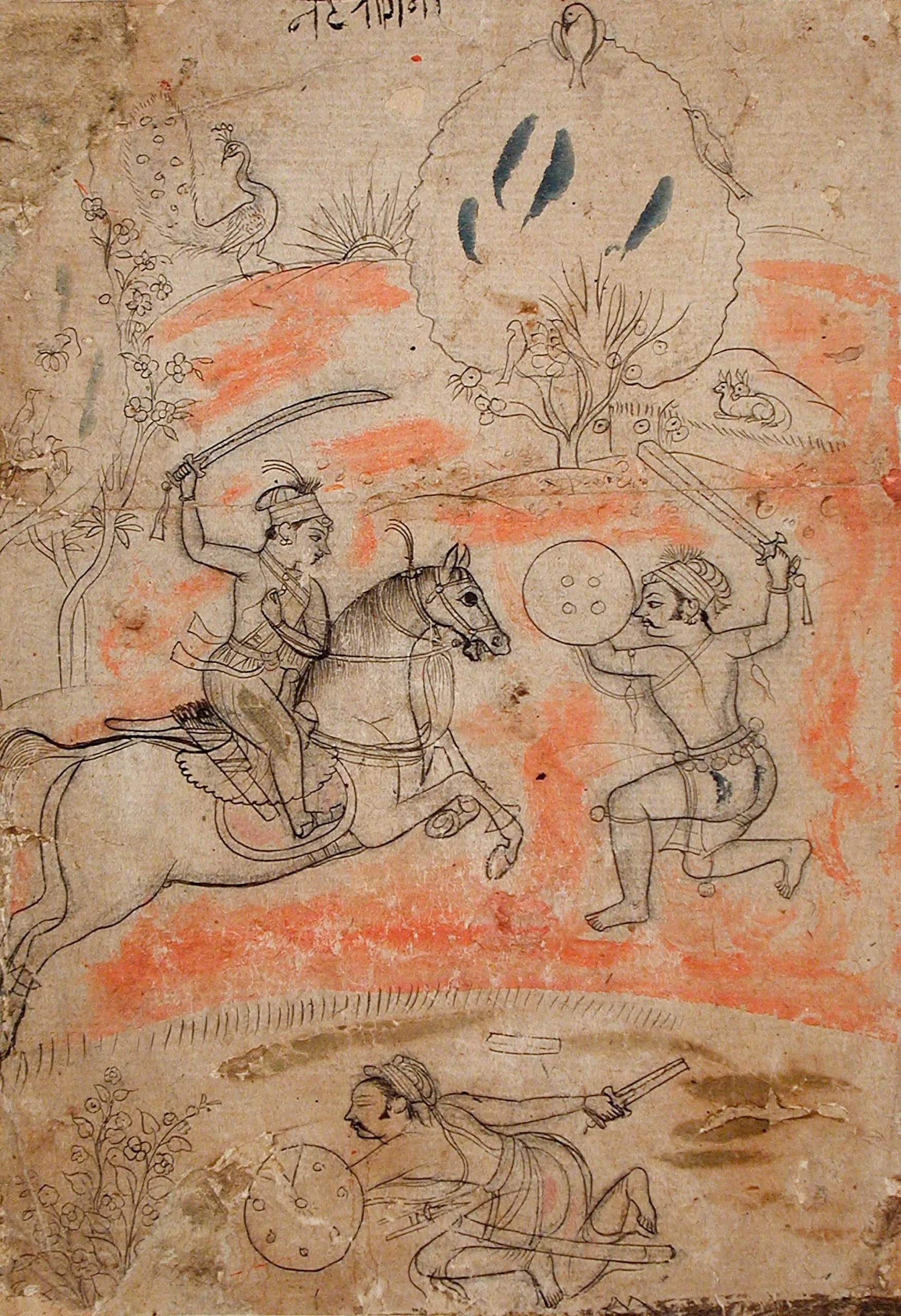
Nata Ragini is the second wife of Bhairava Raga in the predominant ragamala (garland of melodies) classification system generally known as the Rajasthani system. It is a heroic melody evoking a martial spirit, hence its common imagery of a battling warrior or warriors. It is associated with late afternoon or early evening and Summer (May–July). The ostensive gender disparity between a feminine melody (ragini) and martial combatants resulted in some pictorial traditions depicting the warrior as a woman. For example, see female Nata Raginis in the Philadelphia Museum of Art (1987-52-3); Virginia Museum of Fine Arts, Richmond (2023.1348); and National Museum, New Delhi (60.811).
Here, a male Rajput warrior on a rearing stallion raises his sword to strike a swordsman on foot. In the foreground, a slain swordsman lies fallen on the ground beside his broken sword. The upper half of the drawing contains trees inhabited by birds and a peacock beside a setting sun indicating the time of day. Along the top is a truncated Hindi inscription that reads, Nata Ragini [Ragani]. (Translation by Stephen Markel.)
Additional Bundi or Kota Nata Raginis that feature closely parallel renditions, with minor compositions and landscape variations, are in the Harvard Art Museums, Cambridge, (2009.202.131); Museum of Fine Arts, Boston (66.164); Allahabad Museum (07283 (1)); and the National Museum, New Delhi. The National Museum folio attributed to circa 1640 is the earliest, which raises the possibility that the LACMA drawing of circa 1675 is a later version. See Pramod Chandra, Bundi Painting (New Delhi: Lalit Kala Akademi, 1959), p. 2; and Milo Cleveland Beach, Rajput Painting at Bundi and Kota (Ascona: Artibus Asiae, 1974), p. 10, pl. IX, fig. 10.
See also M.83.105.15 and M.84.222.2.