- Title
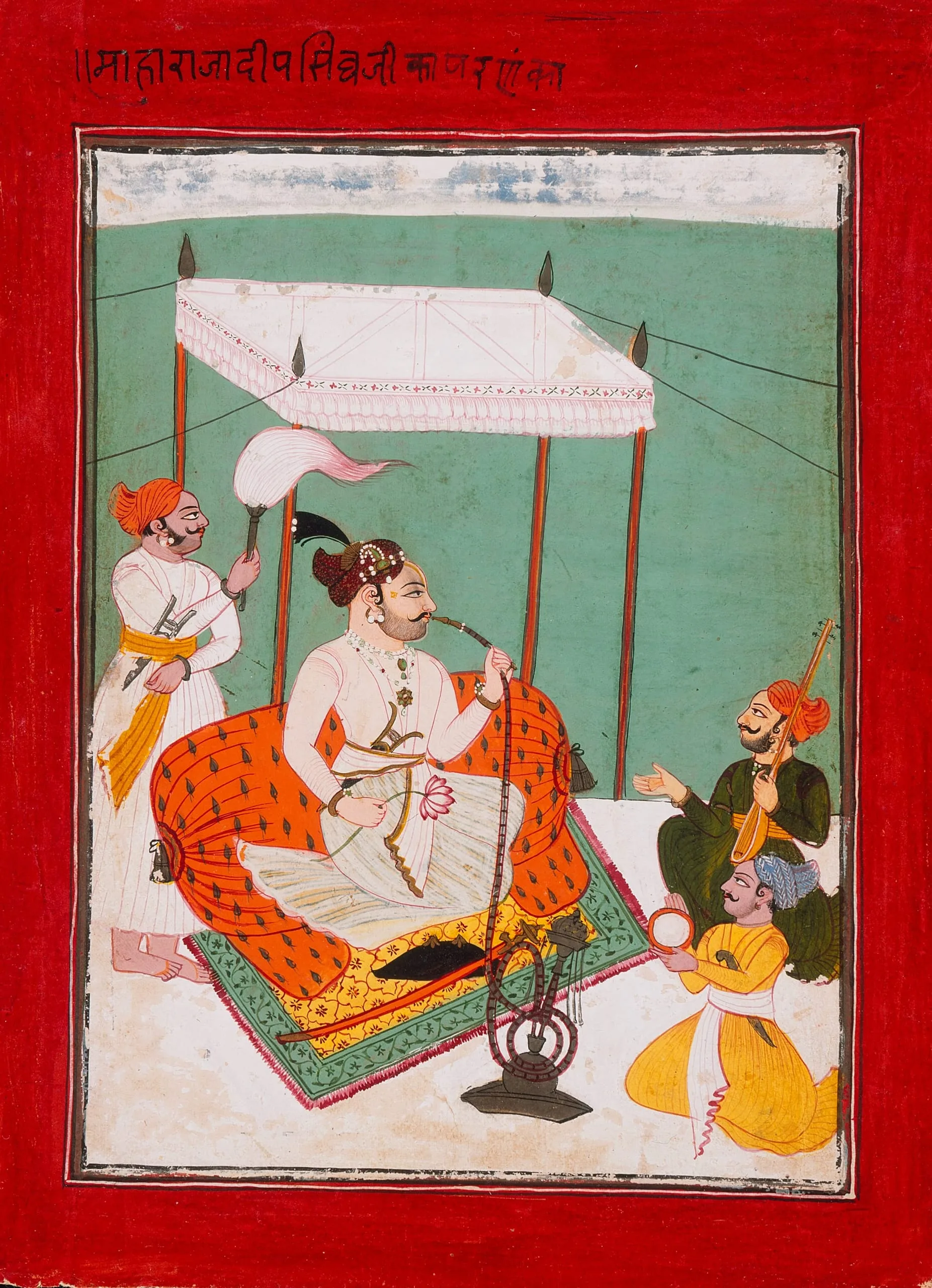
- Maharaja Dip Singh of Kaparan (Kapren)
- Date Made
- circa 1775-1800
- Medium
- Opaque watercolor, gold, and ink on paper
- Dimensions
- Image: 9 1/4 x 6 3/4 in. (23.5 x 17.15 cm); Sheet: 11 3/4 x 8 3/4 in. (29.85 x 22.23 cm)
- Accession Number
- M.86.417.2
- Curatorial Notes
The devanagari inscription in the red border identifies the subject as “Maharaja Dip Singhji of Kaparan [modern Kapren],” which was a fiefdom of Bundi, Rajasthan. Dip Singh was the brother of the renowned Rao Raja Umed Singh of Bundi (r. 1739-1771) and the uncle of Rao Raja Ajit Singh of Bundi (r. 1771-1773; see AC1993.162.1). This portrait of Dip Singh was likely made during the reign of Rao Raja Bishan Singh of Bundi (r. 1773-1821), who entered a tributary alliance with the British East India Company in 1818.
Dip Singh is portrayed seated on a terrace under a canopy listening to a singer and a musician playing a drone instrument (tambura). He wears a red-and-gold turban crested with a plume set in a golden feather brooch and, above the brow, the royal turban jewels of a jigha (similar to an aigrette) and a sarpati (horizontal tripartite ornament). He is smoking a hookah and holds a lotus symbolic of his cultural refinement. His punch dagger (katar) tucked into his waist sash and his sword and shield on the carpet beside him convey his prowess as a Rajput warrior. Behind him is an attendant waiving an honorific fly whisk made with a white yak tail.