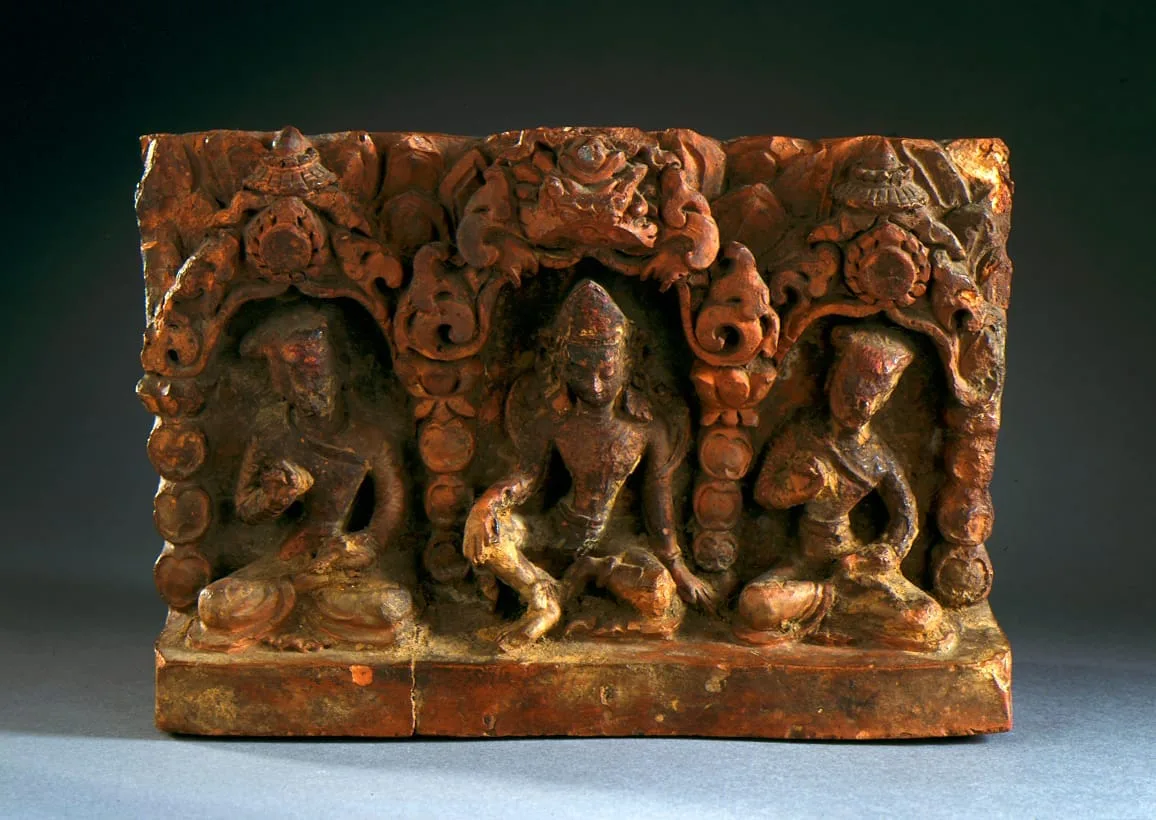
Fashion separately, the principal icon that originally surmounted this Newari earthenware image base was likely the Buddha Shakyamuni or a major Bodhisattva. Indra, Chief of the Gods, sits under the central architectural niche. Indra’s prominent placement on the image base indicates his role as a Dharmapala (protector of the Buddhist teachings). Indra can be identified by his primary attribute of the thunderbolt (vajra) that rests atop the lotus by his left shoulder, and by the horizontal third eye on his forehead that refers to his one thousand eyes (sahasranayana) symbolic of his cosmic nature. He has long hair and wears a tall crown similar to a mitre, which is an idiosyncratic Nepalese attribute. He is seated in the kingly posture of royal ease (maharajalila) befitting his role as king of the gods. His right hand rests on his right knee, and his left hand is extended to touch the ground beside his left knee. See also M.69.13.4 and M.84.168.
Indra is flanked by two male donor figures seated cross-legged under foliate arches crowned with a lotus bud and jewel. They presumably represent the patrons who commissioned the image. The figures are identical except for the slant of their heads. Each wears the traditional Newari cap (Bhadgaule topi), an outer garment with a thick hem over the right shoulder, and the Newari flaring skirt (tapalan). Each holds what may be a lotus stalk in his right hand, and rests his left hand in his lap. See also M.80.225.2.
The partially damaged Newari inscription reads, … (made) this image, from the merit (of this act) may the client’s long life, family and wealth be increased… (and in the other life) may he attain liberation… may it be good for all time… [a person whose role is not specified, but likely the officiating priest] (was) bhiksu sri amarajoti of yaitha- tuthi che, xxx ba-ha-ra [vihara]… may it be good. (Translation by Ian Alsop.)
See also a Tibetan Buddhist image base (M.2010.78.4) and Gujarati Jain image base (M.86.299.2).