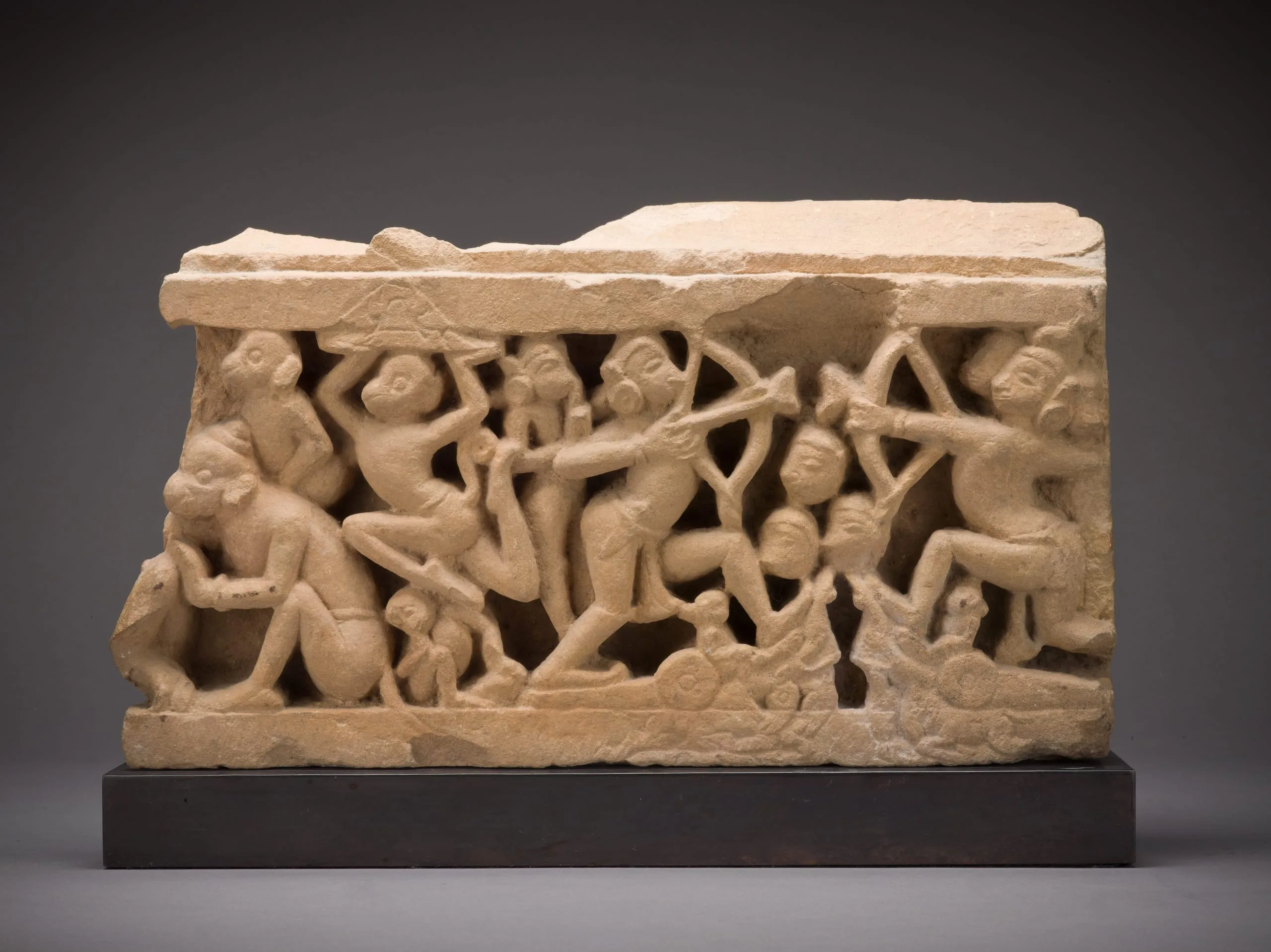
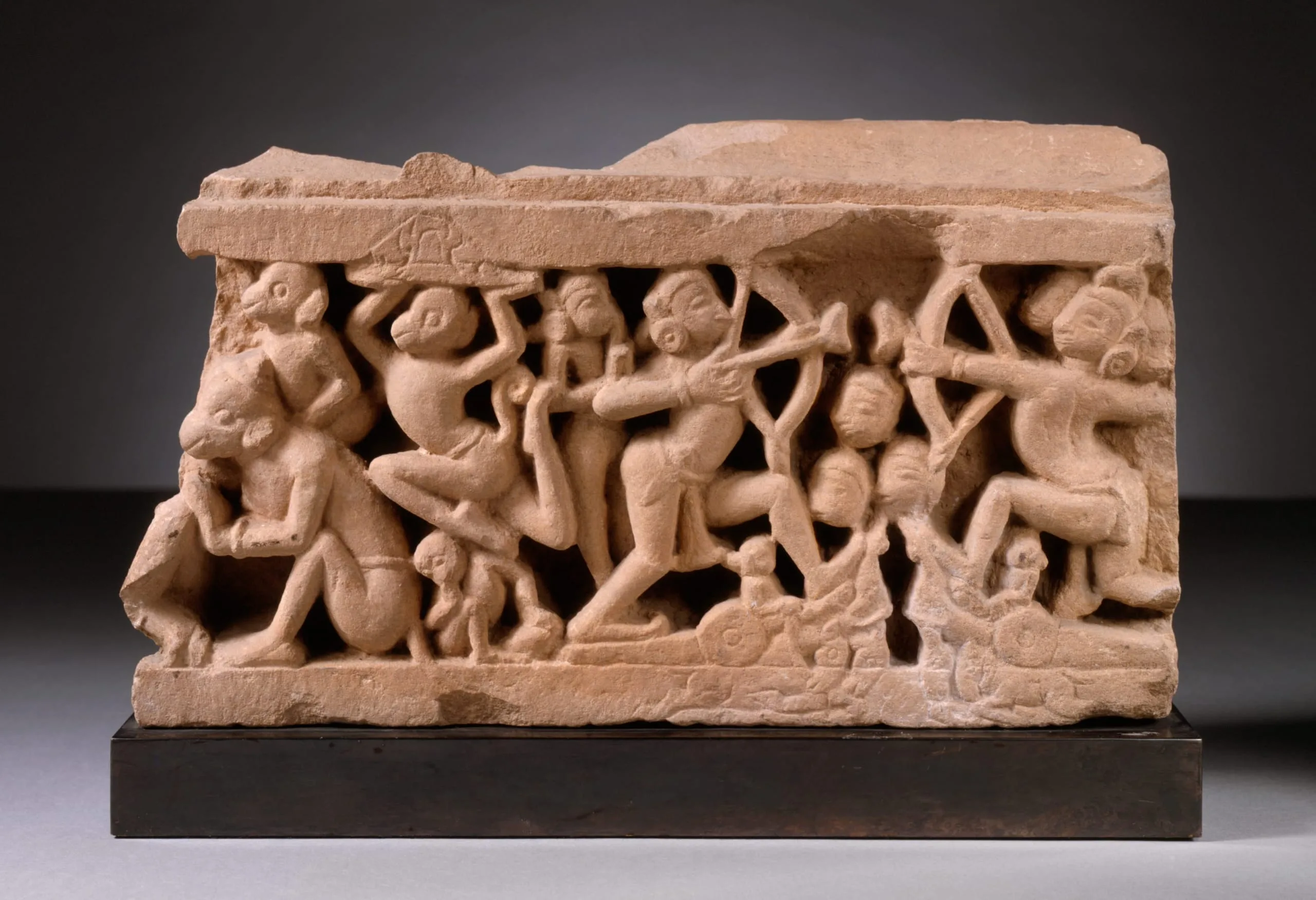
The Ramayana (Adventures of Rama) was a favored subject for the friezes around the base or plinth of Hindu temples, as its long story line and numerous scenes of dramatic action were well suited for visually translating into a linear telling of the tale. Although this section of frieze is fragmentary, its subject is clearly identifiable by the four main figures that serve as visual shorthand representing two distinct episodes.
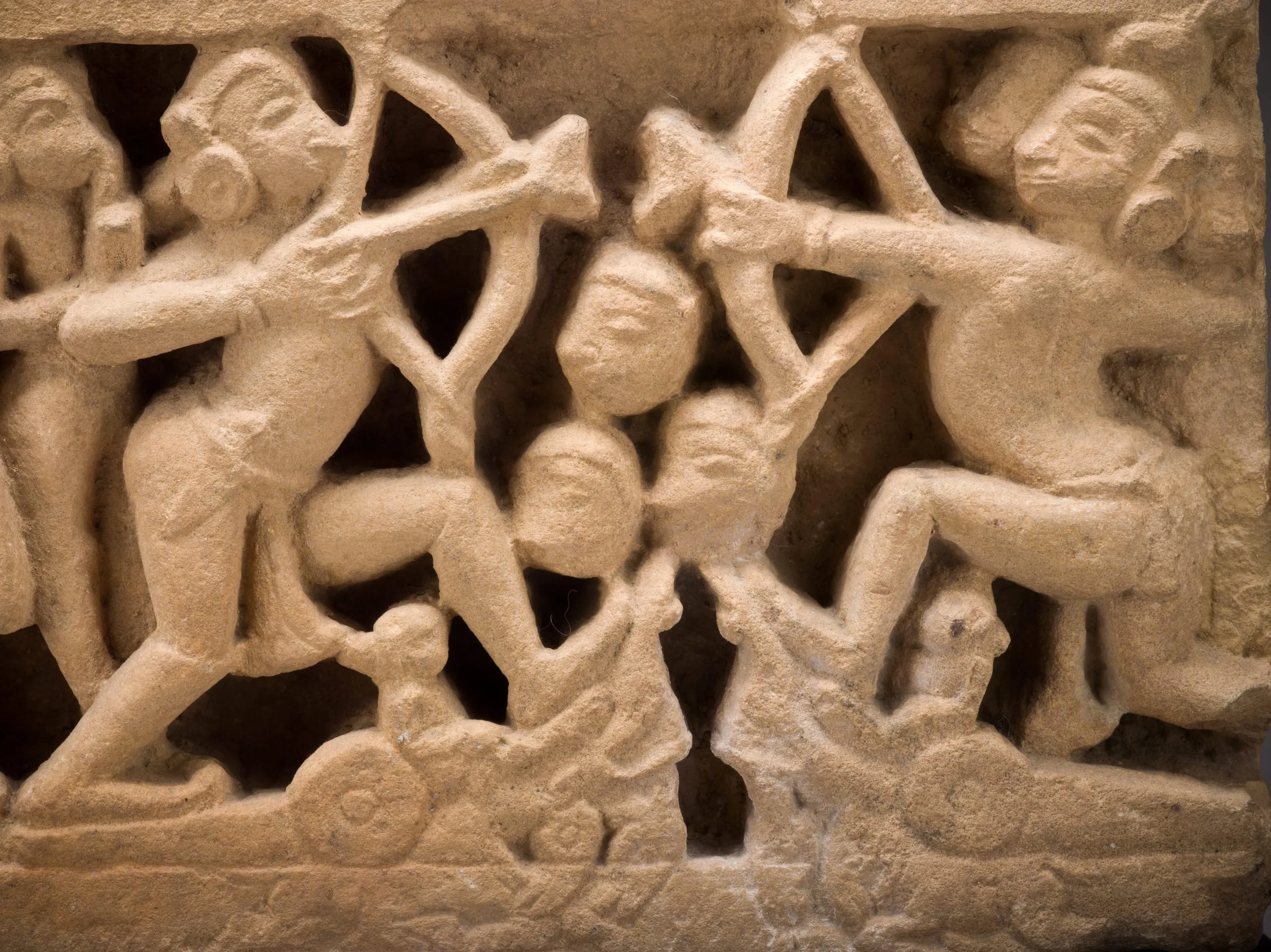
The right half of the relief portrays Prince Rama engaged in a fierce battle fought with magic arrows against the demonic multi-headed Ravana who had kidnapped Rama’s wife, Princess Sita. Floating in the space between the mighty foes are three severed heads facing Rama, which may represent the dreadful Asura (demon) weapon of various disembodied heads that Ravana fired futilely at the divine hero (Ramayana 6:87:38-42). The two great warriors are represented in hierarchical scale so as to tower over their diminutive charioteers in the foreground. Rama is accompanied by the faithful Lakshmana, whose figure serves as the dividing line between the two episodes.
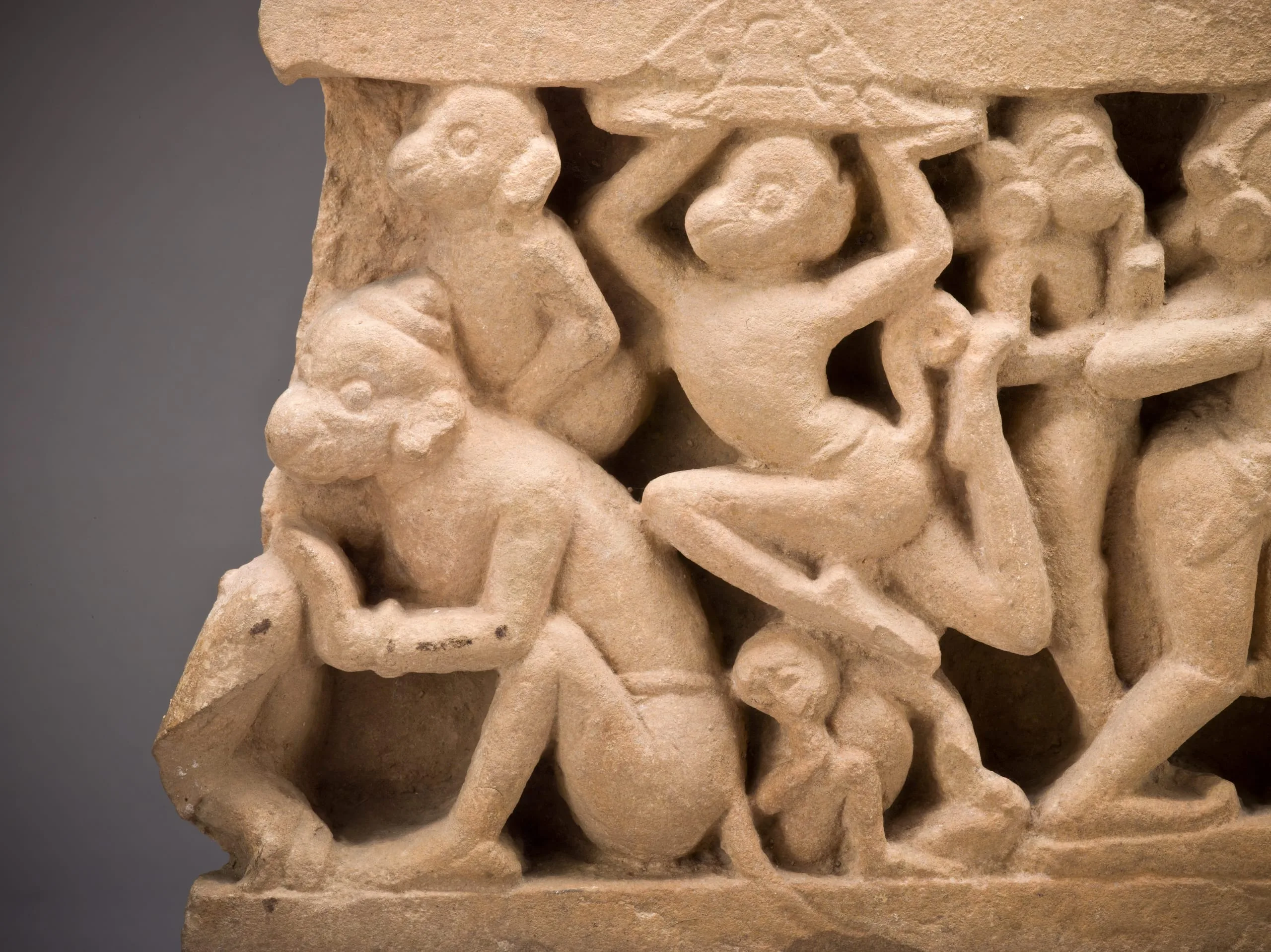
The left half of the deeply carved relief depicts the monkey general Hanuman carrying aloft a mountain of medicinal herbs for their use in healing Rama’s brother Lakshmana who had been impaled with a magical javelin thrown by Ravana on the field of battle. (Ramayana 6:88:22-89:25). At the left end, a large monkey sitting on his haunches may be Sushena who took the herbs from Hanuman and administered them to Lakshmana. A smaller smiling monkey above Sushena may represent the multitude of monkeys joyfully praising Sushena’s success. Assuming this interpretation of the figures is accurate, then the direction of the relief is from right to left. Alternatively, the scene may illustrate Hanuman’s earlier journey to fetch a mountain of medicinal herbs to heal Rama and Lakshmana after they had been struck down the magical arrows shot by Ravana’s son Indrajit (Ramayana 6:60:48-61:68). If this interpretation is accurate, then the direction of the relief is from left to right. This is less likely, though, because it would result in a significant section of the narrative being omitted between the two episodes.
Ramayana verse citations from Robert P. Goldman, Sally J. Sutherland Goldman, and Barend A. van Nooten, trans., The Ramayana of Valmiki: An Epic of Ancient India., Vol. 6. Yuddhakanda (Princeton: Princeton University Press, 2009).