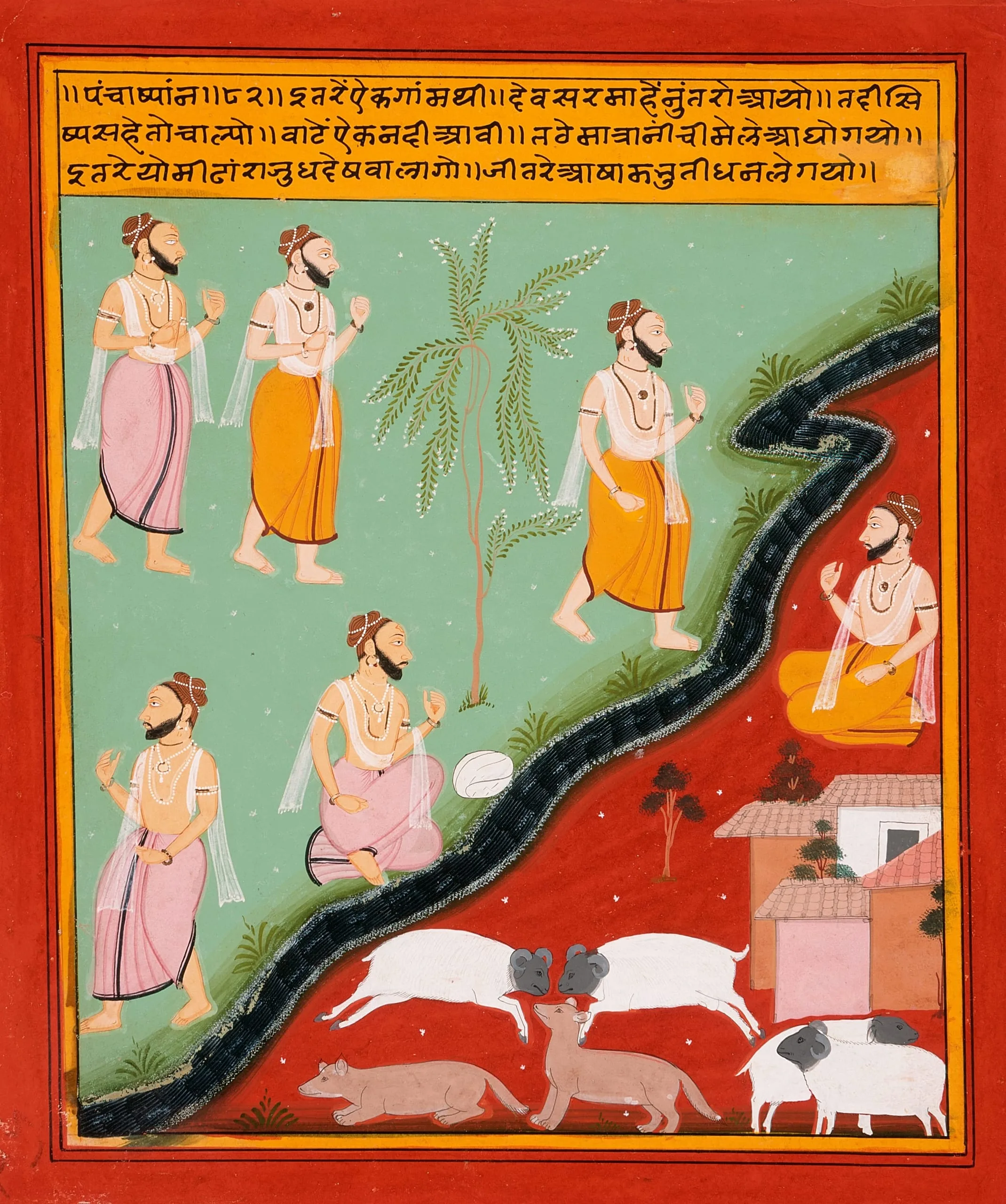
The Panchakhyana (Five Stories) is a Jain recension of the Panchatantra (Five Treatises) edited by the Jain monk Purnabhadra in 1199 CE. It was particularly popular in western and central India. The Panchatantra (Five Treatises) is an ancient compendium of interwoven allegorical and moralistic fables, many involving anthropomorphized animals with human virtues and vices. The original Sanskrit text is indecisively ascribed to Vishnu Sharma and likely dates from 300–200 BCE, but the animal tales are presumably incorporated from a much earlier oral folklore tradition. The Panchatantra tales form one of the bases of Aesop’s Fables and numerous other renditions of the animal stories in myriad languages worldwide.
The identifying Sanskrit inscription in the header reads, Panchakhyana [Story] 82. The other [priest] was single-minded. An invitation came from Devasar, so he set out along with his disciple. On the way, a river appeared. Then, leaving the bundle or upper garment aside, he went forward. Meanwhile, he began to look at the sweet-milk (or viewing the processing of dairy below in the village). In that moment, the half-minded or deceitful man took the wealth and fled. (Translation by Google. subject to verification.)
The visual narrative depicts these events in a clockwise layout across the banks of the dividing river. The story involves a Brahmin priest, Dev Sharma, and his duplicitous disciple, Ashadhabhuti, who plans to steal the priest's bag of donated wealth (matra). At the top left, the two priests are traveling together and arriving upon the invitation. In the top right, Dev Sharma walks towards the riverbank to cross the river. In the middle right, he sits down to observe or rest while his bundle (symbolizing the wealth) is left across the river. Then, Ashadhabhuti, steals Dev Sharma’s bundle and flees. On the bottom right, is a jackal shown twice and some domesticated rams. The two rams are locked in head-butting fight when a jackals sneaks up to lap up the blood dripping onto the ground from the rams' injuries. The allegorical meaning of the fighting rams and the jackal is a cautionary metaphor about the dangers of distraction and blind greed. While the jackal is fixated on the dripping blood, it ignores the danger of getting crushed by the fighting animals. The prostrate jackal represents the dead jackal who was accordingly killed by the rams. This mirrors the foolish priest in the primary story who gets so distracted looking at milk and worldly temptations that he lets down his guard, allowing the thief to steal his wealth.
Series mates from this dispersed Panchakhyana are in the Asian Art Museum, San Francisco (B87D28 and 1991.250). See also M.2011.156.2.