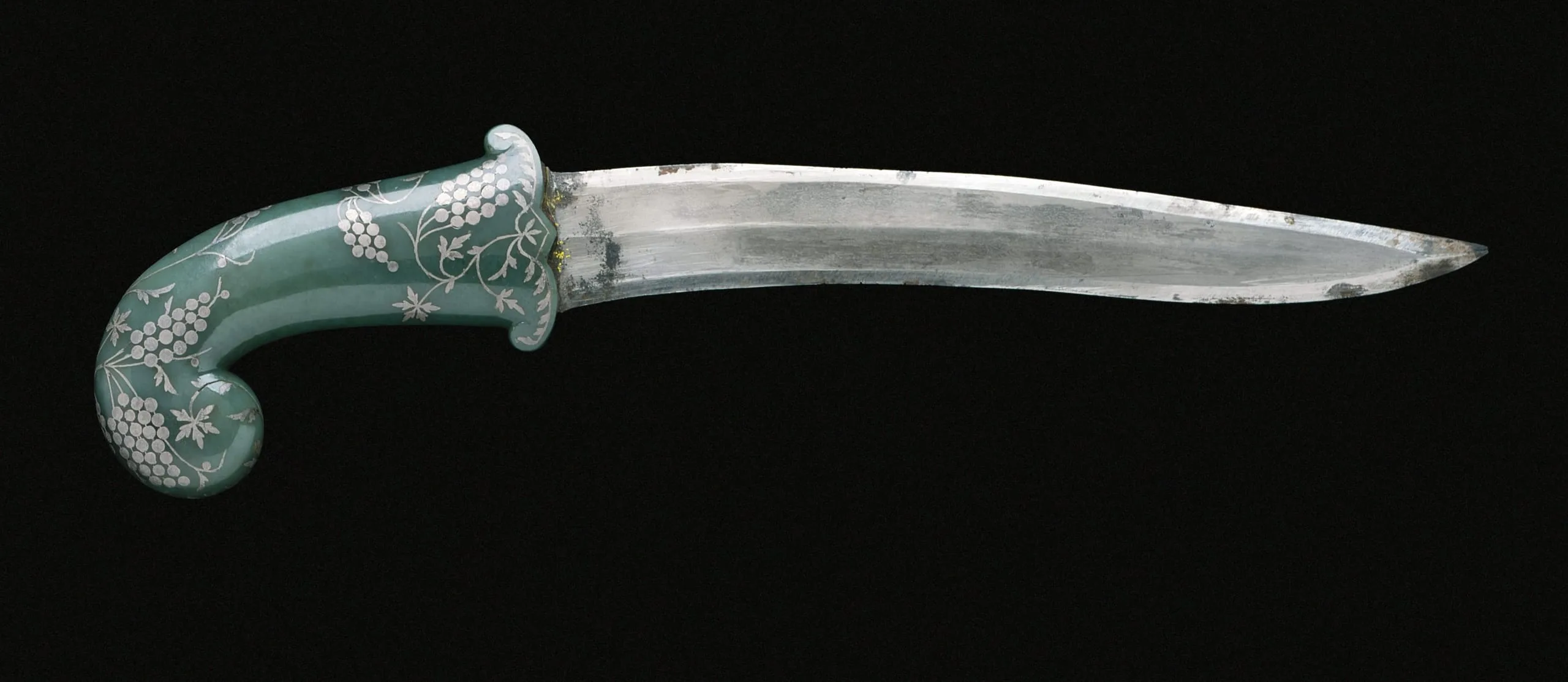
Currently mounted on what is likely a replacement blade, the medium green nephrite jade hilt is embellished with inlaid silver hybrid designs of pendant grape bunches dangling from thin stalks with stylized acanthus leaves rather than a true-to-life meandering grape vine with grape leaves. The acanthus leaves are represented in two forms: digitally compound clusters of either five or three leaves and split leaves that form a border along the mouth of the hilt where the tang of the blade is inserted and at the end of the pommel or knob-like butt of the hilt.
Grape bunches are occasionally found on a small group of silver-inlaid jade dagger hilts produced throughout the first half of the eighteenth century. Their representations are not static, however, as a stylistic progression is noticeable. In works made early in the century, there is generally a denser and more varied design pattern and a greater elegance of line. By the middle of the century, there is a marked reduction in the amount, density, and delicacy of the silver inlay.
Silver inlay is rarely found in the Imperial Mughal decorative art tradition. Rather, its use is primarily associated with a distinctive metal alloy, known as bidri, which often features silver inlay. The leading production centers of bidri-ware were in Bidar, Karnataka and Hyderabad, Telangana during the late 16th through 19th centuries. Given that silver-inlaid jades likely represent a syncretic mixture of the Mughal medium of jade with the Deccani bidri technique of silver inlay, it is probable that the patrons of the silver-inlaid jades were Mughal nobles serving in the Hyderabad region during the first three-quarters of the 18th century. The small number of extant silver-inlaid jades and their modest repertoire of decorative motifs help corroborate their limited locale and production duration.
See Stephen Markel, "Non-Imperial Mughal Sources for Jades and Jade Simulants in South Asia," Jewellery Studies 10 (2004): p. 72, fig. 7.