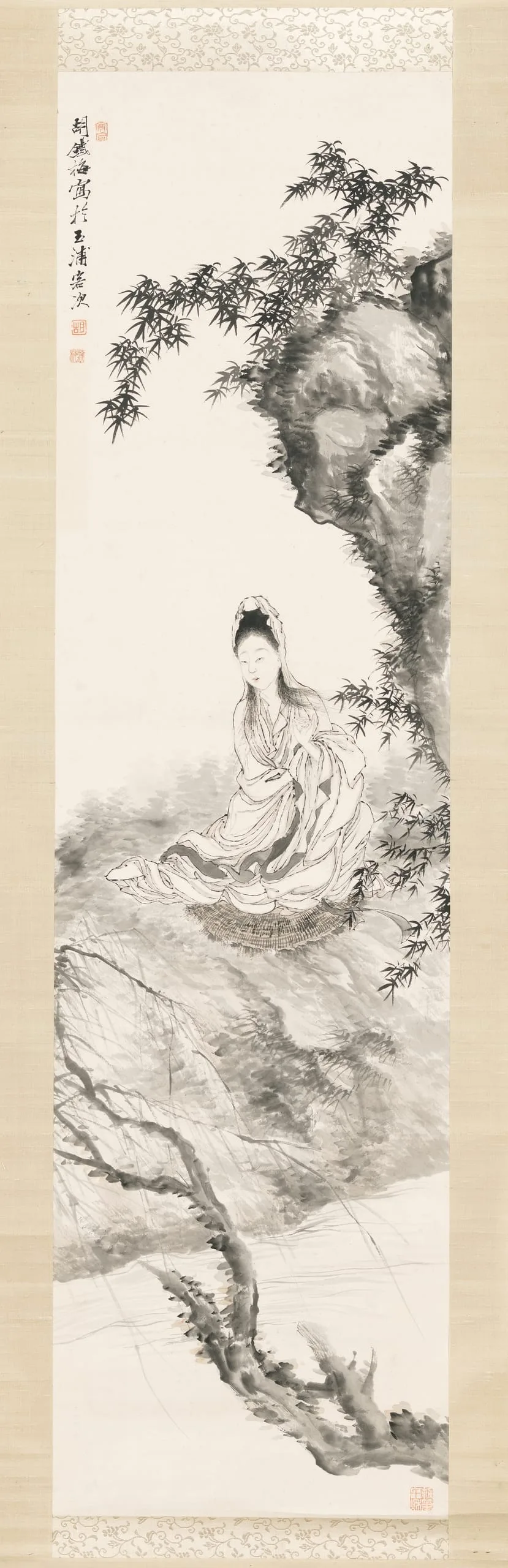
Hu Zhang was best known for his landscapes and flower-and-bird (huaniao) images. From 1879 to 1886, he visited Japan, living variously in Nagasaki, Nagoya, Kyoto, and Osaka; he also married a Japanese woman. Based on the inscription and the Japanese brocade mounting, it appears that this scroll was painted during Hu’s stay in Japan.
Guanyin is presented as a female figure, seated outdoors on a reed mat next to a stream or lake, in the white-robed form most closely associated with Chan (Zen) Buddhism. Here, however, the figure’s face has the distinct look of an actual portrait, given the woman’s strange (if not unsettling) expression, and what appear to be her blackened teeth. The latter feature, achieved in Japan by rinsing the mouth with a solution of tea or sake containing iron filings (known as ohaguro), was considered highly fashionable. It was practiced by married women, single women over the age of eighteen, prostitutes, and geisha during the Edo period (1600–1868) as a sign of sexual maturity. The practice continued among prostitutes in the succeeding Meiji period (1868–1912), during which Hu Zhang was active in Japan. His image of Guanyin thus has complex overtones, including presenting the enlightened bodhisattva as a sexually active woman. This layering of meaning was already well established in the Edo period; for example, in paintings in which the courtesan Eguchi no Kimi is depicted in the guise of Fugen (Sk. Samanatabhadra), Bodhisattva of Benevolence, on an elephant, welcoming the Buddhist monk Saigyō (1118–1190) into her residence during a rainstorm.
Hu Zhang’s painting is signed, “Sketched by Hu Tiemei at a guesthouse in Tamaura [Ch. Yupu].” Its landscape elements—rock, bamboo, earthen bank, foreground tree—are all rendered in monochrome ink with bold and spontaneous brushwork.
Stephen Little
2017