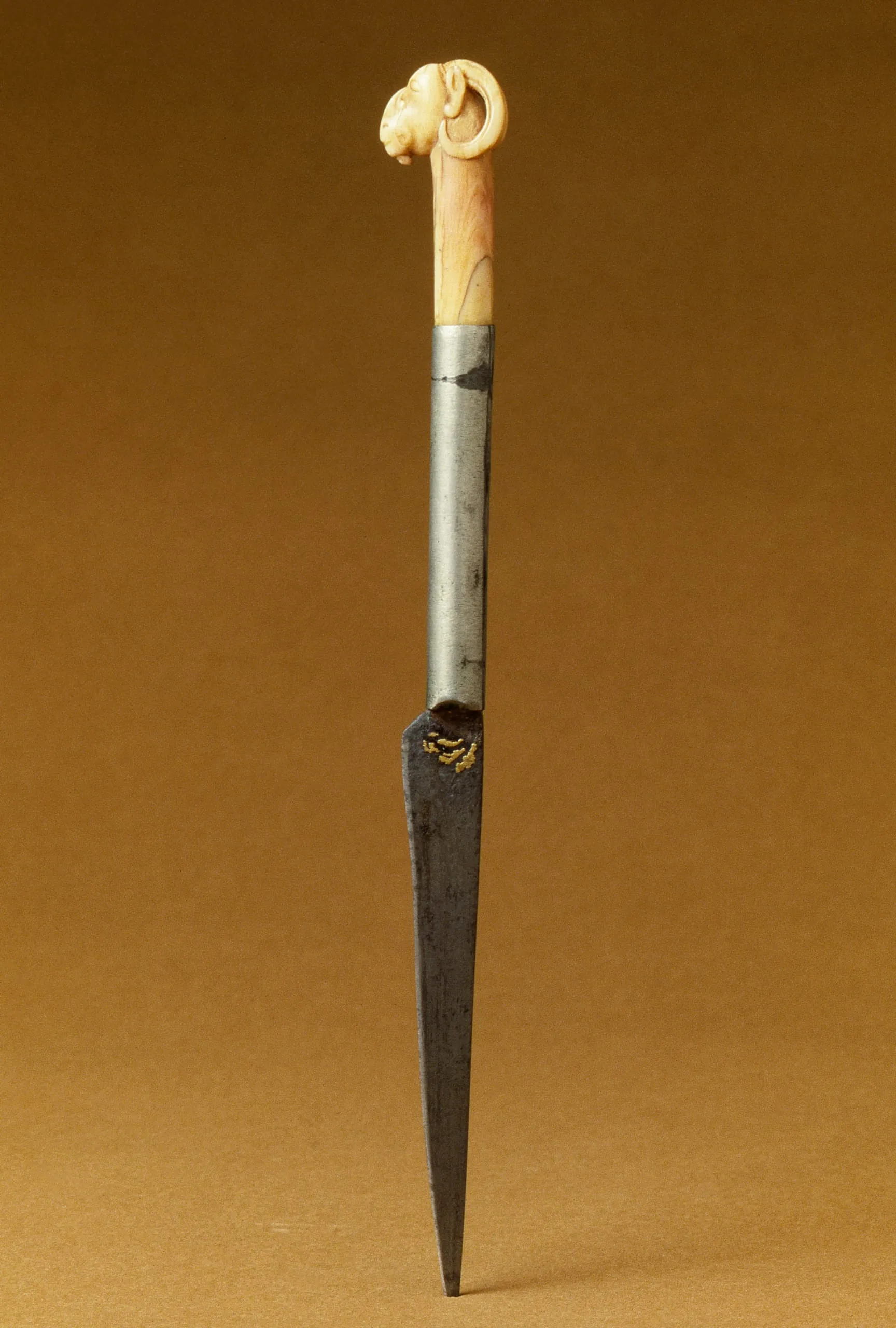
This small knife with a single-edged straight blade is a type of knife or dagger known generally as a kard. Its diminutive size suggests that it may have been used by a lady of the court, perhaps to cut fruit. The ivory terminal in the form of a wild goat’s head is sensitively portrayed with its distinguishing goatee, curled horns, upright ears, and a short, angular snout. For a comparison of anatomical features, see a slightly earlier ram's head hilt made of jade (M.76.2.12). The base of the iron blade has an undecipherable inscription or decorative pattern inlaid in gold.
Lions, horses, nilgais (blue-gray Indian antelopes), camels, elephants, parrots, rams, and goats were the favored animals reproduced with keen observation by the Mughal artists for use as hilts on knives, daggers, and swords. The naturalistic renditions of the animals were accurately modeled with distinct bone structures, pliant soft tissue, and flowing or curly hair.