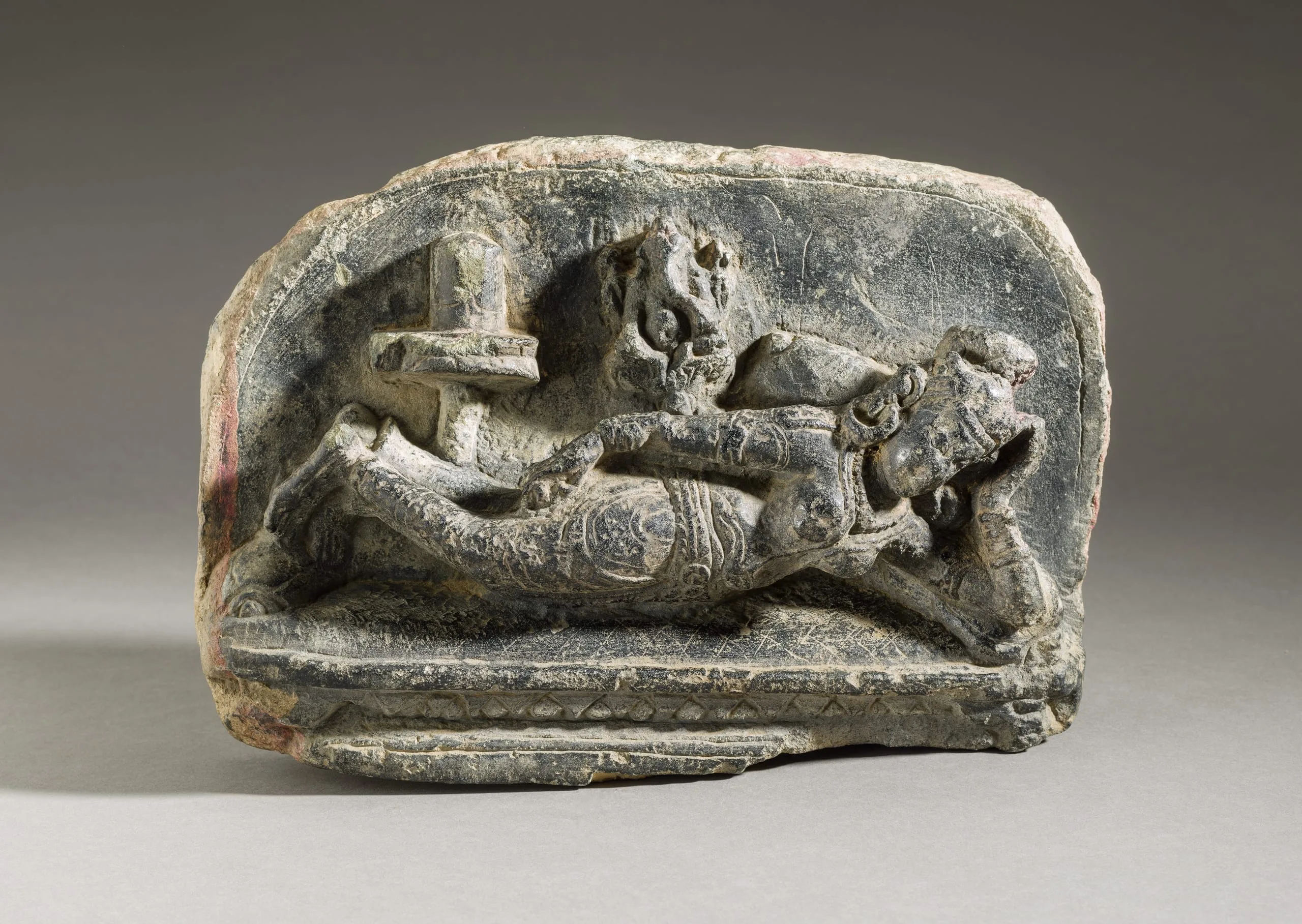
Sculpted images of a reclining woman with or without a child by her side were popular during the Pala dynasty (750–1161). They have been customarily identified in scholarly literature as either Gauri, a form of Parvati, and the newborn (sadyojata) child Shiva or as Shiva being born as his avatar Grihapati (Lord of the Householders), the child of Shuchishmati. However, an inscription from one such stele found at Kosham Shahar (now housed in the Mahasthan Museum, Bangladesh) identifying the woman as Gauri was published by Enamul Haque in 1973. In representations where no child is depicted, the sculpture is interpreted as emphasizing the recumbent goddess's divine womb and fertility, and the ritual worship by childless women. An image of the elephant-headed Ganesha seated on a lotus base emerges from the region of her navel and a Shivalinga on a pedestal rises from near her knees.
See Enamul Haque, "The Iconography of the Hindu Sculptures of Bengal, up to circa 1250 A.D. (PhD dissertation, University of Oxford, 1973), p. 484, no. 128; Susan Huntington, The 'Pāla-Sena' Schools of Sculpture. Studies in South Asian Culture 10 (Leiden: E. J. Brill, 1984), p. 185, fig. 248; Stella Kramrisch, Manifestations of Shiva (Philadelphia: Philadelphia Museum of Art, 1981), p. 83, no. 68; and Rakesh Datta Trivedi, “Mother and Child Sculpture in the National Museum, New Delhi, Representing the Gṛhapati Form of Śiva,” East and West 24:1/2 (March-June 1974): 141-145.