- Title
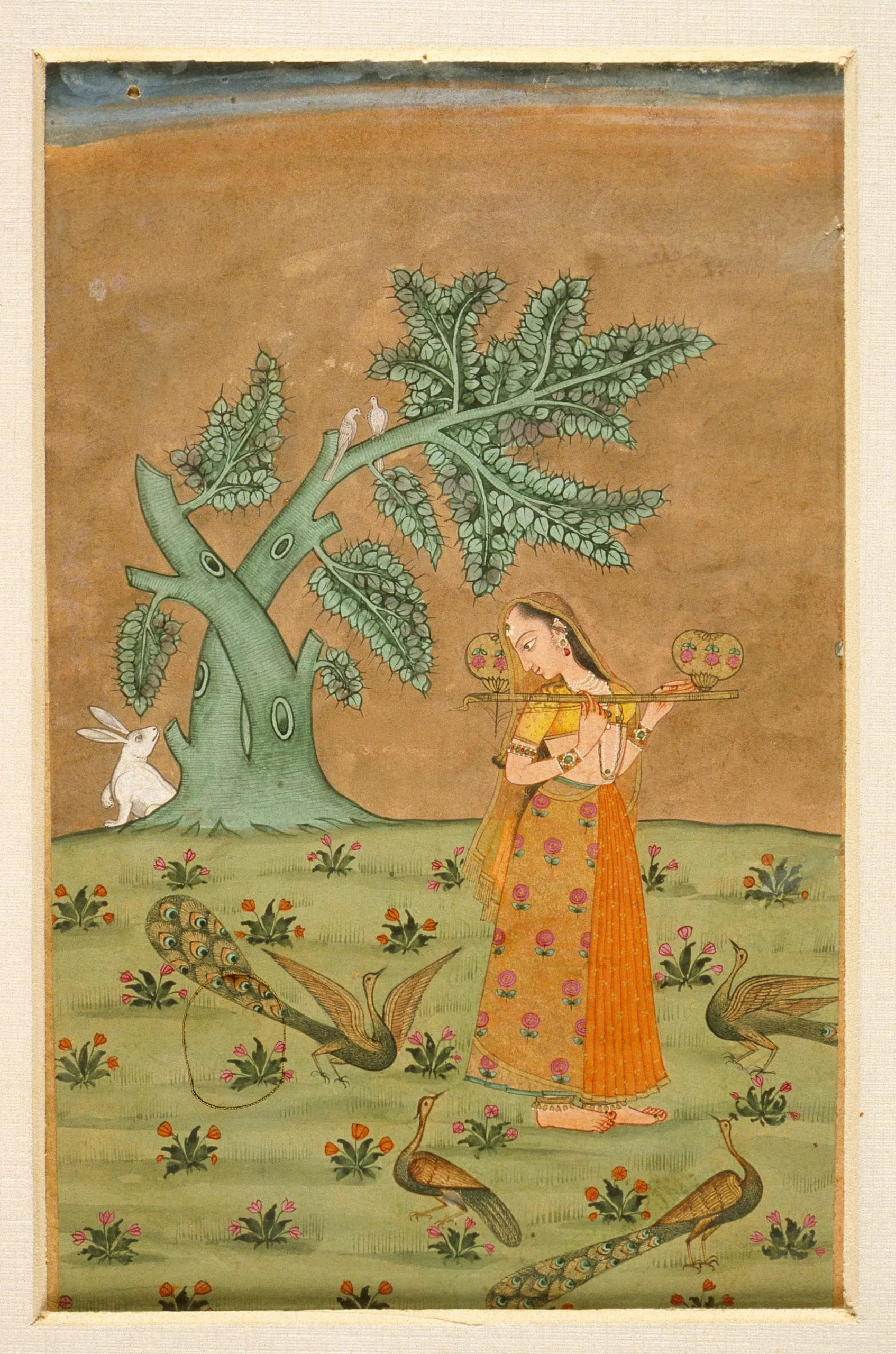
- Sorathi Ragini, Third Wife of Megha Mallar Raga, Folio from a Ragamala (Garland of Melodies)
- Date Made
- circa 1775
- Medium
- Opaque watercolor and gold on paper
- Dimensions
- Sheet: 8 11/16 x 5 3/4 in. (22.06 x 14.61 cm); Image: 7 1/2 x 4 1/2 in. (19.05 x 11.43 cm)
- Accession Number
- M.85.290.4
- Curatorial Notes
Sorathi Ragini is the third wife of Megha Mallar Raga in some 18th-century Deccani ragamala (garland of melodies) traditions. Its iconography consists of a standing heroine playing or carrying a vina and accompanied by peafowl. Here, a garland lies on the ground beside her. The personification is similar to Kakubha Ragini, who is also the third wife of Megha Mallar Raga in the predominant ragamala classification system generally known as the Rajasthani system and in some 18th-century Deccani pictorial traditions (for the latter, see M.87.278.16). The chief iconographic distinction between the two melodies is that Sorathi Ragini is depicted standing or walking rather than sitting on a hillock or peak.
Here, the heroine plays a vina and stares down at a mesmerized peacock while walking in a field of flowers. Two more peacocks and a peahen also gaze up at her. On the ground behind her is a gold beaded garland cast aside or dropped in her distraught mood. The plain tan background with a narrow band of clouds is dominated by a contorted tree with a white hare at its base looking up at the peculiar tree with the same enraptured expression as the peafowl.