- Title
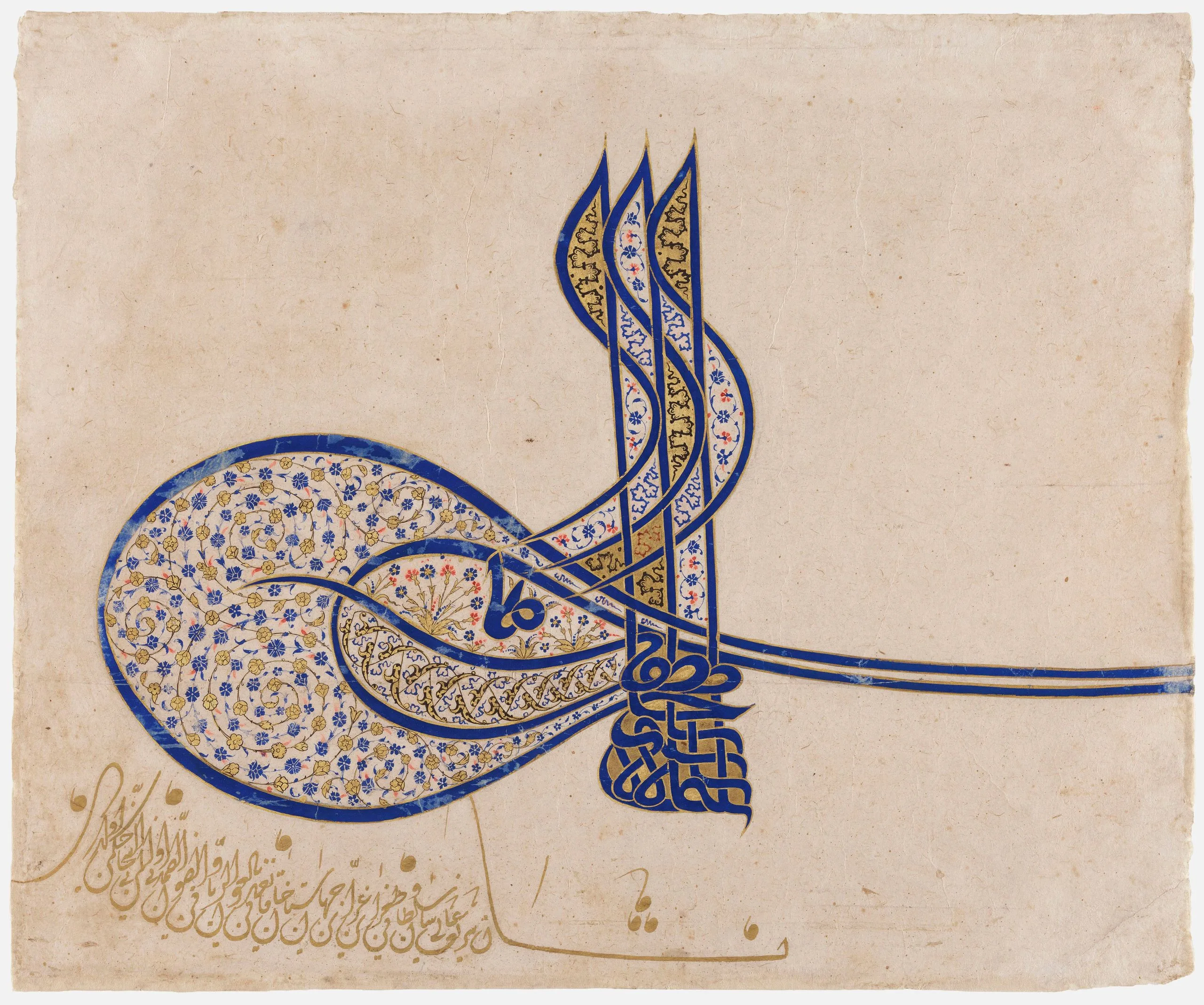
- Tugra (Calligraphic Monogram) of Sulayman the Magnificent
- Date Made
- circa 1550-1565
- Medium
- Ink, opaque watercolor, and gold on paper
- Dimensions
- 13 1/4 × 16 in. (33.66 × 40.64 cm)
- Accession Number
- M.85.237.17
- Curatorial Notes
In Muslim cultures, words are used not only to communicate but to decorate. Because it is through writing that the Qur’an is transmitted, scripts in the Arabic alphabet were devised and perfected to be worthy of divine revelation. On this account, calligraphy became the most important art form regardless of the text.
This elegant calligraphy is the tuğra, or imperial monogram, of the Ottoman sultan Süleyman (r. 1520–66). Each reigning sultan possessed his own tuğra drawn by the court calligrapher and used for all of his official documents, court decrees, and coinage (see M.2002.1.458). Originally placed at the head of a royal document, as in this example, it transforms the sultan’s name and titles and the formula “ever victorious” into a uniform and harmonious series of curved and vertical lines, while the actual letters are stacked close together in the lower portion, emphasizing aesthetics over legibility. It serves to demonstrate the overwhelming concern for exquisite detail that characterizes the art of Süleyman’s reign in particular and Ottoman art in general.
- Selected Bibliography
- Denny, Walter B. Turkish Treasures from the Collection of Edward Binney, 3rd. Portland, OR: Portland Art Museum, 1979.
- Komaroff, Linda. Islamic Art at the Los Angeles County Museum of Art. Los Angeles: Museum Associates, 2005.
- Overton, Keelan. "A History of Ottoman Art History Through the Private Database of Edward Binney, 3rd." Journal of Art Historiography 6 (2012): 1-19.
Pal, Pratapaditya, Thomas W. Lentz, Sheila R. Canby, Edwin Binney, 3rd, Walter B. Denny, and Stephen Markel. "Arts from Islamic Cultures: Los Angeles County Museum of Art." Arts of Asia 17, no. 6 (November/December 1987): 73-130.
- Komaroff, Linda. Beauty and Identity: Islamic Art from the Los Angeles County Museum of Art. Los Angeles: Los Angeles County Museum of Art, 2016.
- Binney, Edwin, 3rd. "Turkish Arts of the Book in the Binney Collection." Arts of Asia 17, no.6 (Nov/Dec 1987): 97-104.