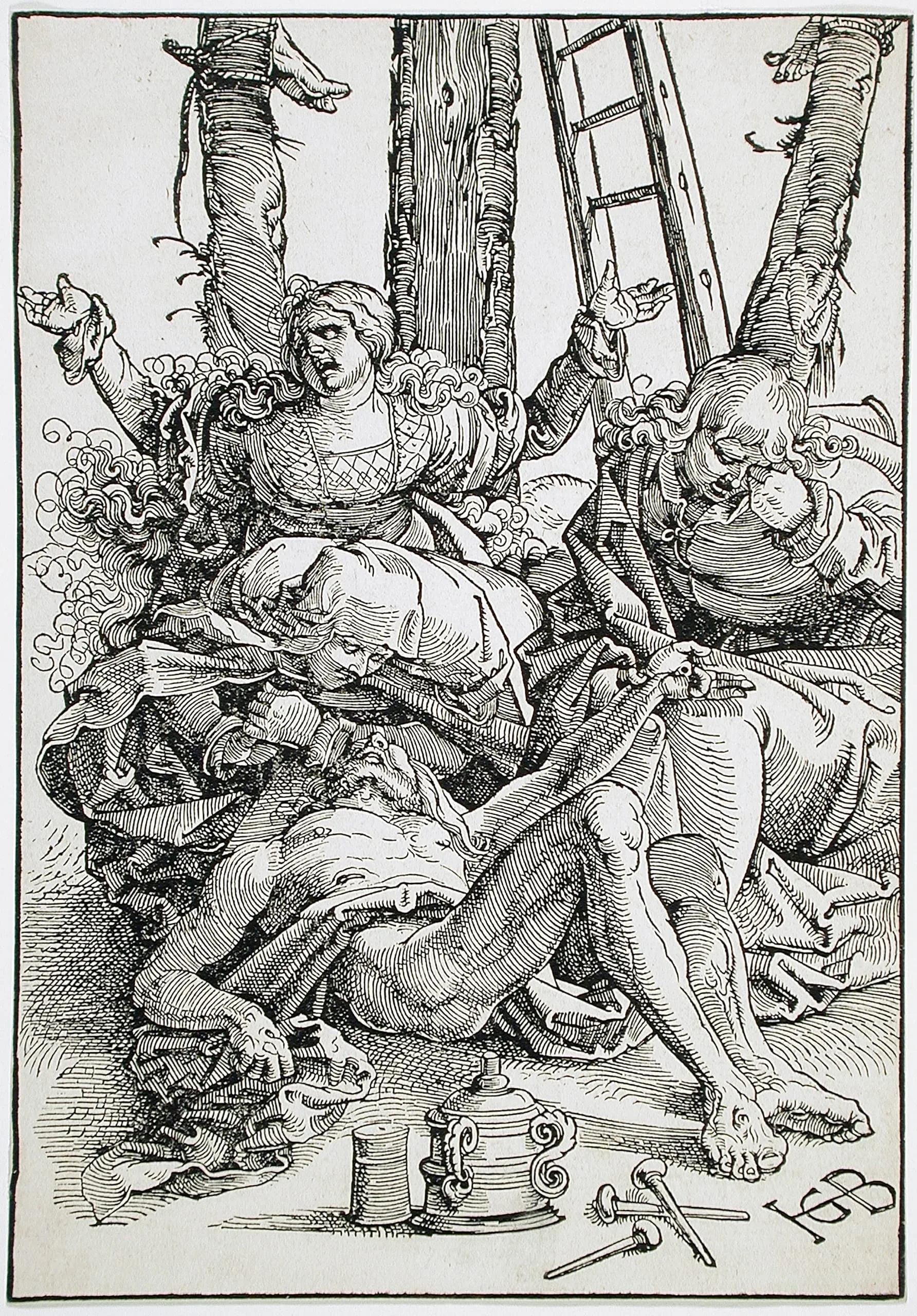
In the first two decades of the sixteenth century woodcut design and execution attained a virtuosity never since surpassed. Wood's grain and brittleness impose limitations on fineness, degree of curve, and proximity of lines. Early woodcut artists acknowledged these constraints with compositions displaying simple outlines, broad curves, and little modeling. By 1500 Albrecht Dürer, Baldung Grien, and their contemporaries had mastered more advanced techniques. Crosshatching enabled them to achieve light, shade, and modeling in complex compositions with sophisticated surface pattern and anatomically correct figures, and under the impetus of artistic developments in Renaissance Italy, these printmakers began to employ the innovations of foreshortening and perspective as well as conventions of gesture and costume. Baldung Grien was especially adept at combining these new methods of depiction with the traditional northern European fascination with pattern.
The Lamentation alludes forcefully and economically to the Passion narrative. The site on Calvary is indicated only by three cross standards, the ladder, and the thieves' feet. In the foreground, spikes and a pot of unguent refer to Christ's crucifixion, deposition, and entombment. Christ's body echoes the pose of the crucifixion, and the mourners' postures convey their grief. Mary Magdalen's raised arms and tumultuous hair form an iconic gesture of despair; John weeps over Christ's mutilated hand. The Virgin and Christ are sharply foreshortened, displaying Baldung's mastery of perspective.