LACMA

ShopMembershipMyLACMATickets
LACMA
Los Angeles County Museum of Art
5905 Wilshire Blvd.
Los Angeles, CA 90036
info@lacma.org
(323) 857-6000
Sign up to receive emails
Subscribe
© Museum Associates 2025

Museum Hours

Monday

11 am–6 pm

Tuesday

11 am–6 pm

Wednesday

Closed

Thursday

11 am–6 pm

Friday

11 am–8 pm

Saturday

10 am–7 pm

Sunday

10 am–7 pm


  • About LACMA
  • Jobs
  • Building LACMA
  • Host An Event
  • Unframed
  • Press
  • FAQs
  • Log in to MyLACMA
  • Privacy Policy
© Museum Associates 2025
Collections

Unknown
Parodies of Europeanscirca 1760-1775

Not on view
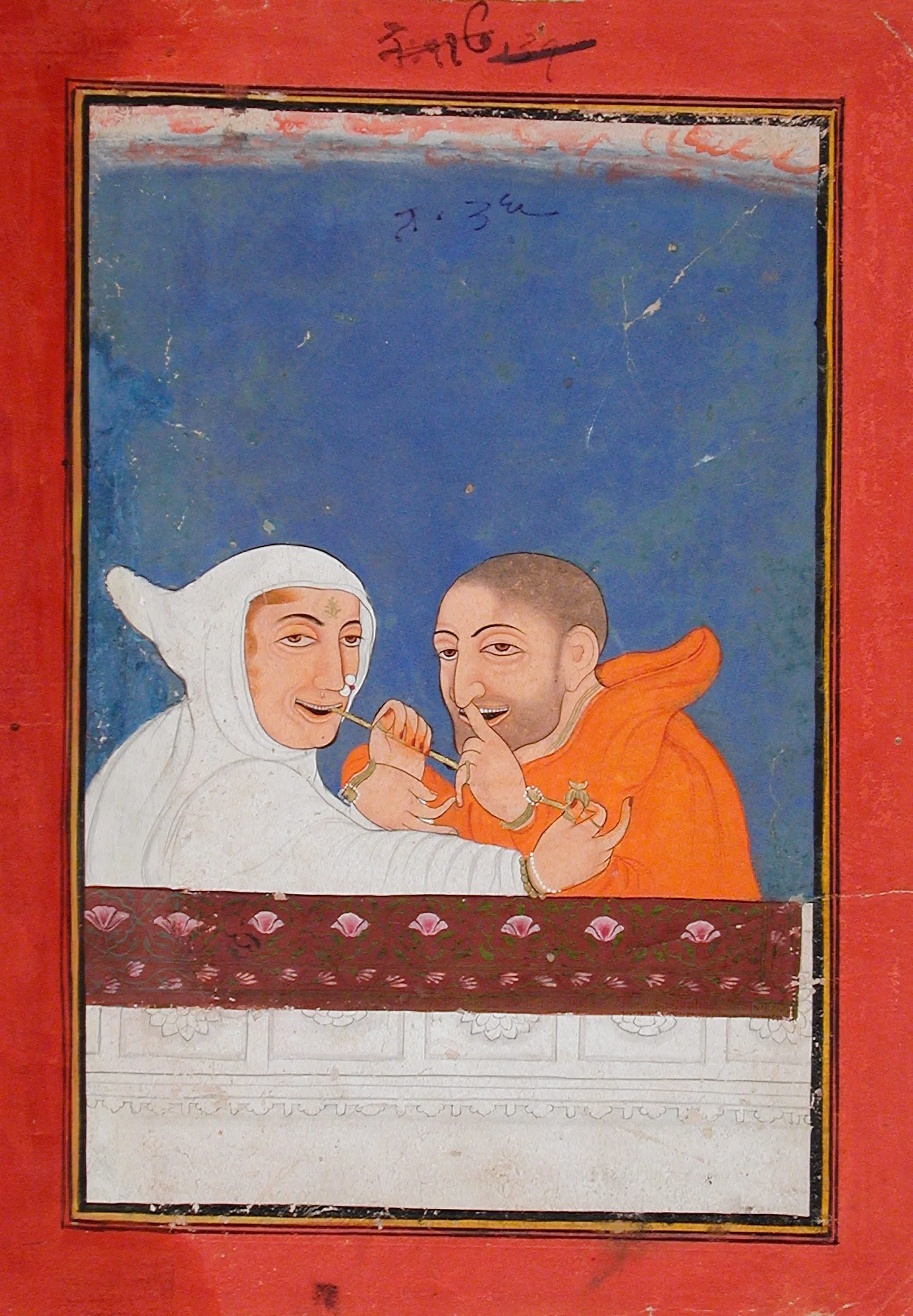
Indian opaque watercolor painting of two robed figures leaning together over a lotus-decorated balustrade, hands joined around a gold stem, cobalt blue background
Artist or Maker
Unknown
Title
Parodies of Europeans
Place Made
India, Rajasthan, Mewar
Date Made
circa 1760-1775
Medium
Opaque watercolor, gold, and ink on paper
Dimensions
Image: 9 1/4 x 6 1/8 in. (23.5 x 15.56 cm); Sheet: 11 1/4 x 8 1/4 in. (28.58 x 20.96 cm)
Credit Line
Indian Art Special Purpose Fund
Accession Number
M.85.147
Classification
Drawings
Collecting Area
South and Southeast Asian Art
Curatorial Notes
The grinning odd couple depicted in this double portrait, and also reproduced in M.2001.229.3 and in a painting in the Philadelphia Museum of Art (2004-149-59), represent a genre of Indian court paintings portraying exotic Europeans (farangis) as isolated subjects, which due to their exaggerated features and loss of historical context may have come to be viewed as parodies.
The visual source of these enigmatic figures may be the representation of fools in 16th- and 17th-century northern European paintings and prints illustrating the Dutch proverb “the world feeds many fools.” The figures touching of their noses with their forefingers has been said to suggest the use of snuff, but the gesture may have also found resonance in India because of its resemblance to a well-known hand position expressing astonishment. This distinctive gesture, in which the index finger and sometimes the middle finger are held touching the chin or lips, has been featured in Indian art for centuries. The appeal of these eccentric figures was such that they were often repeated as stock motifs with minor variations, including being shown individually rather than as a pair, and with sundry changes of gender, clothing, hand positions, and objects held.
Selected Bibliography
  • Markel, Stephen. "The Enigmatic Image: Curious Subjects in Indian Art." Asianart.com, July 28, 2015. http://asianart.com/articles/enigmatic.

  • Heesch, Daan van. "The Graphic Source for Rajput Images of Fools." Print Quarterly 35, no.1 (2018): 50-53.