The Bhagavata Purana (Ancient Stories of the Lord) is traditionally ascribed to the legendary poet-sage Vyasa in the 8th-10th century CE. It stresses the path of devotion (bhakti) to Krishna, the eighth incarnation of Vishnu, the Hindu God of Preservation. To fulfill his role as the guardian of the world and savior of humanity, Vishnu appears as a succession of heroic animals and semi-mortal saviors, called avatars, through which he intervenes in times of crisis or unrighteousness. The most common list of Vishnu's avatars in Hindu religious literature features ten incarnations, but there are slight variations in both number and identity throughout India.
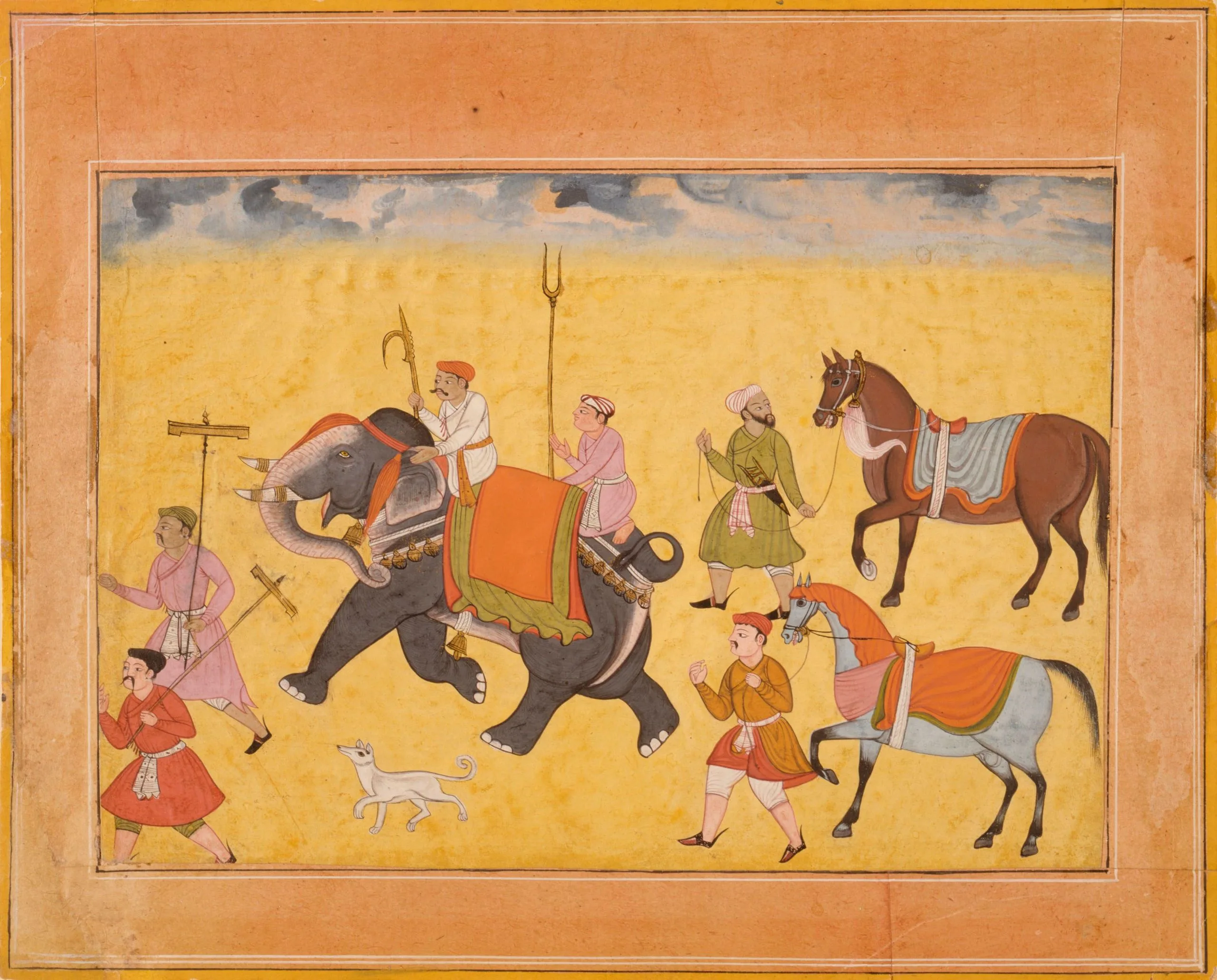
This illustration depicts a procession, perhaps in connection with a royal elephant hunt. In the center is a caparisoned elephant with a mahout carrying a large elephant goad (ankus) and an attendant holding a double-bladed polearm. Preceding them are two retainers with fireworks mounted on poles used to control wild elephants. At the rear, two grooms lead riderless horses. A white Saluki dog accompanies the entourage.
This folio and its series mate M.81.277 are from a widely dispersed Bhagavata Purana. Additional folios are in the Art Institute of Chicago (2007.384), Cleveland Museum of Art (2018.186), Metropolitan Museum of Art, New York (1977.441, 1978.535, 2001.437, and 2002.176), Museum of Fine Arts, Houston (2008.292), and Philadelphia Museum of Art (2004-149-17).