In the first through fifth centuries both the Buddhist and Hindu religions spread and flourished throughout the enormous geographical area of Southeast Asia, creating a need for icons to worship. Artists in Thailand, Sri Lanka, Burma Cambodia, Indonesia, Laos, and Vietnam used Indian models for their sacred and profane images. Although this common artistic heritage and the adoption of Sanskrit as a court language helped lend unity to these diverse cultures, their religious images evolved into different expressions.
Some of the finest Buddhist images were produced in Thailand in the seventh and eighth centuries, in the era of the Dvaravati kingdom (sixth to eleventh centuries), a culture defined largely by its uniform art style, since it is otherwise known only from a few Chinese references and inscriptions on three surviving Thai medals. At that time the Theravada form of Buddhism prevailed, an essentially monotheistic and monastic religion whose worship focused on the historical Buddha.
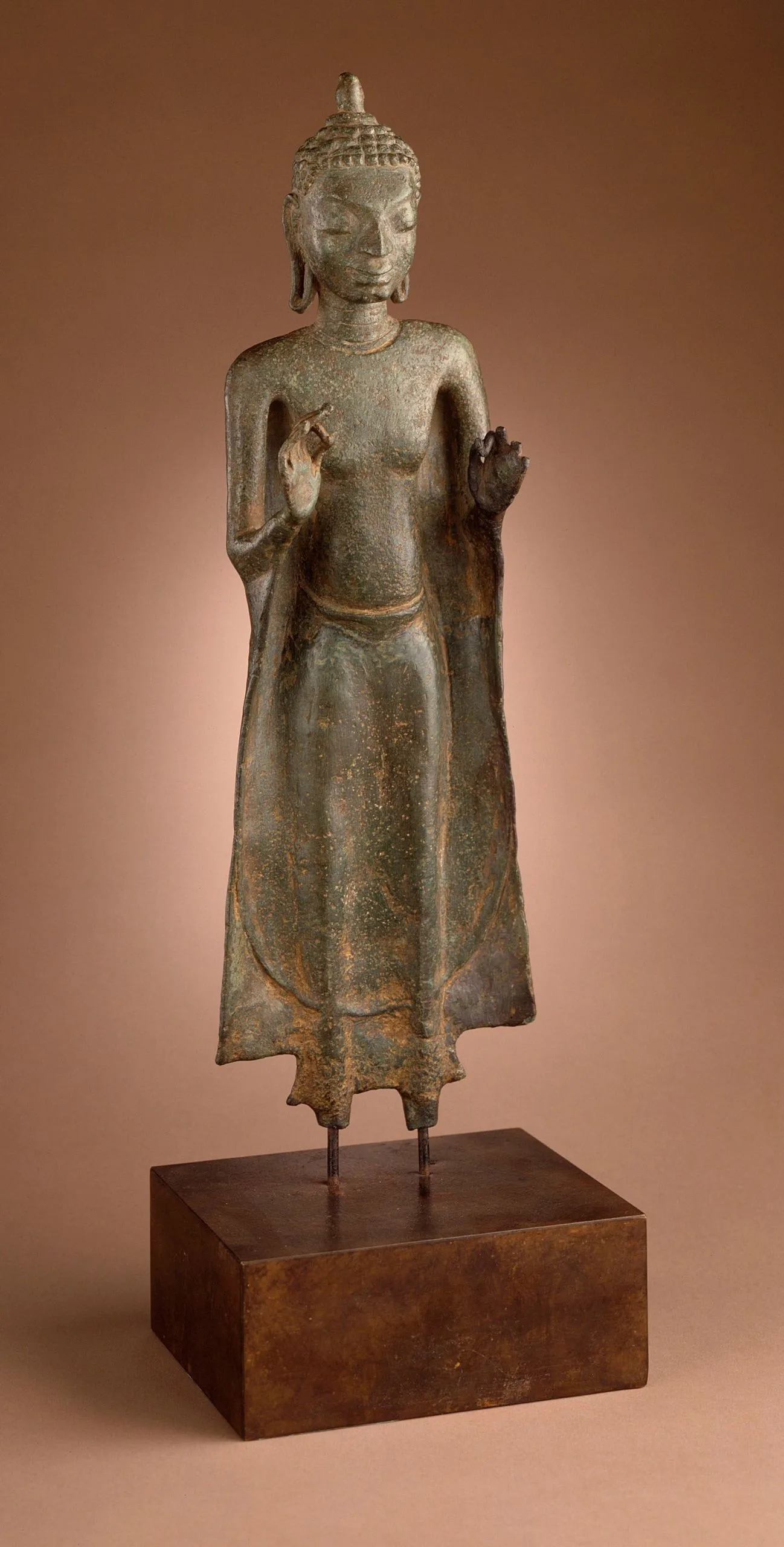
This standing bronze Thai Buddha is a classical example of Dvaravati sculpture. It has a characteristically slim, elegant body and swelling limbs and a frontal and symmetrical stance with hands raised in a double gesture of explanation. The serene face has distinctive Mon features. The treatment of the body and transparent garment reveals the influence of Gupta images from Sarnath and perhaps Ajanta, but the symmetry and frontality, not found in these Indian prototypes, are Thai traits.