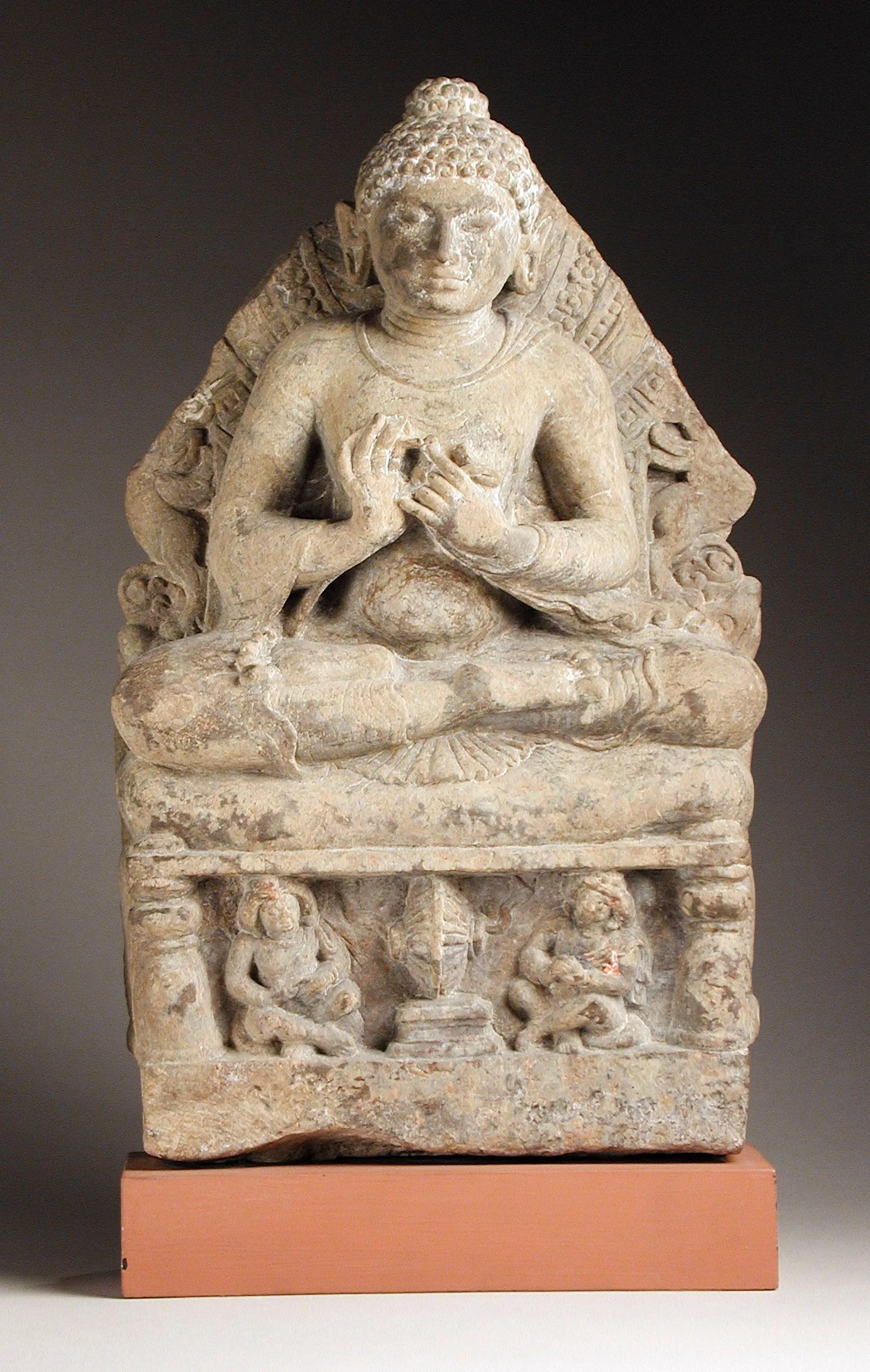
Above the base, this is generally a standard representation of an enthroned Buddha Shakyamuni with his hand held the teaching gesture of Turning the Wheel of the Law (dharmachakra mudra or dharmachakra-pravartana mudra). The Buddha and throneback have the customary iconographic features with minor variations. For a discussion of these aspects and the date of the sculpture, see Pal 1986, pp. 261–261, no. S136.
Conversely, the composition of the base is unusual. In the center is the Wheel of the Law shown in profile mounted on a pedestal and adorned with streamers. Instead of the typical two couchant deer flanking the wheel, there are two nimbate figures with Gupta-period hairstyles (see M.87.279.3). Each figure is seated on a cushion with their legs crossed. Pal identifies the hand gesture of the flanking figures as "the adoration gesture," which would typically be the anjali mudra with the palms of the hands joined together and held in front of the chest. Here, however, their arms and hands are roughly horizontal instead of being angled sharply upwards as they would be in making the anjali mudra. The gestures of the two figures are also not identical. In the figure on the viewer’s right, the right hand is wrapped around the left hand, which is held clenched in a closed fist. This may represent the gesture of the Enveloped Fist (avahittha mudra), which is displayed by various attendants to a central Buddha. It is a visual signal that the attendant’s mystical prowess is subservient to the Buddha's peaceful spiritual energy. In the figure on the viewer’s left, the index finger of the right hand is extended and touching the thumb of the left hand, which has its remaining fingers prolonged together. This may be an early variant of a wisdom gesture (jñana mudra). Given the figures’ atypical or esoteric hand gestures and that their divinity is indicated by their nimbuses, they may portray generic bodhisattvas or gods expressing their reverence for the Buddha. The base is also unusual in that it is not a lion throne with theological significance. Rather, it appears to be a plain platform supported by two posts with pot-shaped capitals akin to the architectural columns found in early Buddhist chaitya-halls.