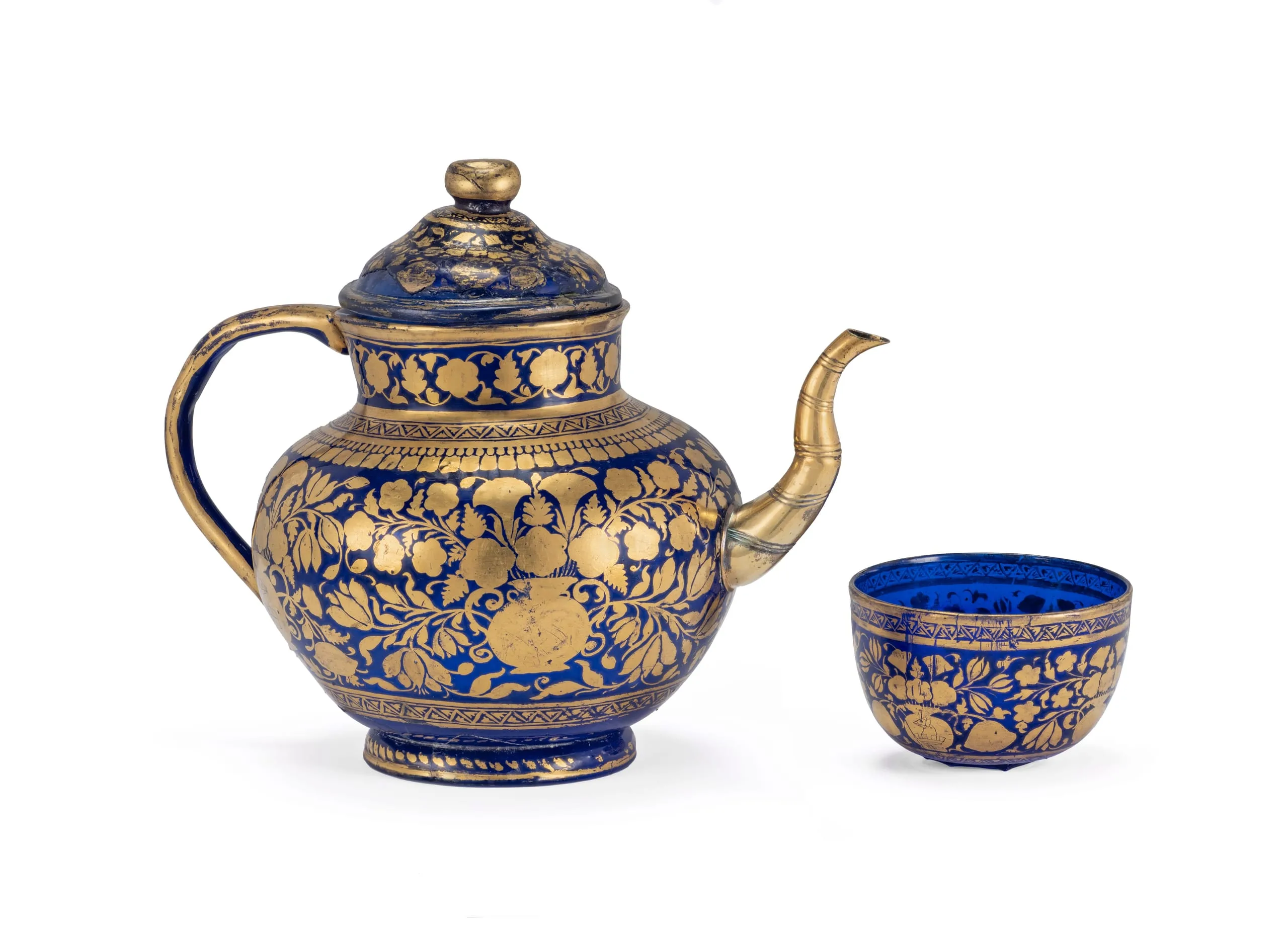
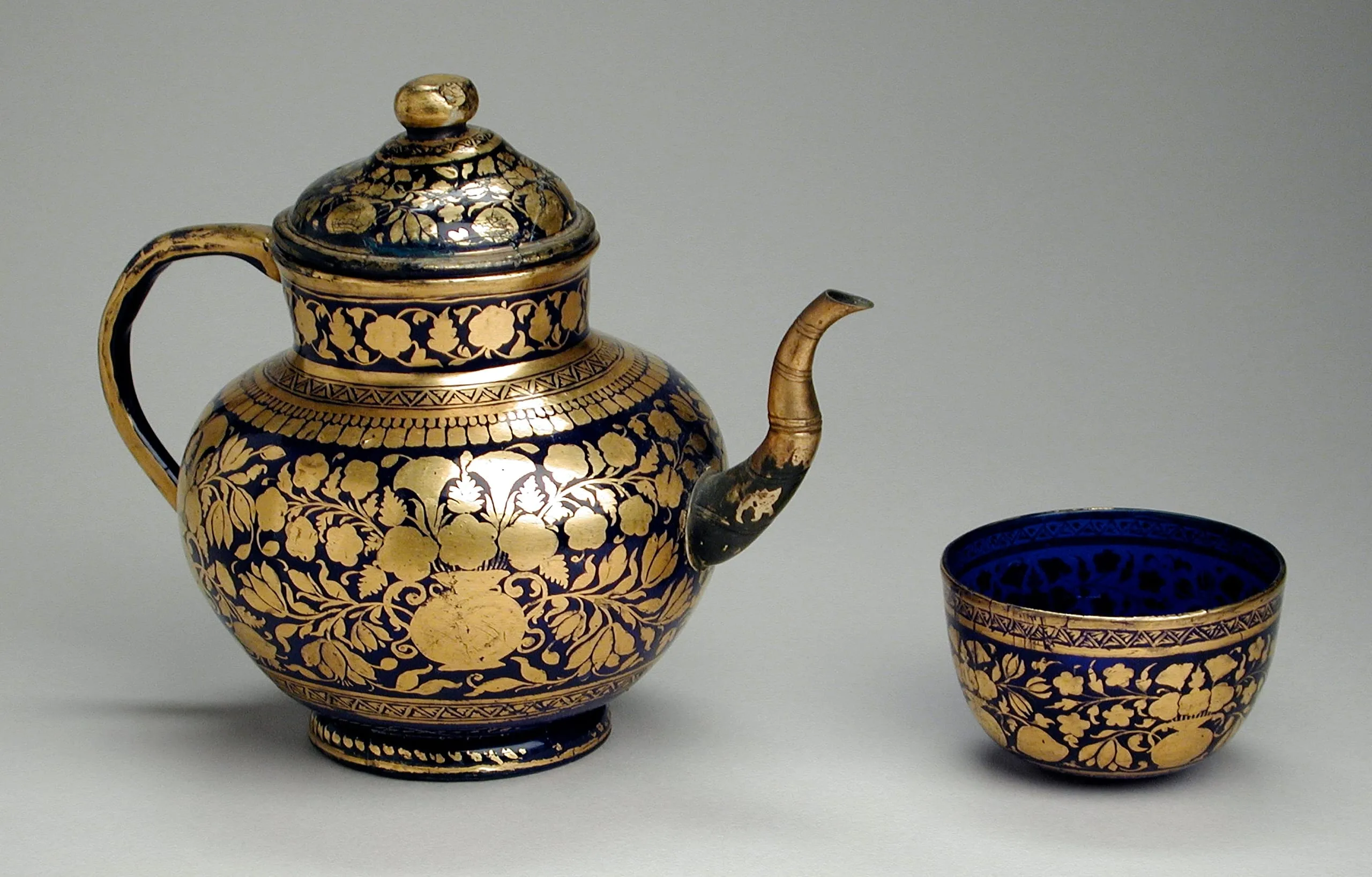
This teapot and cup were made as a set judging from the almost identical decoration on their surfaces. They are made of cobalt blue glass with gilded flowering pot motifs on the body and lid of the teapot and side of the handleless cup. An interlocking triangular motif enriches the teapot’s shoulder and forms a border along the lower body. It is paralleled on the cup’s mouth and lower border. Stylized pendant acanthus leaves form an additional design band around the shoulder of the teapot between the row of triangular motifs and the floral decoration on the body. The teapot's neck is decorated with a flowering vine pattern.
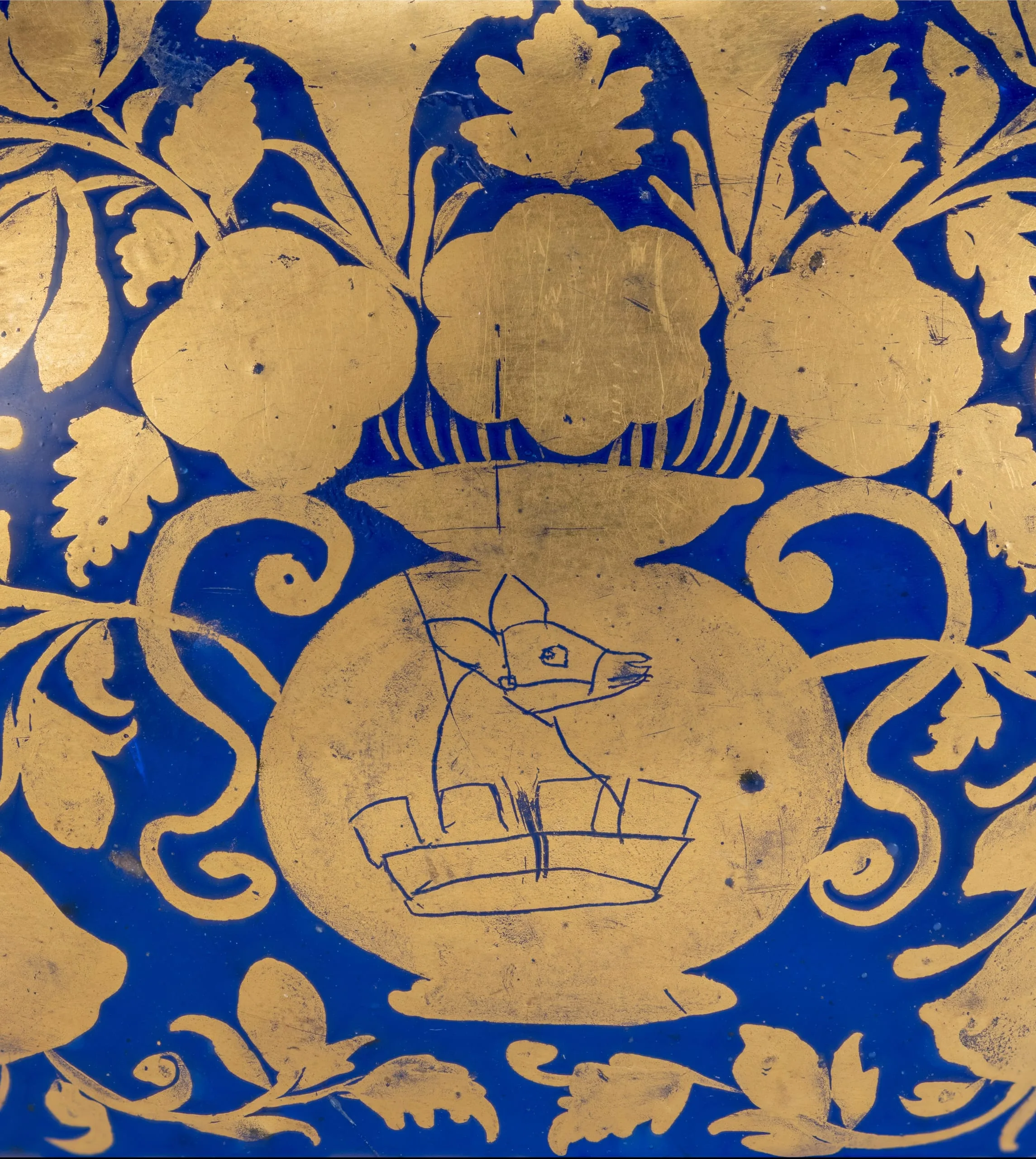
The flowering pots on the opposite sides of the teapot and cup each bear an outline emblem of a crest of arms identifiable as an "out of a mural coronet argent a bear's head couped erminois muzzled gules," which describes a silver (or white) coronet (crown), from which emerges a gold bear's head covered in black ermine spots, with a red muzzle. Per the records of the College of Arms, London, this crest was granted on February 23, 1725/6, to John Deane of Bengal, East India, and his brother Thomas Deane of Gray’s Inn co, Middlesex, England. John Deane, an English East India Company merchant, was twice the governor of Bengal (1723–26 and 1728–32). He is recorded as having been given permission in 1726 to import significant quantities of glassware into Bengal.
Tea and the Chinese manner of drinking it with porcelain spouted teapots and handless cups were introduced into England and its colonial spheres of influence in the 17th century. By the mid-18th century, the early Chinese vessel forms were supplanted by English made wares in pottery, glass, and precious metals that added handles to the cup and enhanced its profile and decoration.
Additional components of a bottle, two cups, and a saucer from this set or a closely similar one are in the Victoria and Albert Museum, London (C.140–C.143-1936).
See Stephen Markel, Molten Treasures. Review of Mughal Glass: A History of Glassmaking in India, by Tara Desjardins (New Delhi: Roli Books, 2024) in Marg 76:2 (September – December 2024): pp. 111 and 113, figs. 9a-b and 10a-c.