- Title
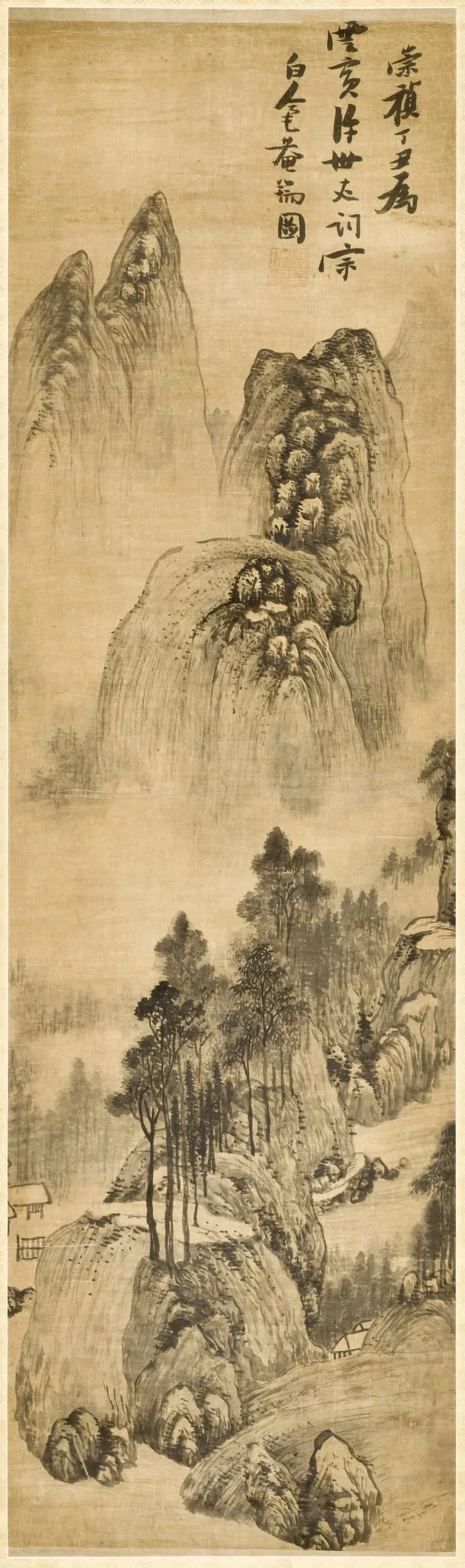
- Landscape
- Date Made
- Ming dynasty, 1637
- Medium
- Hanging scroll, ink on satin
- Dimensions
- Image: 88 x 29 in. (223.5 x 73.6 cm); Mount: 96 x 35 in. (243.8 x 88.9 cm); Roller length: 29 5/8 in. (75.2475 cm)
- Accession Number
- M.83.6.15
- Curatorial Notes
Zhang Ruitu was a high official and artist who, during the reign of Chongzhen (1628–44), narrowly escaped a death penalty for his ties to the heinous eunuch and former de facto head of government Wei Zhongxian. Zhang’s Landscape, made in 1637, presents a dynamic mountain scene painted in ink on satin (a favorite artist’s material in the seventeenth century). In its powerful brushwork and strong contrasts of dark and light ink, this work reflects the impact of Dong Qichang (1555–1636), the most influential painter of the late Ming dynasty. Today, however, Zhang Ruitu is best known as a calligrapher. His writing at the top of this scroll is an excellent example of his bold and individualistic calligraphic style and technique. Because he was a native of Fujian Province, many of his works now survive in Japan, where they were taken from Mount Huangbo by Chan (Zen) Buddhist monks, who established a first branch temple of the Ōbaku sect at Uji in the mid-seventeenth century.
Stephen Little
2017
- Selected Bibliography
- Little, Stephen. An Introduction to Chinese Paintings in the Los Angeles County Museum of Art. Los Angeles: Art Catalogues; LACMA, 2017.


![Artists Represent Themselves: Widline Cadet on “Seremoni Disparisyon #1 (Ritual [Dis]Appearance #1)”](/_next/image?url=https%3A%2F%2Funframed.lacma.org%2Fsites%2Fdefault%2Ffiles%2Fstyles%2Farticle_full%2Fpublic%2Ffield%2Fimage%2FM2023_47_1-20221007-Access.jpg%3Fitok%3DDEdu6xhk&w=828&q=75)
