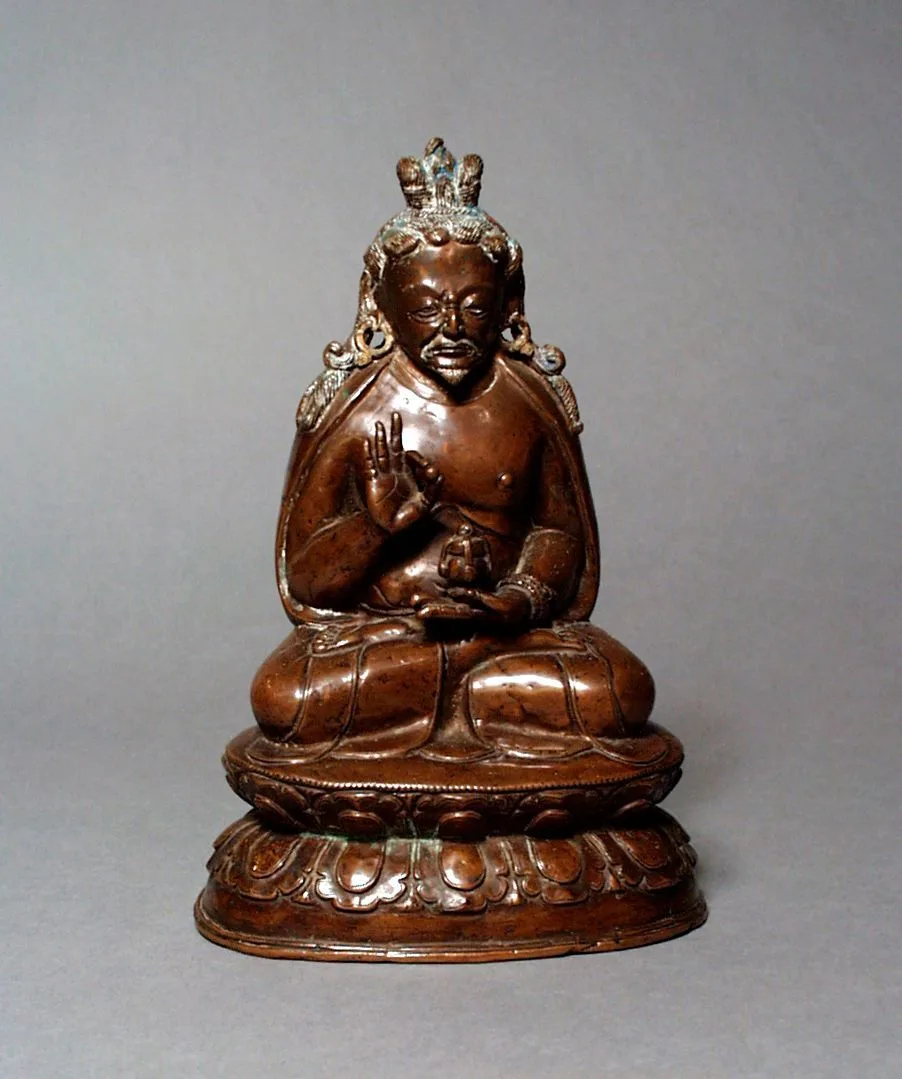
- Title
- Yuthok Yönten Gonpo the Younger (1127-1203)
- Date Made
- 16th century
- Medium
- Unalloyed copper with traces of paint
- Dimensions
- 10 1/8 x 6 1/2 x 5 in. (25.71 x 16.51 x 12.7 cm)
- Accession Number
- M.80.231.1
- Curatorial Notes
Yuthok Yönten Gonpo the Younger (1127-1203) was a Tibetan doctor and is regarded as the Physician King of Tibet. He wrote a treatise entitled, Four Medical Tantras (rGyud bzhi), and Yuthok Nyingthik, which is the primary Yajrayana Buddhist tantric practice-cycle associated with Tibetan medicine. There was also a legendary Yuthok Yönten Gonpo the Elder (8th century).
Yuthok Yönten Gonpo the Younger is depicted as an elderly yogi with streaks of white in his ascetic’s matted long hair, moustache, and goatee. He wears round earrings (kundala) typical of the Tantric yogins, and a rosary (akshamala) tied around his left wrist. His right hand is placed at chest level and holds a medicinal myrobalan fruit (amalaka). His left hand holds a vase (tshe-bum) containing the divine elixir of immortality (amrita). He is seated in the meditation posture (padma asana) on a lotus base that is inscribed on the back with his name.
See Himalayan Art Resources, no. 85749, https://www.himalayanart.org/items/85749
- Selected Bibliography
- Pal, Pratapaditya. Art of Tibet. Los Angeles; Berkeley, CA: Los Angeles County Museum of Art; University of California Press, 1983.
- Pal, Pratapaditya. Art of Tibet. Expanded edition. Los Angeles: Los Angeles County Museum of Art, 1990.
- Reedy, Chandra L. Himalayan Bronzes: Technology, Style and Choices. Newark: University of Delaware Press, 1997.