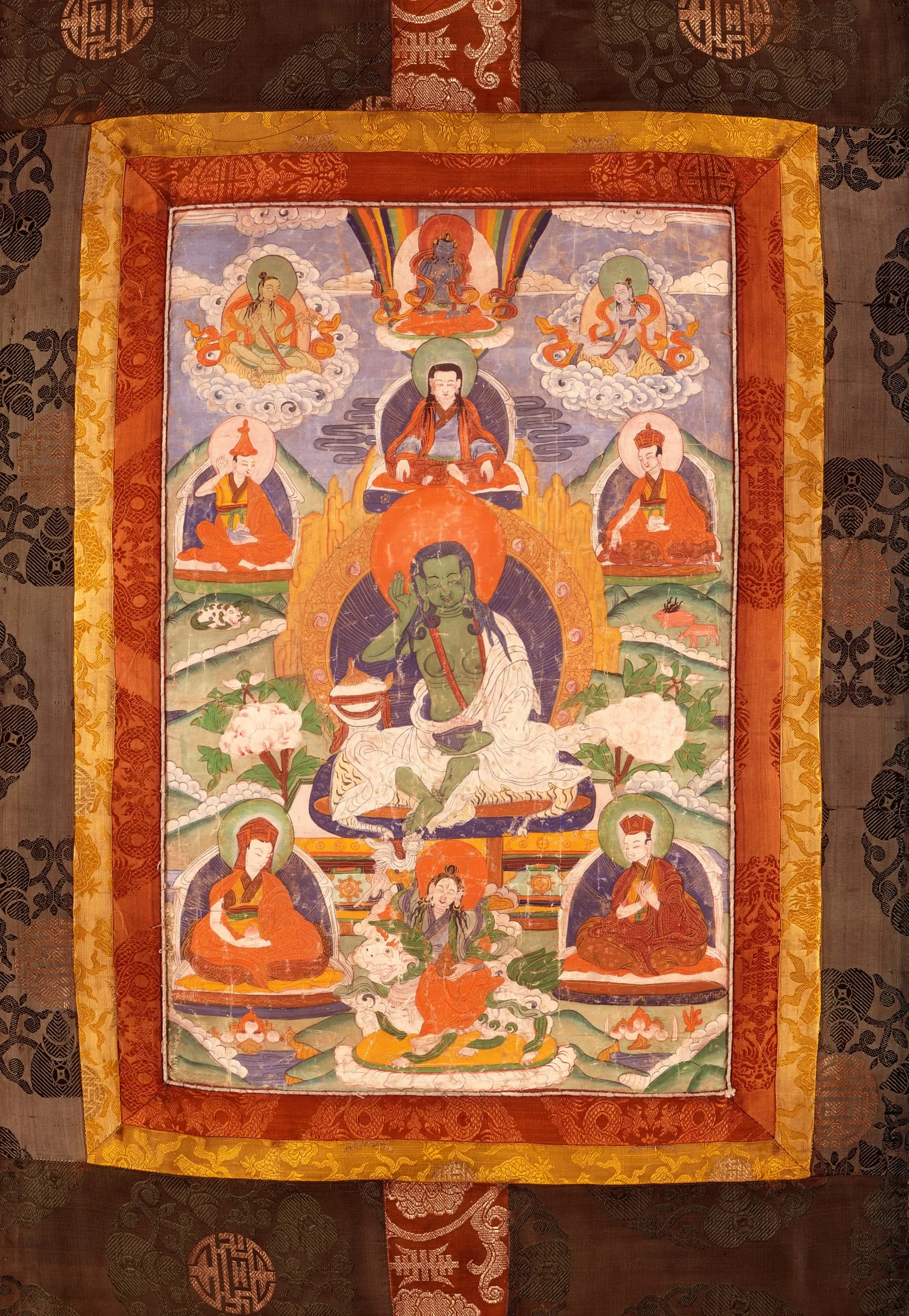
Milarepa (1040-1123) was a Tibetan master yogi, spiritual poet, and Buddhist saint. He was born in Gungthang in western Tibet into a wealthy family, but a wicked aunt and uncle stole their property. He studied black magic and cast a destructive spell on his evil relatives. Many people were killed and stricken with remorse, Milarepa sought the great Vajrayana teacher Marpa (1012–1097) to teach him how to overcome his vengeful desires. As part of the teaching process, Marpa had Milarepa perform many arduous tasks such as building several towers by hand. In time Marpa imparted his teachings to Milarepa, who then withdrew from human company to devote himself to meditation in solitude. After meditating in a cave for several years he became enlightened. Despite his withdrawal from human company, numerous monks sought his instruction and guidance in their religious studies.
Milarepa wears the simple white cotton robes that he reportedly wore even during the coldest winters. His right hand is raised to his ear in a characteristic gesture that has several interpretations: some devotees believe that it signifies his listening to the sounds of nature; while others believe that it might refer to his knowledge of secret oral traditions in the Kagyupa monastic school that were passed verbally from master to disciple. It is also a gesture used by singers and may refer to his singing of his sermons. Milarepa holds a skull cup (kapala) with offerings in his left hand. A lidded skull cup is beside him (see M.82.201a-c). He is seated in the relaxed posture (lalita asana) with his right leg slightly pendant. He sits on a tiger skin on a bolster on an elaborate throne. He is nimbate and has an aureola (prabhavali) with floral motifs and an outer band of mountain peaks referring to Milarepa’s cave habitat. Directly above him is his teacher Marpa. At the apex of the painting is the primordial Buddha Vajradhara, the celestial progenitor of the Vajrayana sect. In the upper left corner, the deity floating in the clouds is the spiritual forefather of the Kagyupa Order, the Mahasiddha (Great Adept) Tilopa (988-1069) holding his fish attribute. In the upper right corner, the Mahasiddha Naropa (956-1040) sits holding a skull cup. Naropa was the student of Tilopa and the teacher of Marpa (see M.2001.45). Below Milarepa is Vaishravana, the God of Riches and protective Regent of the Northern Direction (dikpala). He carries a victory banner in his right hand, holds a treasure vase in his left hand, and rides a snow lion. The four monks surrounding Milarepa may represent his four principle disciples who founded the four major branches of the Kagyu lineage: Barom Kagyu, Karma Kagyu, Phagdru Kagyu, and Tshalpa Kagyu.
See also M.72.108.1 and M.81.90.2. Comparable painted portraits of Milarepa are in the Art Institute of Chicago (1995.277) and Rubin Museum of Himalayan Art, New York (C2002.7.2 and C2006.66.174).