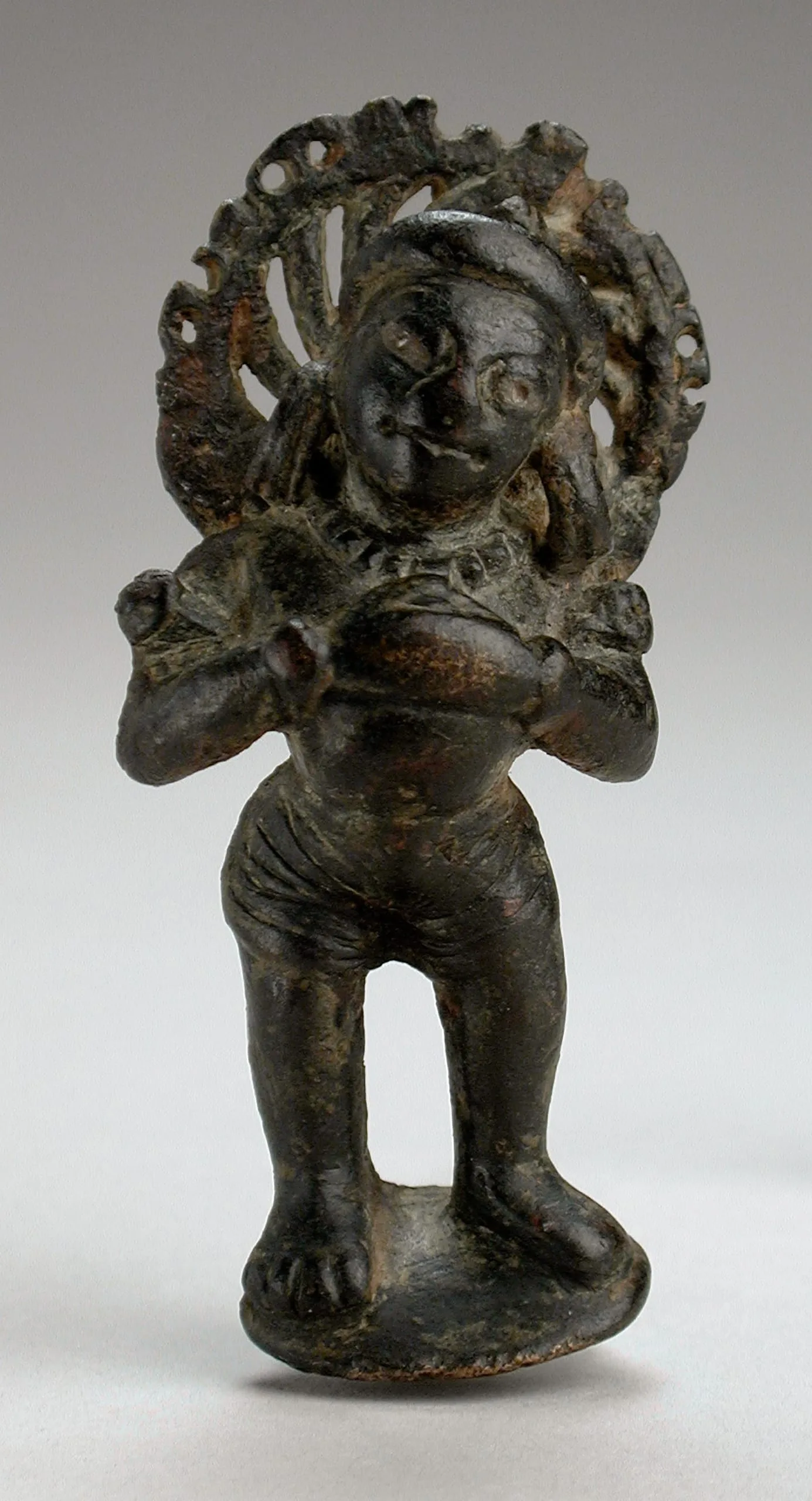
Personified weapons (ayudha purusha) of deities, particularly those of Vishnu, the Hindu God of Preservation, began to appear in South Asian art by the 4th century. The weapons are revered as partial incarnations (ansha) of Vishnu’s cosmic energy (see M.80.6.2, M.81.90.20, and M.85.279.1).
The two principle personified weapons associated with Vishnu are the discus and mace. Each has a technical name and a personal name.
1) Discus (Chakra Purusha or Sudarshana): Anthropomorphic male figures with a discus or spoked wheel (chakra) emerging from the top of their head, such as here, represent the personified discus of Vishnu. They often have their arms crossed in front of their chest. The chakra symbolizes Universal law, time, and the destruction of evil. See also M.89.84; and W. E. Begley, Visnu's Flaming Wheel: The Iconography of the Sudarsana-Cakra (New York: New York University Press, 1973).
2) Mace (Gada Devi or Kaumodaki): The anthropomorphic female form of Vishnu's powerful mace (see M.87.62). The gada symbolizes mental and physical strength, authority, and discipline. Because the word "gada" has a feminine gender in Sanskrit, it is personified as a woman. Accordingly, her personal name is Gada Devi rather than Gada Purusha. A mace emerges from the top of her head, and she often holds a fly whisk (see AC1998.136.1).
See also M.74.105.2, Personified Thunderbolt (Vajra Purusha).