- Title
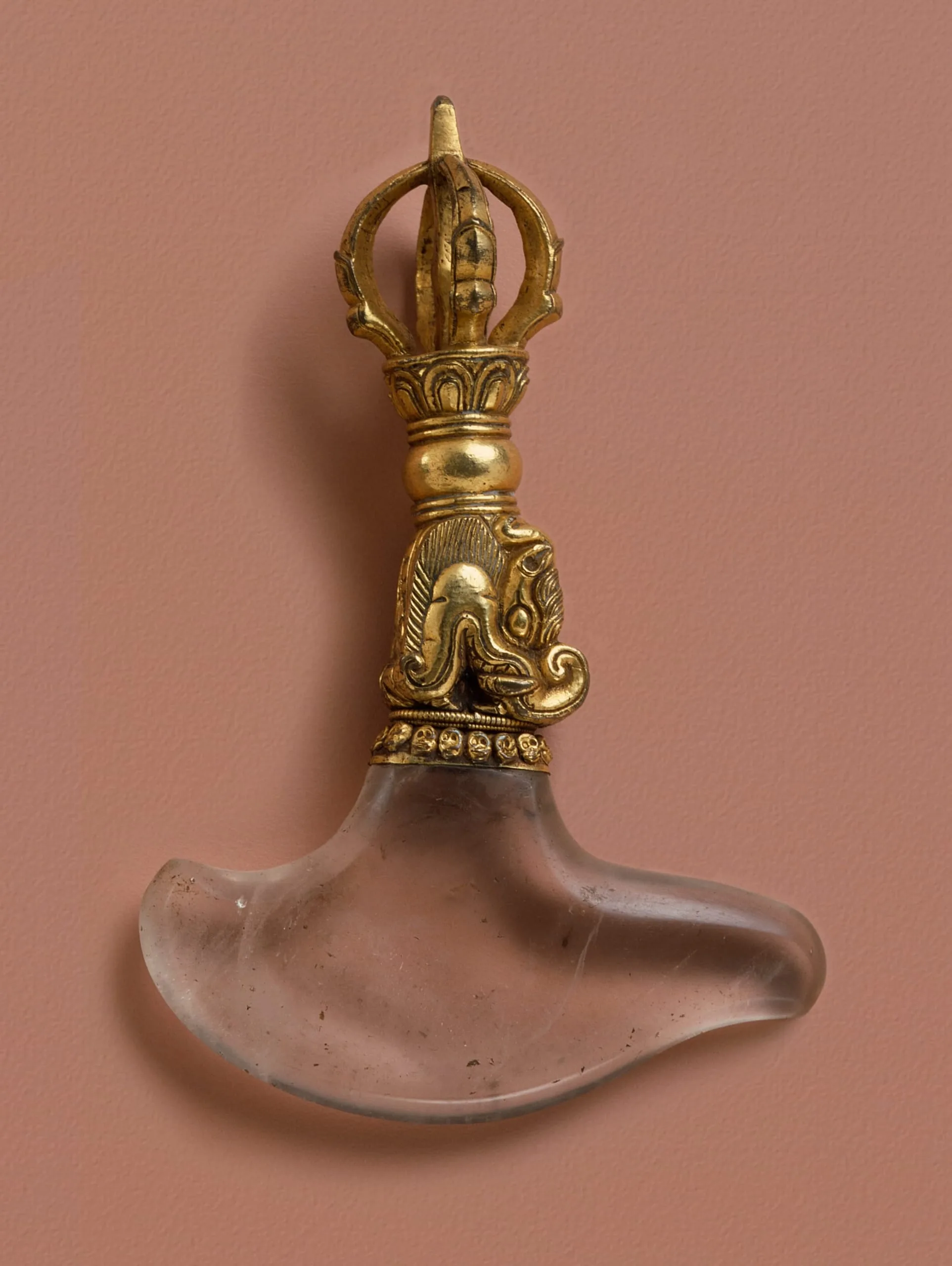
- Ritual Flaying Knife
- Date Made
- 17th century or earlier
- Medium
- Gilt copper alloy and rock crystal
- Dimensions
- 8 1/2 x 6 x 1 1/8 in. (21.59 x 15.24 x 2.85 cm)
- Accession Number
- M.79.243.1
- Curatorial Notes
This Ritual Flaying Knife (kartrika), and its set mates of a Ritual Axe (parashu; M.79.243.2) and Ritual Dagger (phurpa or kila; M.79.243.3), are from a set of initiation utensils likely used in ritual meditation on Vajrabhairava (Adamantine Anger). Vajrabhairava has thirty-two arms that carry many implements and attributes. The practitioner must visualize each ritual object and its specific Tantric symbolism. Usually, the officiating priest lifts such implements at the time they are invoked as a part of a ceremony to protect against negative forces. Full sets of ritual implements were often offered to teachers from wealthy patrons and disciples.
The Ritual Flaying Knife or Chopper has a rock crystal blade with a gilt copper alloy handle. The blade is attached to the mouth of the hilt by means of a clasp embellished with a row of grinning skulls. The blade appears to be issuing out of the mouth of a mythical aquatic animal (makara). Demarcated by plain roll borders, the ellipsoid-shaped grip is unadorned. A band of eight lotus petals forms the junction to the pommel in the form of a half-thunderbolt (vajra) with five prongs (four outer and central). See also AC1992.302.1.
- Selected Bibliography
- Pal, Pratapaditya. Art of Tibet. Los Angeles; Berkeley, CA: Los Angeles County Museum of Art; University of California Press, 1983.
- McArthur, Meher. Reading Buddhist Art: An Illustrated Guide to Buddhist Signs and Symbols. London: Thames & Hudson, 2002.
- Maxwell, Gail. Visual Art for Meditation: Resource Book. Los Angeles: Museum Associates/Los Angeles County Museum of Art, 2005.
- Pal, Pratapaditya. "Art and Ritual in Buddhism." Asian Art vol. II, no. 3 (Summer 1989): 33-55.
- Pal, Pratapaditya. Art of Tibet. Expanded edition. Los Angeles: Los Angeles County Museum of Art, 1990.
- Huntington, John C. and Dina Bangdel. The Circle of Bliss: Buddhist Meditational Art. Columbus: The Columbus Museum of Art; Chicago: Serindia Publications, 2003.
- Little, Stephen, Tushara Bindu Gude, Karina Romero Blanco, Silvia Seligson, Marco Antonio Karam. Las Huellas de Buda. Ciudad de México : Instituto Nacional de Antropología e Historia, 2018.
- Little, Stephen, and Tushara Bindu Gude. Realms of the Dharma: Buddhist Art across Asia. Los Angeles: Los Angeles County Museum of Art, 2025.
- Selected Exhibition History
- Ritual Offerings in Tibetan Art. Saturday, September 13, 2014 - Sunday, October 25, 2015