- Title
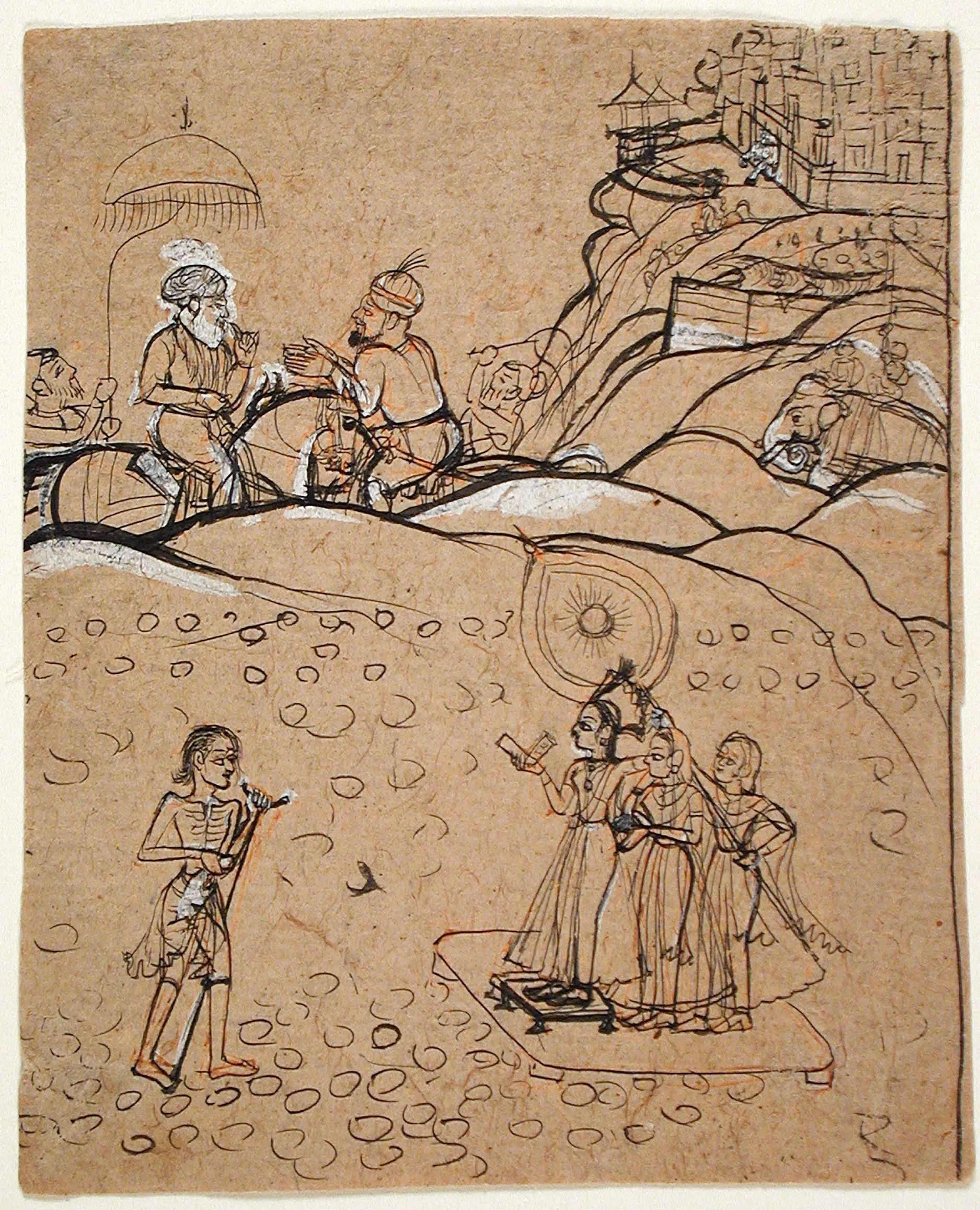
- Layla meets Majnun in the Desert, Illustration from the Story of Layla and Majnun
- Date Made
- circa 1770
- Medium
- Ink and opaque watercolor on paper
- Dimensions
- 6 1/4 x 5 in. (15.87 x 12.7 cm)
- Accession Number
- M.79.191.4
- Curatorial Notes
The ill-fated 7th-century Arab lovers Layla and Majnun are depicted in this preparatory sketch that follows the story recounted in the Khamsa (Quintet) of Nizami Ganjavi of Iran (circa 1141–1209). Layla was the daughter of the tribal chief (Emir) Mahdi of the wealthy Bedouin tribe of Banu Amir. Majnun was the Arabic poet Qays ibn al-Mulawwah but is better known by his epithet Majnun ("madman") because of his obsession with Layla. The lovers were childhood sweethearts, but Layla’s father forbade them to be together and instead arranged for Layla to marry a rich merchant from Ta’if in Saudia Arabia. Obsessed with Layla, Majnun left home to wander in the desert for the remainder of his life. Layla died of heartbreak.
Majnun is represented in the bottom left corner. He is emaciated from being love-struck and leans on his ascetic’s crutch used as a walking stick. Ahead of him on a platform, Layla stands on a stool with two attendants, one of whom holds an honorific sunshade (kiraniya) over her mistress. Forbidden from seeing or speaking to one another, the lovers had communicated by secret love letters and poems. Layla reads from a text symbolic of their lovelorn communiques.
In the upper left corner, Layla’s father is shown on horseback under a ceremonial royal umbrella (chhatra). The Emir and his entourage had accompanied Layla so that she could have a brief, supervised glimpse of the exiled Majnun. See also M.83.105.22.
- Selected Bibliography
- Pauwels, Heidi Rika Maria. Cultural Exchange in Eighteenth-Century India: Poetry and Paintings from Keshangarh. Berlin: EB-Verlag, 2015.