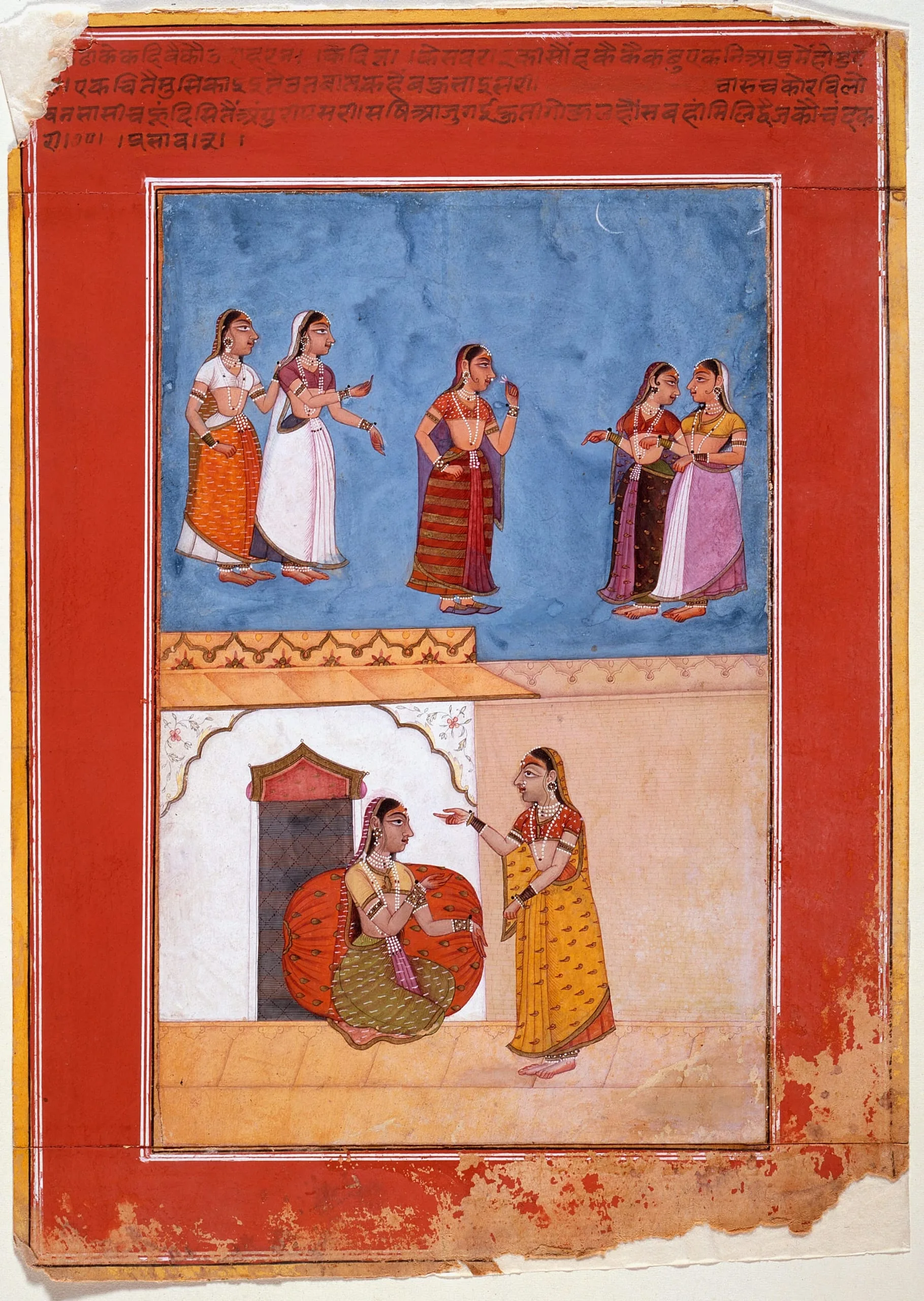
The Rasikapriya (Connoisseur’s Delights) was composed in 1591 in the Hindi dialect of Braj-Bhasa by the poet Keshavdas (1555–1617). The text portrays Radha and Krishna as archetypal male and female lovers (nayakas/nayikas) and their corresponding emotions and encounters.
This folio illustrates The Discourse of a Married Woman (Udha) (Rasikapriya 3:97):
‘Today to Gokul when I went,
Oh! bosom friend, the maidens there
Did treat me as the moon new-bent
Upon the sky; at me they stared
And fingers shared - as though above
At the new moon: and all did swear
I was the maid by Krishna beloved.
And wagering, some said, “I declare
She’s so; and others she is not!”
Some looked at me and laughed or smiled;
With glances meaningful they talked,
And looked at me with chiding eyes.
(Translation by K. P. Bahadur.)
In the lower register the married woman describes the event at Gokul to her companion. The scene is illustrated in the upper section where she is being pointed at by the maidens under a nighttime sky with a crescent moon.
An inscription on the reverse states that the painting was made in 1692 (samvat 1749) by Vriham (a.k.a Ibrahim Umrani, the son of the master artist Ruknuddin, active circa 1650-1697).
Another folio from this dispersed series is in the Metropolitan Museum of Art, New York (1975.410.30).
For an alternate translation by V. P. Mishra, see Harsha V. Dehejia, Rasikapriya: Ritikavya of Keshavdas in Ateleirs of Love (New Delhi: D.K. Printworld, 2013), pp. 63, 171, verse and fig. 3.73