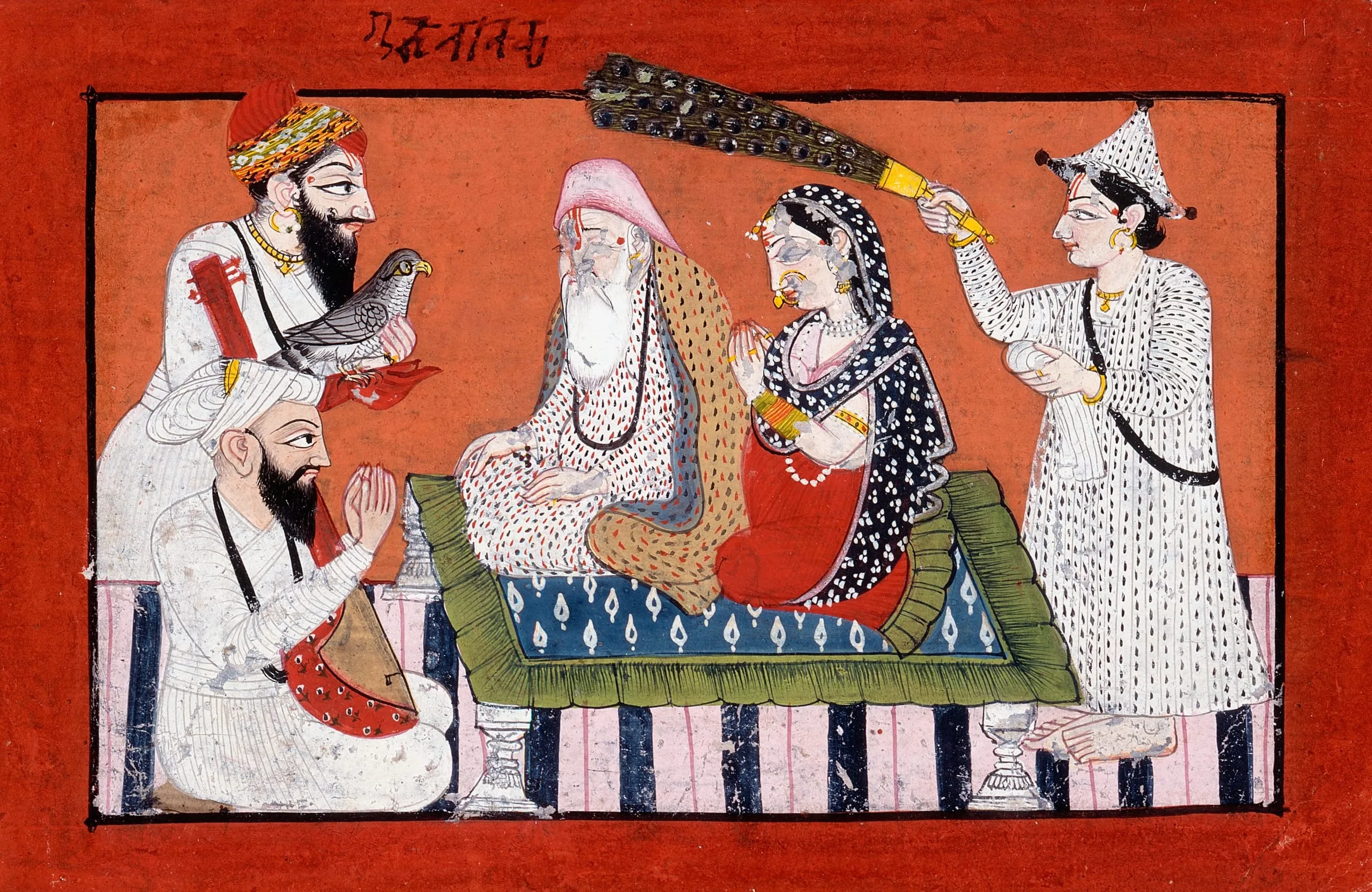
This painting depicts an imaginary meeting between the first and last Sikh Gurus. Guru Nanak (1469-1539), the founder of Sikhism and the first Sikh Guru, is identified by the devanagari inscription in the upper red border. He and his wife Sulakhani (married in 1487) are seated on a covered platform on a striped carpet. She holds her hands together in a gesture of reverence.
Guru Gobind Singh (1666-1708), the tenth and last Sikh Guru, wears a falconry gauntlet and holds a hawk named Rustam that represents the Kalsa, the Sikh code of conduct initiated by Gobind Singh. He was a Sikh warrior trained in the traditional martial skills of nobility, including hawking. Gobind Singh visited Mandi in circa 1697 during the reign of Raja Sidh Sen (r. 1684-1727) to raise support in the Sikh resistance against the Mughals under Emperor Aurangzeb (r. 1658-1707).
Bala (1466–1544), Guru Nanak’s childhood friend and longtime companion, waves an honorific peacock feather fan (morchal) over Guru Nanak and Sulakhani. Mardana (1459-1534), Guru Nanak’s longtime Muslim disciple and companion, has a rubab (lute-like instrument) and holds his hands together in veneration.
Numerous painted and printed group images of the Sikh Gurus and the Janam Sakhi (Life Stories of Guru Nanak) series were produced in the 18th and 19th centuries, particularly in the Panjab and Kashmir. See M.74.88.3.