- Title
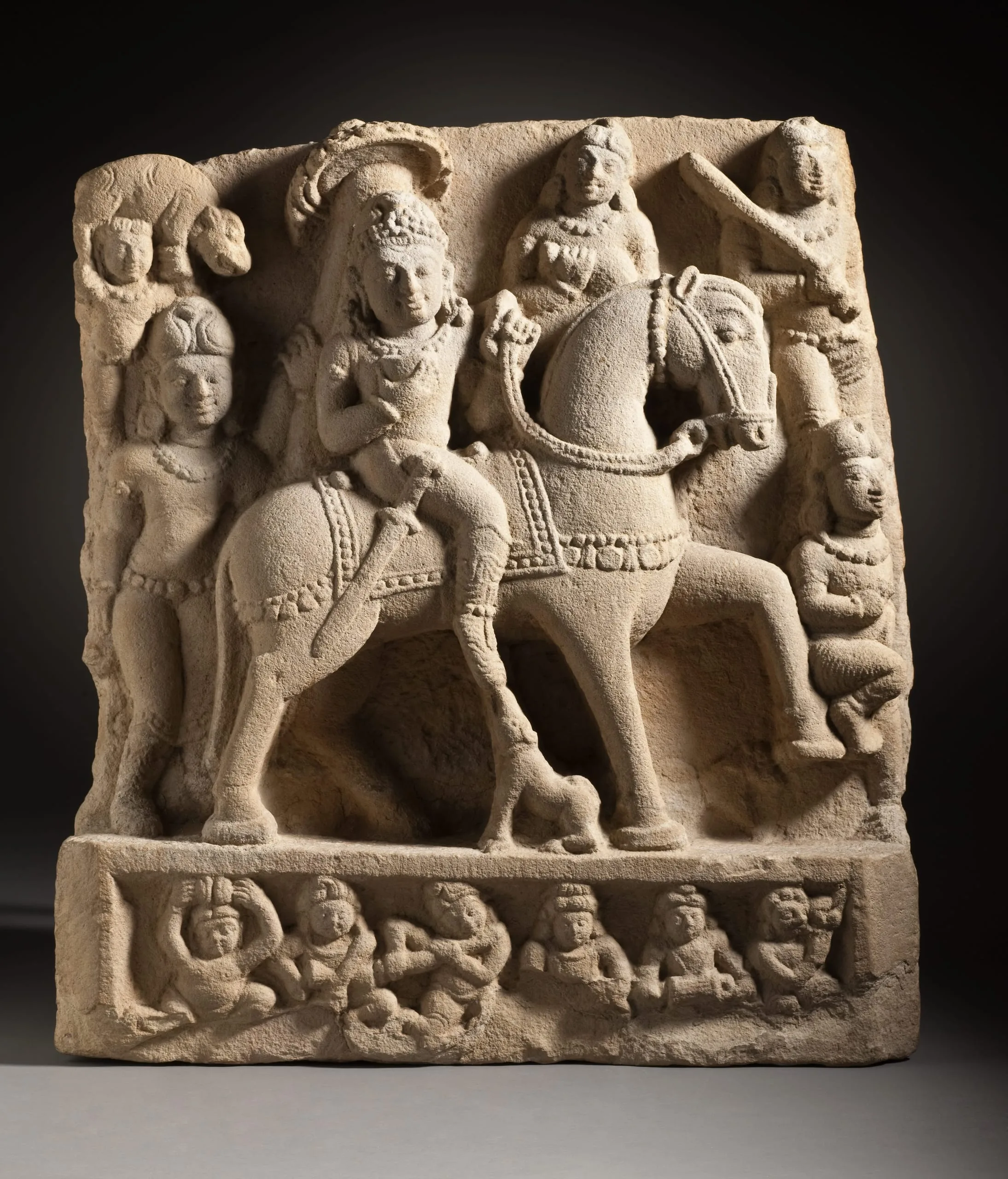
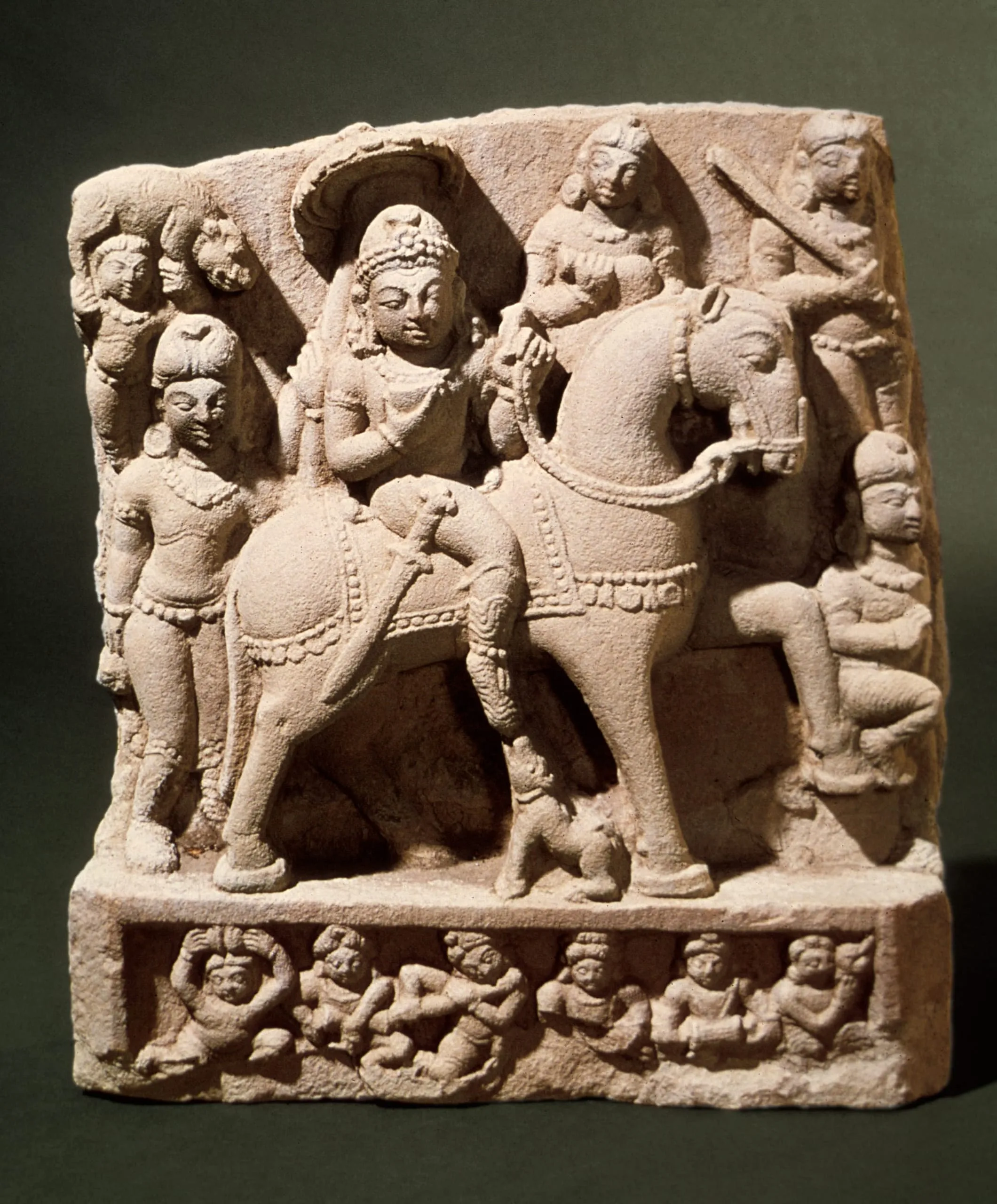
- The Hindu God Revanta and Companions
- Date Made
- early 7th century
- Medium
- Pale cream sandstone
- Dimensions
- 23 x 20 in. (58.42 x 50.8 cm)
- Accession Number
- M.73.87.1
- Curatorial Notes
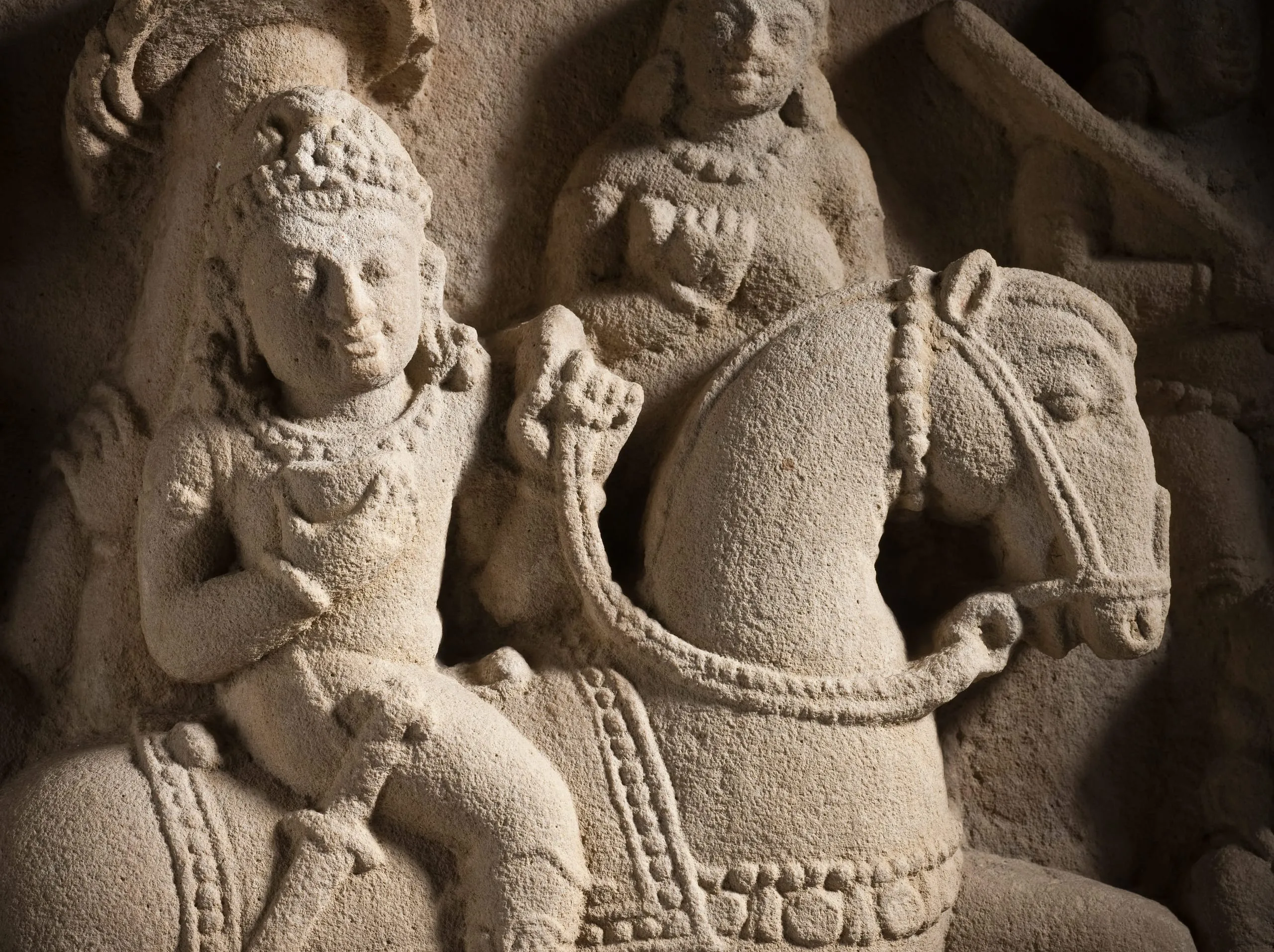
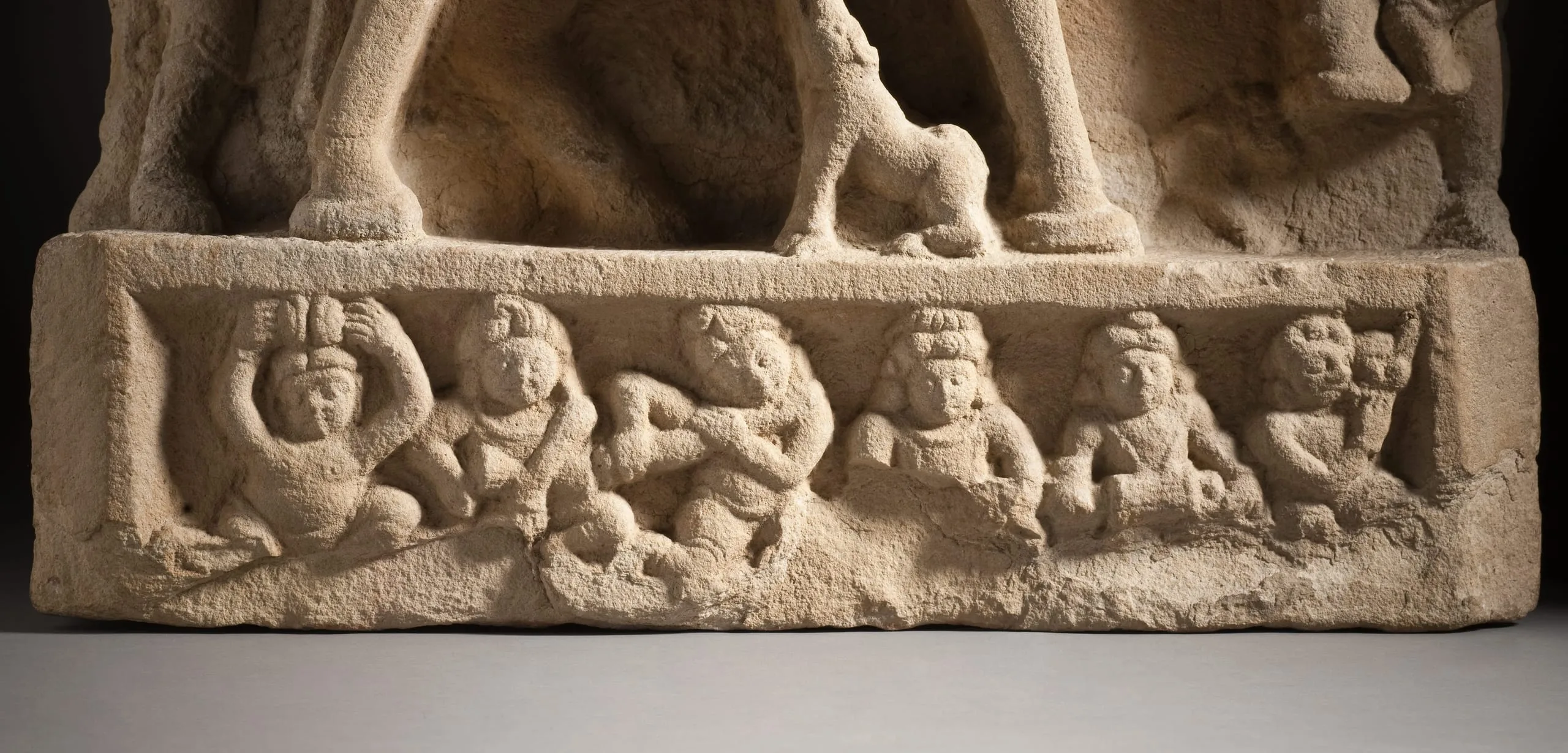
Revanta (Brilliant) is the youngest son of the Hindu Sun God, Surya, and his wife Sañjña (or Saranya). He is the chief of the Guhyakas (Hidden Ones), nature spirits who dwell in mountain caves and protect forest travelers. Revanta is worshiped as a patron deity of horse traders and is represented as a hunter on horseback returning from a successful hunt. Perhaps due to Iranian cultural influence, and in accordance with his father’s attire in northern Indian representations, he wears boots, trousers, and a tunic. His hair is styled like a Phrygian cap and he wears a bejeweled diadem. He carries a drinking cup in his right hand and holds the horse’s reins in his left. He is accompanied by five Guhyaka attendants with similar hairstyles. The attendant behind him carries an honorific parasol (chattra) over Revanta’s head. An attendant behind the horse’s head holds a flask to refill his master’s drinking cup. The attendant in the upper left corner carries a slain boar captured in the hunt. The hunting dog licks his master’s boot in a charming genre embellishment. Beneath the hunting procession is a frieze of dancing musicians celebrating the good fortune of the hunt. See also M.86.61.1.
A comparable sandstone sculpture of Revanta, attributed to North India, 9th–10th century, is in the Linden-Museum Stuttgart.
- Selected Bibliography
- Pal, Pratapaditya. Indian Sculpture, vol.1. Los Angeles: Los Angeles County Museum of Art; University of California Press, 1986.
Pal, Pratapaditya. The Divine Presence: Asian Sculptures from the Collection of Mr. and Mrs. Harry Lenart. Los Angeles: Los Angeles County Museum of Art, 1978.
- Pal, Pratapaditya. The Sacred and Secular in Indian Art. Santa Barbara, CA: University of California, 1974.
- Newman, Richard. The Stone Sculpture of India: a Study of the Materials Used by Indian Sculptors from ca. 2nd Century B.C. to the 16th Century. Cambridge, MA: Center for Conservation and Technical Studies, Harvard University Art Museums, 1984.
El Universo de la India: Obras Maestras del Museo de Arte del Condado de Los Angeles. Santiago: Centro Cultural Palacio La Moneda, 2012.