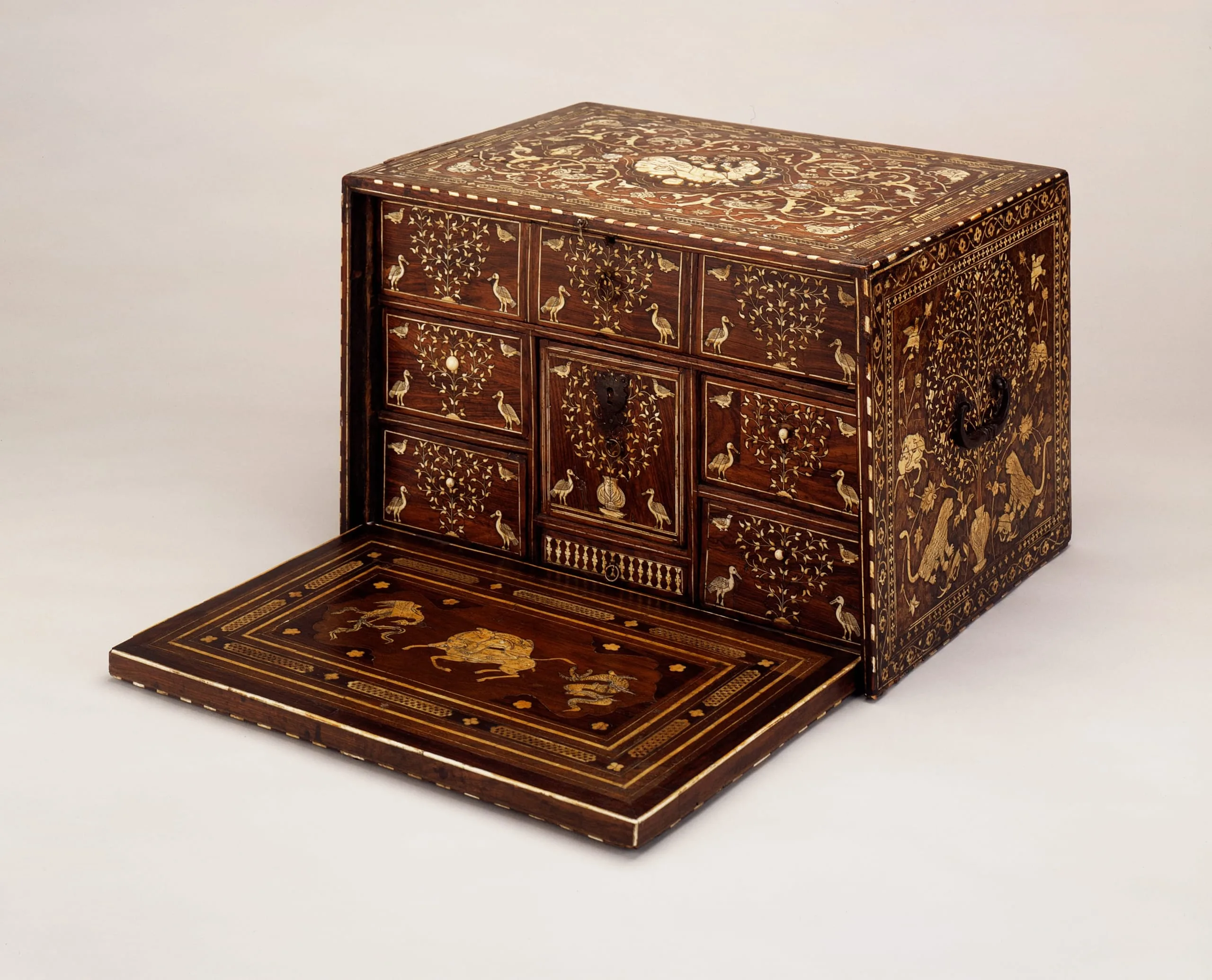
Ornate cabinets inlaid with ivory and bone were a specialty product of the indigenous and expatriate furniture craftsmen working in several centers of production and commerce along the western coast of the Mughal Empire, in what is now the modern Indian state of Gujarat and the present-day Pakistani province of Sindh. Made in the 16th-19th centuries for both domestic and foreign markets, they typically feature a standard repertoire of flora, fauna, figural, and florid designs with minor compositional or thematic variations. Originally a European furniture form known as a fall-front cabinet, the front cover is hinged at the bottom and opens to reveal interior drawers for stationery and valuables. This cabinet is noteworthy for its inscribed poetic verses heralding its beauty. Written in Nastaliq script, the couplets are painted in gold along the drop-down door’s exterior outer border.
An Iranian artist’s name, Mirza Ibrahim, and the date [A.H.] 966 (14 October 1558 to 7 October 1559) are carved in Naskh script on the inset bone roundels on the exterior top of the cabinet, but an examination by LACMA’s Conservation Dept. suggests they may be later insertions and that the present components of the cabinet are likely a pastiche drawn from at least two sources.
Ivory inscription:
The Pioneer of Crafts, Mirza Ibrahim, is well-known as Irani.
There will not remain in the world anything except our works.
[A.H.] 966 (14 October 1558 to 7 October 1559)
Gilded inscription:
I saw a jeweled chest.
I asked it, “What are you and what name do you bear?
Every good thing that exists in the world
You possess it in the present times.
You are lovely-colored like a lustrous pearl.
You cause astonishment to all.
In the eyes of the men of discernment
Certainly, you are a creation of the Maker [God]
Even though a human being has manufactured you,
You are admired by crowned monarch.
You are a beloved of the whole world.
You are like a garden and an orchard in full bloom in new spring.
On account of the many roses and tulips that are painted on you,
You are a store-house of the secrets of a king.
You are better than treasure and wealth-store.
You are sweet-smelling like the musk pod of Tatary [central Asia].”
Translation by Dr. Z.A. Desai, 7-31-95