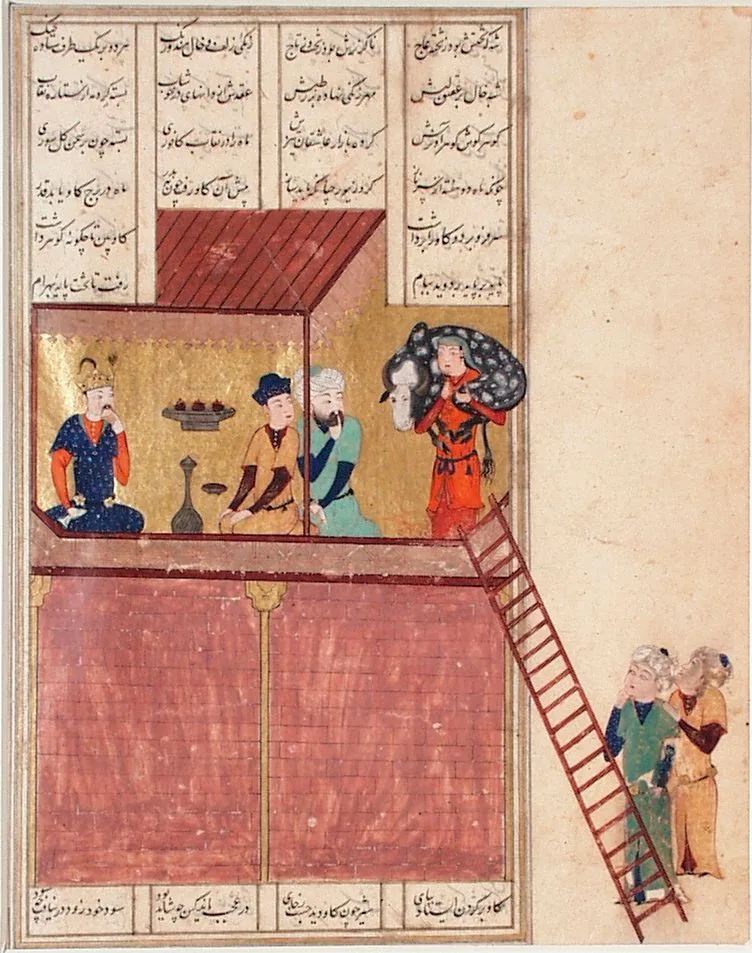
The classical Persian poet Nizami Ganjavi (d. 1209) composed five long poems about the spiritual refinement of man that are known collectively as the Khamsa (Quintet). One of these poems, the Haft Paykar (Seven Portraits), recounts the exploits of the Sasanian ruler Bahram Gur. In one episode, Bahram Gur is challenged by his harpist Fitna to pin an onager’s foot to its head with an arrow. When the skilled huntsman does so, Fitna claims his success was due to practice rather than pure talent. Enraged, the king sentences Fitna to death, but she escapes and spends the next several years in hiding. To restore her honor, she trains daily by carrying a calf that grows into an ox up a long flight of stairs. This painting depicts the moment Fitna demonstrates her strength to Bahram Gur. When he praises her dedication, she reveals her identity and reprimands the king for dismissing the value of practice so many years before. Surprised and admonished, he begs her forgiveness and the pair marry.
The manuscript to which this folio belongs was disassembled, most likely when it was brought to the art market, and its pages dispersed. LACMA holds seven of these folios (see also M.73.5.417, .421, .423, .424, and .606), including the colophon, which dates the manuscript to AH 924/1517 CE and lists the scribe as Muhammad Zarin-Qalam (see M.73.5.604).
2025