LACMA

ShopMembershipMyLACMATickets
LACMA
Los Angeles County Museum of Art
5905 Wilshire Blvd.
Los Angeles, CA 90036
info@lacma.org
(323) 857-6000
Sign up to receive emails
Subscribe
© Museum Associates 2026
  • About LACMA
  • Jobs
  • Building LACMA
  • Host An Event
  • Unframed
  • Press
  • FAQs
  • Log in to MyLACMA
  • Privacy Policy
© Museum Associates 2026
Collections

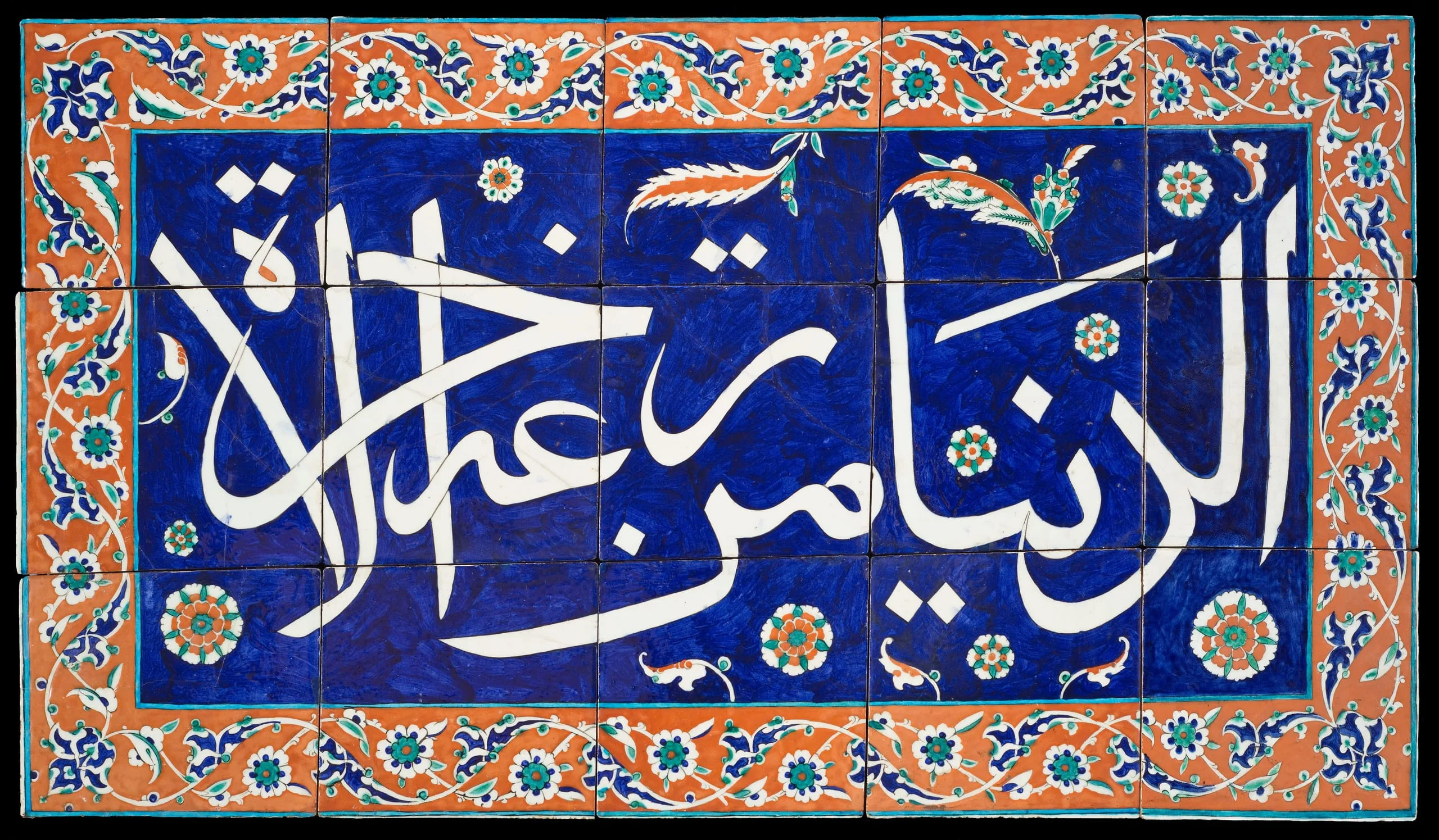
Tile Panellast quarter of 16th century

On view:
Geffen Galleries, floor 3
Horizontal ceramic tile panel with cobalt blue central field bearing large white Arabic calligraphy in thuluth script, framed by a terracotta orange border with scrolling vine and floral motifs in blue, teal, and white

Unknown, Tile Panel, last quarter of 16th century, Los Angeles County Museum of Art, The Nasli M. Heeramaneck Collection, gift of Joan Palevsky, photo © Museum Associates/LACMA

Title
Tile Panel
Place Made
Turkey, Iznik
Date Made
last quarter of 16th century
Period
Ottoman (1281-1924)
Medium
Fritware, underglaze-painted
Dimensions
overall: 29 1/2 x 52 3/4 in. (74.93 x 133.985 cm) Weight: 80 lb. (36.3 kg)
Credit Line
The Nasli M. Heeramaneck Collection, gift of Joan Palevsky
Accession Number
M.73.5.6
Classification
Ceramics
Collecting Area
Art of the Middle East: Islamic
Curatorial Notes

In Muslim cultures, words are used not only to communicate but to decorate. Because it is through writing that the Qur’an is transmitted, scripts in the Arabic alphabet were devised and perfected to be worthy of divine revelation. On this account, calligraphy became the most important art form regardless of the text. This concern with beautiful writing extended beyond the page to objects of all sorts, including metalwork, coins, ceramics, stone, glass, wood, and textiles, as well as inscriptions on buildings, as here.

From the time of the construction of Sultan Süleyman’s great mosque complex in Istanbul (1550–57), inscribed Iznik tiles such as this example increasingly came to embellish Ottoman religious monuments. Stencils were used to transfer the designs of epigraphic compositions. This inscription, however, seems not to have been conceived by one of the many professional calligraphers who flourished under the Ottomans. Rather, it may have been the work of a highly proficient amateur. The Arabic text—“This world is the sowing ground of the next [world]”—is probably a paraphrase of a verse from the Qur’an (42:20).

Ceramics made in Iznik, in western Turkey, are among the most renowned and influential arts of the Ottoman period. The Iznik kilns, about 85 miles southeast of the capital, Istanbul, produced both tableware and architectural revetment such as this. Tiles were first manufactured at Iznik around the early sixteenth century; however, production expanded dramatically in the second half of the century as the court increasingly sponsored new buildings.
Selected Bibliography
  • Pal, Pratapaditya, ed. Islamic Art: The Nasli M. Heeramaneck Collection. Los Angeles: Museum Associates, 1973.
  • Lo Terrenal y lo Divino: Arte Islámico siglos VII al XIX Colección del Museo de Arte del Condado de Los Ángeles. Santiago: Centro Cultural La Moneda, 2015.

Related Unframed

This Weekend at LACMA: Two Film Double-Headers, International Museum Night, Art+Film Lab Arrives in Compton, A Trio of Talks, Edward Biberman Restored, and More!
  • May 16, 2014