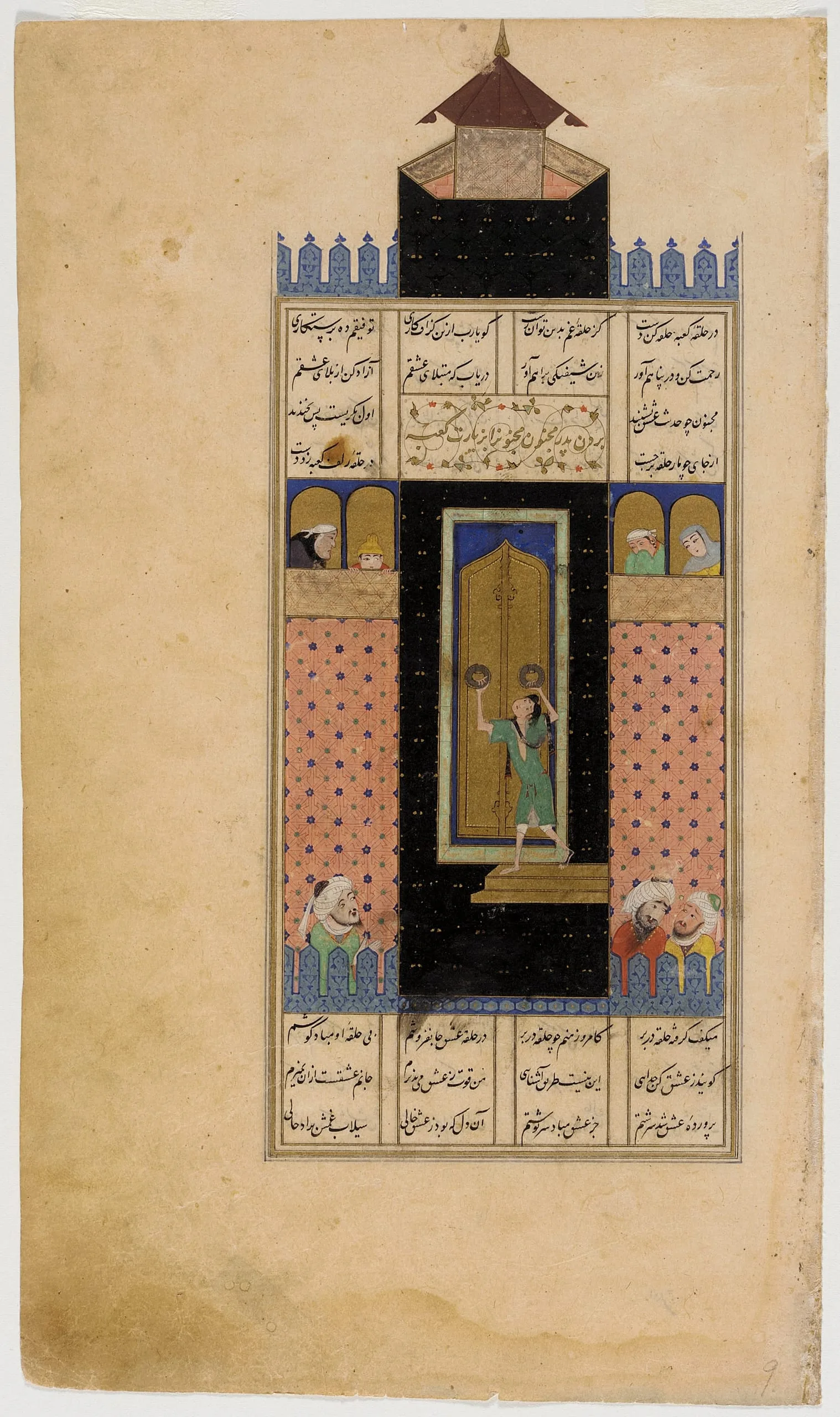
The Khamsa (Quintet) by Nizami Ganjavi (d. 1209) is a collection of five lyrical narrative poems that include some of the most famous tales in Persian literature. The third book, Layla va Majnun, stands out as a timeless tale of unfulfilled passion, devotion, and the transformative power of love. The poem resonates on multiple levels—both as a poignant story of star-crossed lovers and a spiritual allegory. For Sufis, it symbolizes the soul’s longing for the divine, emphasizing all-encompassing love as the path to union with God.
This folio captures a pivotal moment in the narrative, which is set in Arabia, when Majnun’s father takes him on a pilgrimage to Mecca, seeking deliverance from his love for Layla, who belongs to a rival tribe. Instead, Majnun grasps the Ka‘ba’s door knocker and declares his unwavering devotion: “They tell me: abandon love, that is the path to recovery—but I can gain strength only through love. If love dies, so shall I.” This scene is vividly depicted in the Shiraz style, where four columns of text frame Majnun’s elongated figure standing before the black-draped Ka‘ba, surrounded by shocked onlookers. The architecture does not fully resemble the Ka‘ba, likely because the artist, despite some presumed knowledge of its famous black and gold-embroidered covering, had never seen it firsthand, lending the depiction a somewhat imaginative quality.
The manuscript to which this folio belonged was disassembled, most likely when it was brought to the art market, and its pages dispersed. LACMA has seven of these folios (see also M.73.5.418, .421, .424, .560, and .606), including the colophon page, which dates the manuscript to AH 924/1517 CE and is signed by the scribe Muhammad Zarin-Qalam, or “Golden Pen,” an honorific title (see M.73.5.604).
2025