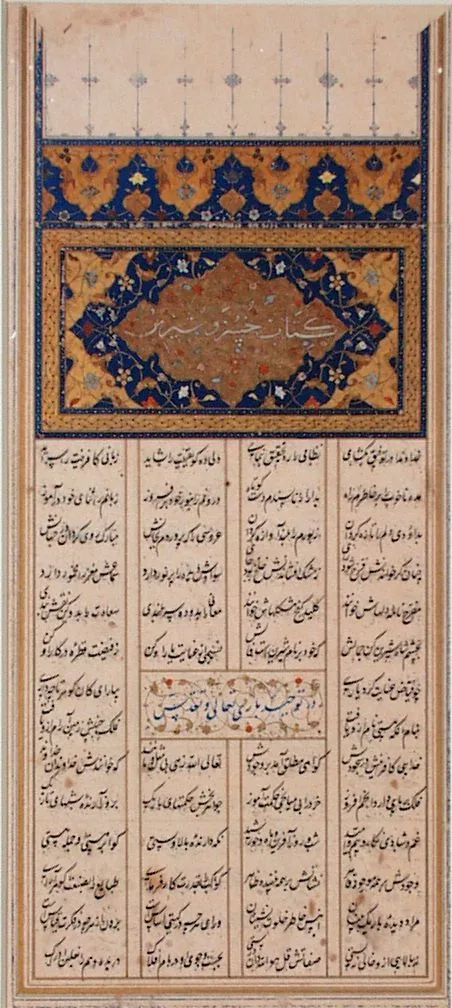
The Khamsa (Quintet) by Nizami Ganjavi (d. 1209), a collection of five lyrical narrative poems, ranks among the most celebrated works of medieval Persian literature. Alongside Firdawsi’s Shahnama (Book of Kings, completed c. 1010), it was frequently produced in manuscript form and richly illuminated and illustrated. The manuscript to which this folio belonged was disassembled, most probably when it was brought to the art market, and its pages dispersed. LACMA has seven of these folios (see also M.73.5.418, .421, .423, .424, and .560), including the colophon page, which dates the manuscript to AH 924/1517 CE and is signed by Muhammad Zarin-Qalam, or “Golden Pen,” an honorific title (see M.73.5.604).
This folio represents the illuminated title page of Khusraw va Shirin, the second book of Nizami’s Khamsa, which tells the mythical love story of the Sasanian ruler Khusraw Parviz (r. 590–628) and the Armenian princess Shirin. It features a richly decorated sarlouh (ornamental heading) with intricate finials and geometric scrollwork in blue, gold, and red. A central gold cartouche supplies the title in white ink, surrounded by red and blue floral motifs. The text below, written in nasta‘liq script and arranged in four columns, exemplifies the refined artistic traditions of Shiraz, where the manuscript was likely made. Further down, another cartouche introduces in gold ink the opening passage “On the Unity of the Almighty and the Most Sacred,” following the tradition of invoking divine unity at the start of each book, thereby grounding the text within a framework of devotion and reverence. The folio demonstrates the fusion of art and poetry, highlighting the role of illumination in Persian literary manuscripts, where elements like the louh-e diwan (diwan’s panel) became hallmarks of book decoration.
2025