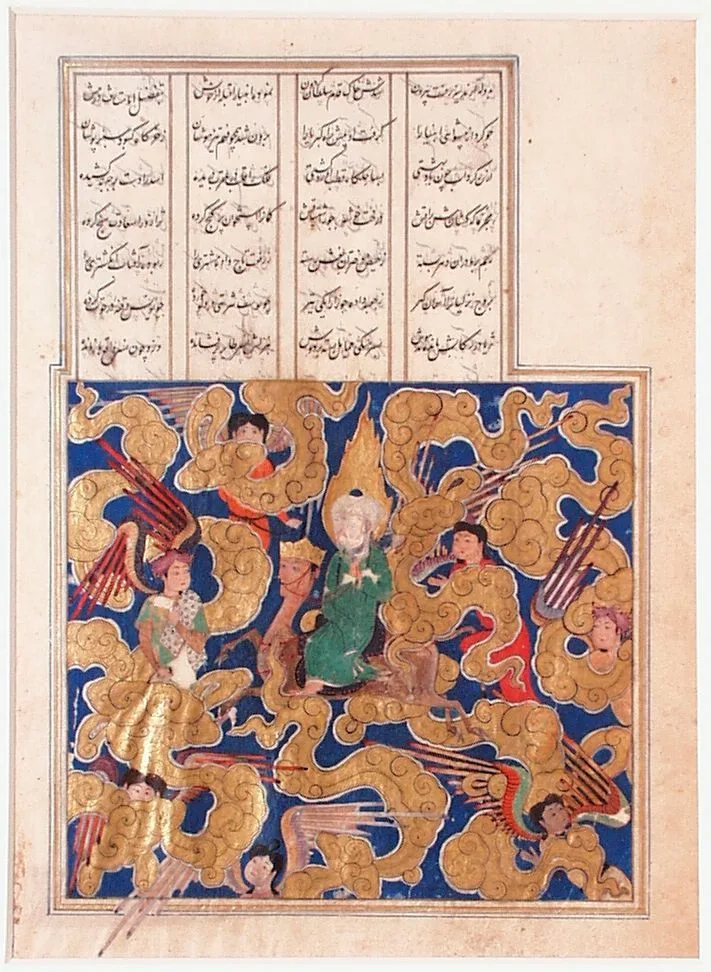
The Khamsa (Quintet) by Nizami Ganjavi (d. 1209), a collection of five lyrical narrative poems, ranks among the most celebrated works of medieval Persian literature. Alongside Firdawsi’s Shahnama (Book of Kings, completed c. 1010), it was frequently produced in manuscript form and richly illuminated and illustrated. The manuscript to which this folio belonged was disassembled, most probably when it was brought to the art market, and its pages dispersed. LACMA has seven of these folios (see also M.73.5.418, .423, .424, .560, and .606), including the colophon page, which dates the manuscript to AH 924/1517 CE and is signed by the scribe Muhammad Zarin-Qalam, or “Golden Pen,” an honorific title (see M.73.5.604).
Despite Islamic tradition generally prohibiting visual representations of the Prophet Muhammad, depictions of his mi‘raj—the miraculous night journey from Mecca to Jerusalem and his ascension to heaven—attained iconic status in Persianate culture, which has had a more relaxed relationship with figural imagery in general. Briefly mentioned in the Qur’an (notably in al-Isra’ 1) and later expanded in hadith and in the Mi‘rajnama (Book of Ascension), this event became a cherished subject in Persian poetry, inspiring numerous illustrations. From the thirteenth century onward, poets incorporated vivid descriptions of the mi‘raj into their works, as here, in Nizami’s Khamsa, despite having no direct connection to the narrative.
Though less detailed than other such examples (see M.85.237.44), this illustration depicts the Prophet Muhammad’s celestial ascent. He is mounted on Buraq, a mystical human-headed winged steed, and is guided by the archangel Gabriel amidst angels and swirling Chinese cloud bands that evoke the divine passage. The Prophet’s head is surrounded by a flaming halo, while his face is covered by a veil out of respect, a mode of depiction adopted in the early sixteenth century. Typical of Shiraz, where the manuscript was likely made, the nasta‘liq text is divided in four columns with a generous right margin, highlighting its artistic and literary significance.
2025