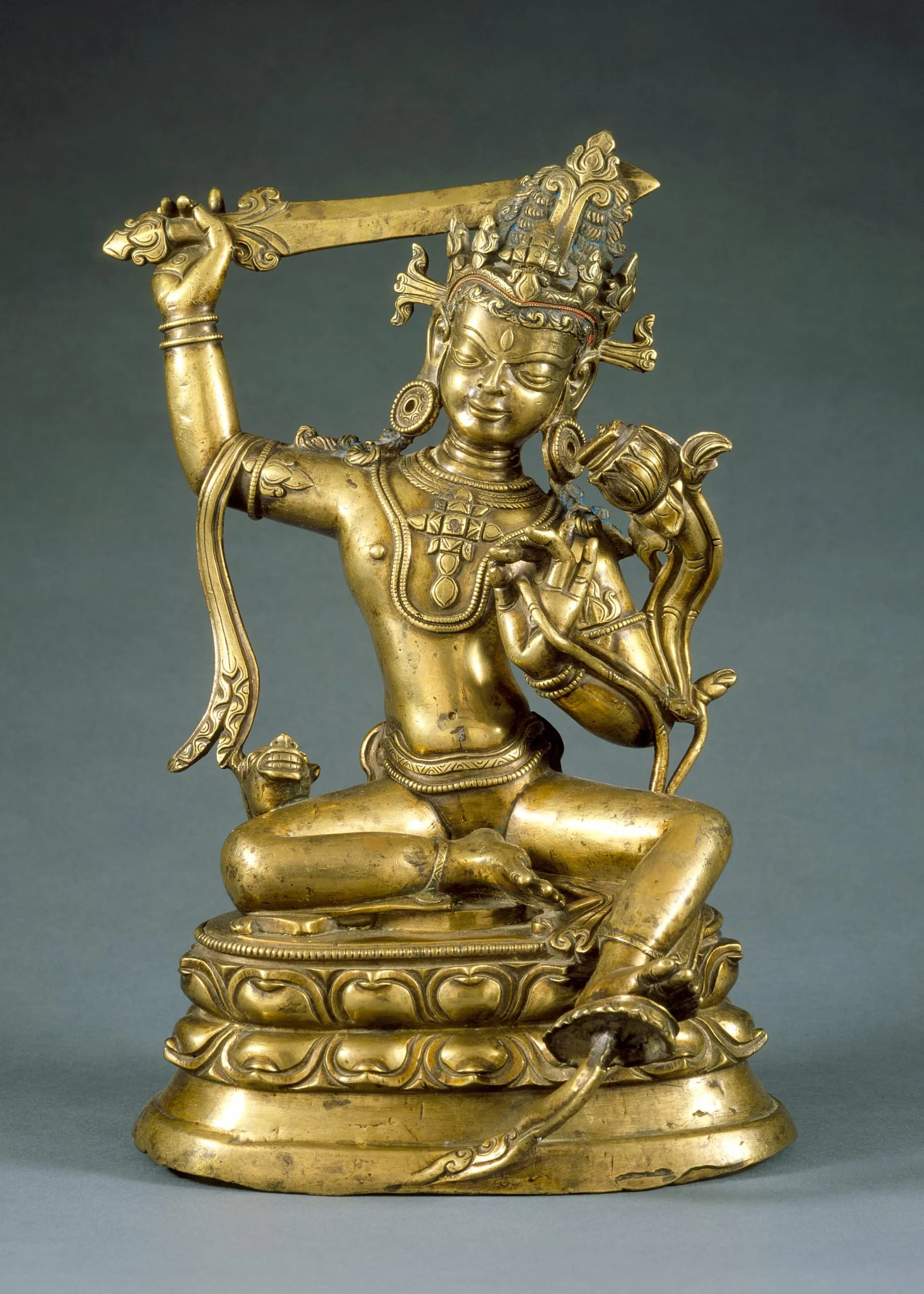
- Title
- The Bodhisattva Manjushri (Arapachana Manjushri)
- Date Made
- 13th century
- Medium
- Brass with traces of paint
- Dimensions
- 11 x 7 3/4 x 5 3/4 in. (27.94 x 19.68 x 14.6 cm)
- Accession Number
- M.78.136
- Curatorial Notes
Manjushri (Beautiful Glory/Goddess) is the Bodhisattva of Wisdom. He is envisioned in at least fourteen iconographic forms per religious textual sources. Perhaps the most distinctive is Arapachana Manjushri, who personifies his eponymous mantra A RA PA CHA NA. In this form, represented here and in M.75.4.6, he brandishes his sword of wisdom and holds a manuscript of the Prajnaparamita (Perfection of Wisdom) surmounted on a lotus stalk. Alternatively, he can carry only the sacred manuscript (M.75.4.9) or hold his hands in the gesture of Turning the Wheel of the Law (dharmachakra mudra) (M.75.4.19).
In this Central Tibetan representation, Manjushri has an ascetic’s piled hair and has long locks of hair cascading onto his shoulders. He wears a tiara and a profusion of jewelry. He sits on a lotus base in a variant of the relaxed posture (lalit asana) with his left leg pendant instead of the more customary right leg. His left foot is supported by the pericarp of a lotus flower (karnika). There are traces of blue paint in his hair and remnants of red devotional paint on his hairline. Behind his right thigh, his lion mount grins up at his divine master like a Cheshire cat.
- Selected Bibliography
- Pal, Pratapaditya. Art of Tibet. Expanded edition. Los Angeles: Los Angeles County Museum of Art, 1990.
- Reedy, Chandra L. Himalayan Bronzes: Technology, Style and Choices. Newark: University of Delaware Press, 1997.
- Pal, Pratapaditya. Art of Tibet. Los Angeles; Berkeley, CA: Los Angeles County Museum of Art; University of California Press, 1983.
- Little, Stephen, Tushara Bindu Gude, Karina Romero Blanco, Silvia Seligson, Marco Antonio Karam. Las Huellas de Buda. Ciudad de México : Instituto Nacional de Antropología e Historia, 2018.
- Little, Stephen, and Tushara Bindu Gude. Realms of the Dharma: Buddhist Art across Asia. Los Angeles: Los Angeles County Museum of Art, 2025.