- Title
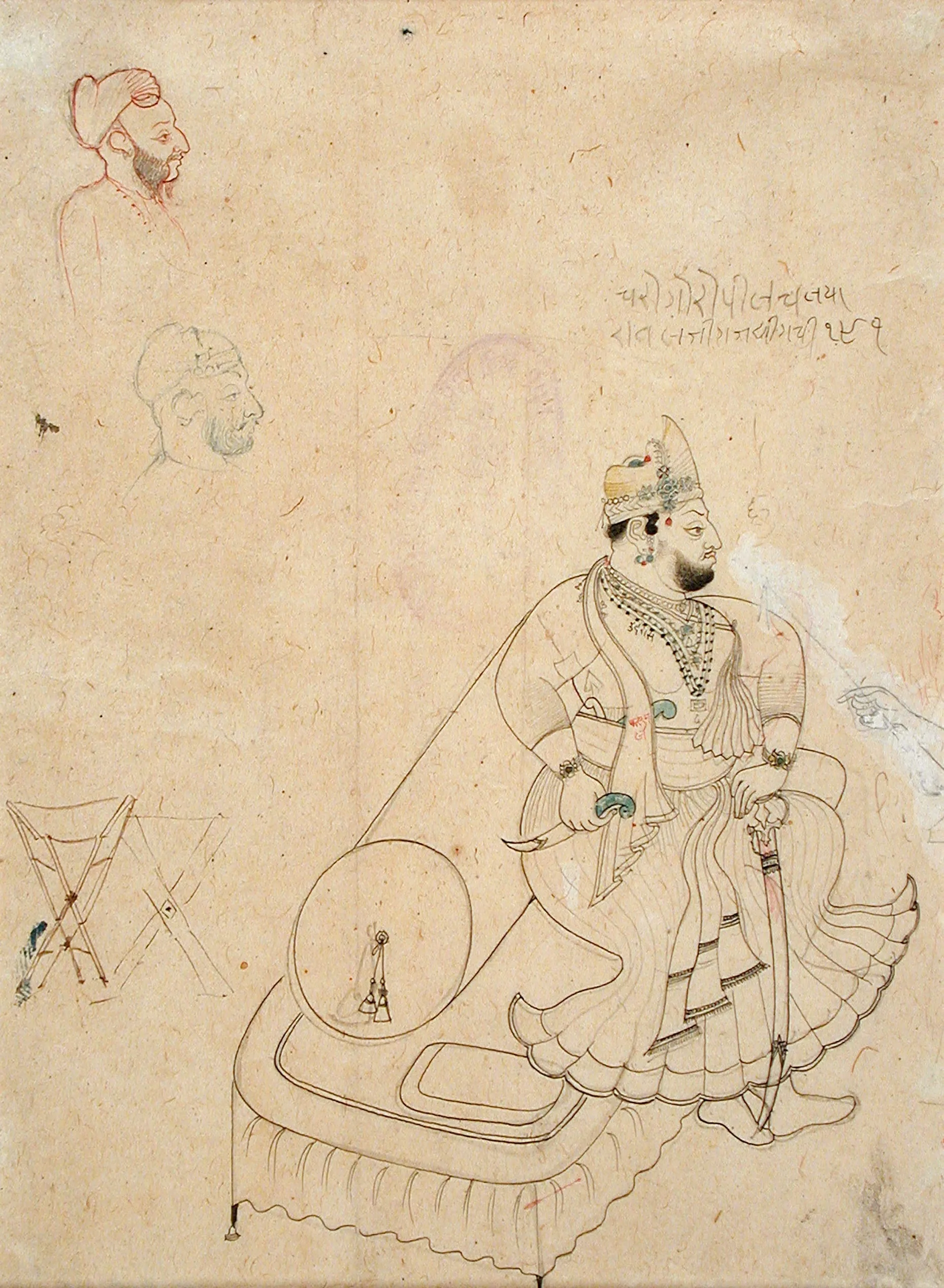
- Maharawal Rawal Gaj Singh of Jaisalmer (r. 1820-1846) and Portrait Studies
- Date Made
- circa 1840
- Medium
- Ink and opaque watercolor on paper
- Dimensions
- 9 1/8 x 7 in. (23.17 x 17.78 cm)
- Accession Number
- M.77.154.7
- Curatorial Notes
As identified by the devanagari inscription, the subject of this fragmentary unfinished preliminary portrait is “Rawal Gaj Singhji.” “Rawal” (from Sanskrit: rajakula, “royal family”) was the hereditary title of the Jaisalmer rulers. Maharawal Gaj Singh of Jaisalmer (r. 1820-1846) was born in 1800 and died in 1846. In 1821 he married Maharajkumari Rup Kunwar, a daughter of Maharana Bhim Singh of Udaipur (r. 1778-1828), during a period of reenergized prosperity for Mewar after its economy collapsed due to incessant tribute demands by the encroaching Marathas. Facing Maratha as well as Jodhpur incursions, Gaj Singh’s grandfather, Maharawal Mulraj Singh II (r. 1762–1820) had signed a protection alliance with the British East India Company in December 1818 but died ten months later. Due to the death of his father and the murder or exile of his uncles, in 1820 Gaj Singh was selected to rule Jaisalmer.
Gaj Singh is depicted here as a stout middle-aged man seated on a divan. Accordingly, the portrait was likely painted in circa 1840, which was six years before his death at age 46. He wears a pointed turban adorned with a jigha (plume-like ornament similar to an aigrette) and a sarpati (horizontal tripartite ornament). He has multiple necklaces with pendants and ornate bracelets. He holds a sword with a curved blade (talwar) and a dagger (khanjar). Another khanjar is tucked into his waist sash. Both daggers have a green pistol-grip shaped hilt, likely intended to represent jade.
- Selected Bibliography
- Pal, Pratapaditya and Catherine Glynn. The Sensuous Line: Indian Drawings from the Paul F. Walter Collection. Los Angeles: Los Angeles County Museum of Art, 1976.