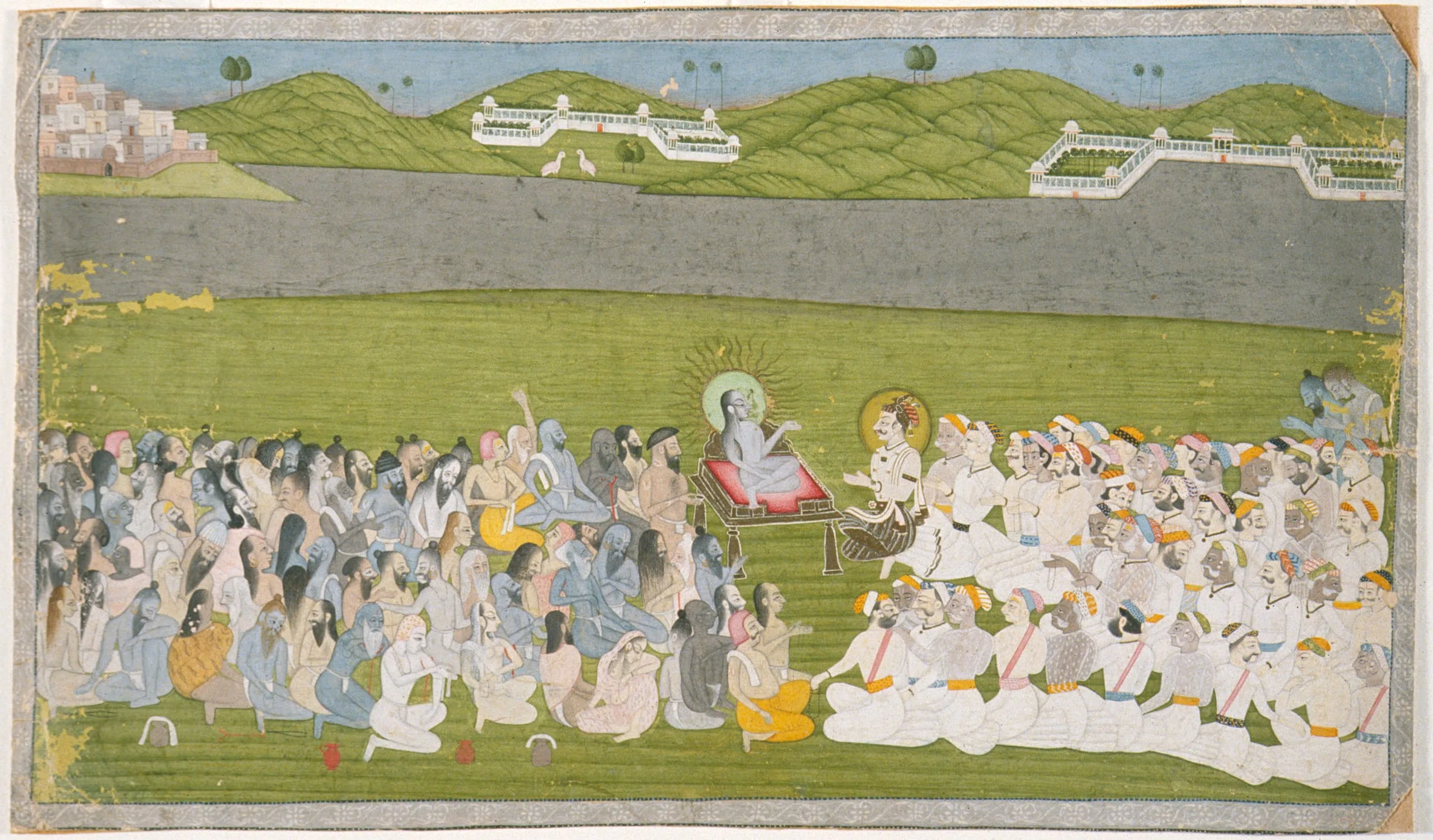
Maharaja Savant Singh of Kishangarh (r. 1748-1757) was the contested ruler of Kishangarh who relinquished his executive authority in 1757 to retire to Vrindaban, the pastoral homeland of Krishna near Mathura, Uttar Pradesh, to compose devotional poetry under his nom de plume of Nagari Das with a poetess and singer known as Bani Thani. See M.83.105.14, M.89.51.2, and AC1999.264.1.
Shukadeva (or Shuka) was the son of Vyasa, the legendary poet-sage credited with composing the epic Mahabharata ([War of the] Great Bharatas), Bhagavata Purana (Ancient Stories of the Lord), and the seventeen additional great Puranas (Mahapuranas). Believed to have been written in circa 500-550, the Bhagavata Purana promotes devotion bhakti (devotion) towards Krishna that leads to liberation (moksha) and bliss. In the text, Shukadeva narrates a series of dialogues and teachings espousing the bhakti philosophy (Bhakti Yoga) to King Parikshit, ruler of the northern Indian Kuru Kingdom in the 12th-10th centuries BCE.
In this imaginary or allegorical representation, the blue-skinned Shukadeva with a solar halo recites the Bhagavata Purana to the nimbate Savant Singh and an assembly divided into two groups. Behind Shukadeva are various Vaishnava ascetics, all male except for two females in the foreground. Behind Savant Singh are numerous turbaned princes or courtiers of varying ages and two ascetics in the back row. The setting is a typical Kishangarh landscape with a lake and palaces in the distance.