The Ramayana narrates the epic saga of the valiant Prince Rama and his dutiful wife, Princess Sita, who was abducted by Ravana, the arrogant ten-headed King of Lanka (probably modern Sri Lanka), during Rama's unjust fourteen-year forest exile from his capital of Ayodhya (near Faizabad in Uttar Pradesh). To rescue Sita, Rama and his faithful brother Lakshmana assembled a great army of monkeys and bears led by the Monkey-King Sugriva and his Monkey-General Hanuman. After several magical battles, the princess was freed, and the happy couple triumphantly returned home to rule Ayodhya. Rama and Sita epitomize the ideal ruler and the paragon of fidelity in traditional Hindu culture.
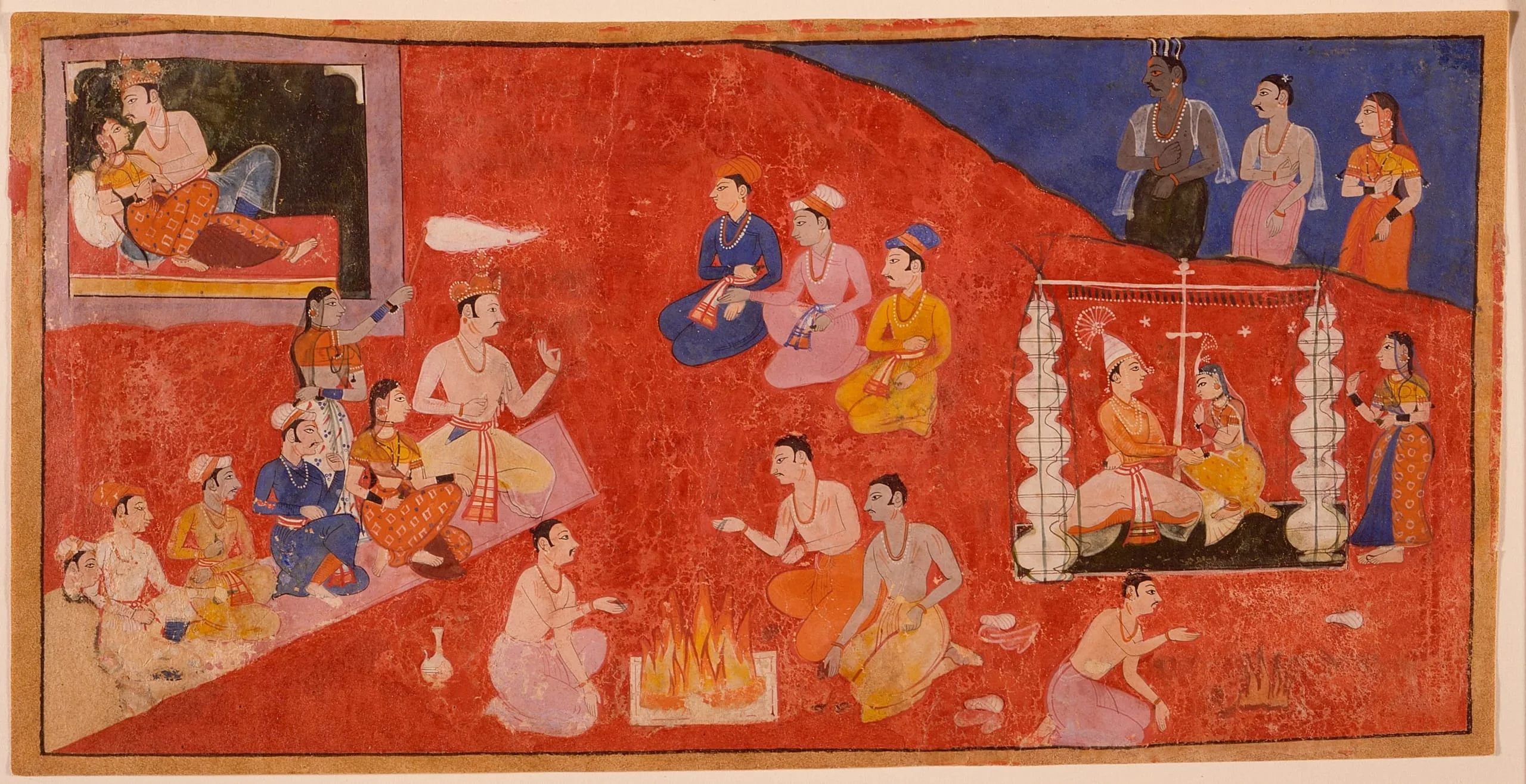
The painting depicts a wedding scene with the bride and groom seated below an awning with columns of auspicious waterpots supporting the corners. Hindu priests are offering ablutions into two fires in the foreground. In the lower left corner, a king and honored guests are seated on a diagonal rug. In the upper left corner, a prince and princess are reclining in a bedchamber. In the upper right corner, a holy man with a cobra-headdress, a priest, and a woman are approaching the festivities.
This folio has been ascribed to a dispersed Mewar series of the Ramayana’s Book 1 (Bala kanda) painted in 1649 by Manohar (active circa 1650). Additional folios, including the colophon page, are in the Chhatrapati Shivaji Maharaj Vastu Sangrahalaya, Mumbai. A comparable episode is Rishyashringa’s Wedding (54.1/3 Obv). See also M.88.222.1a-b.