LACMA

ShopMembershipMyLACMATickets
LACMA
Los Angeles County Museum of Art
5905 Wilshire Blvd.
Los Angeles, CA 90036
info@lacma.org
(323) 857-6000
Sign up to receive emails
Subscribe
© Museum Associates 2025

Museum Hours

Monday

11 am–6 pm

Tuesday

11 am–6 pm

Wednesday

Closed

Thursday

11 am–6 pm

Friday

11 am–8 pm

Saturday

10 am–7 pm

Sunday

10 am–7 pm


  • About LACMA
  • Jobs
  • Building LACMA
  • Host An Event
  • Unframed
  • Press
  • FAQs
  • Log in to MyLACMA
  • Privacy Policy
© Museum Associates 2025
Collections

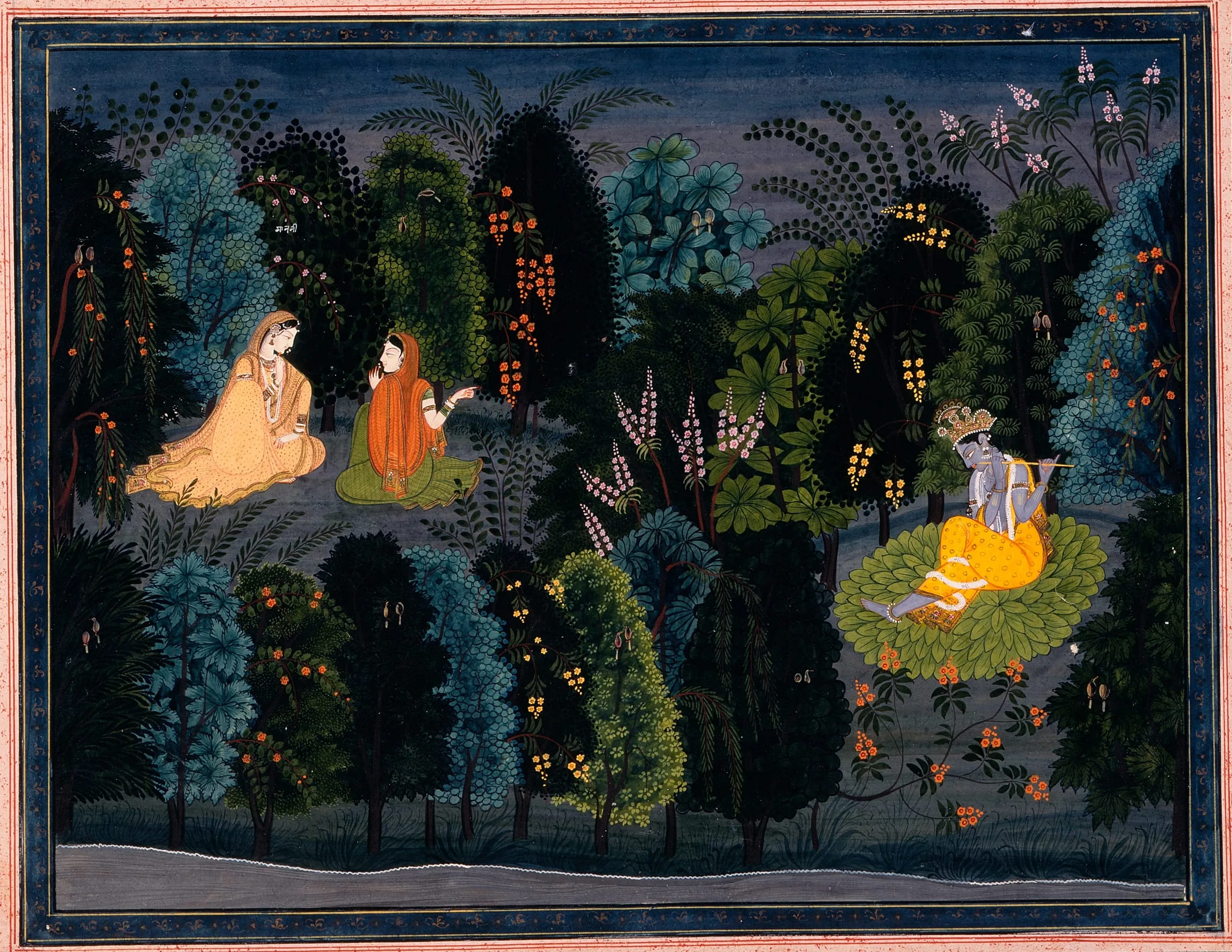
Confidante Persuading Radha as Krishna Flutes (recto), Text (verso); Folio from the "Lambagraon" Gita Govinda (Song of the Cowherd)circa 1820

Not on view
Mughal or Pahari opaque watercolor painting, two women seated in a night garden facing a reclining blue-skinned flute-playing figure on a bed of leaves, surrounded by stylized flowering trees under a dark blue sky
Artist or Maker

Attributed to Purkhu (India, active circa 1780-1820)
Title
Confidante Persuading Radha as Krishna Flutes (recto), Text (verso); Folio from the "Lambagraon" Gita Govinda (Song of the Cowherd)
Place Made
India, Himachal Pradesh, Kangra
Date Made
circa 1820
Medium
Opaque watercolor and gold on paper
Dimensions
Sheet (Sheet): 10 3/4 x 13 3/4 in. (27.305 x 34.925 cm) Image (Image): 9 1/2 x 12 1/2 in. (24.13 x 31.75 cm) Frame: 19 1/2 × 23 3/4 × 1 1/4 in. (49.53 × 60.33 × 3.18 cm)
Credit Line
Gift of the Michael J. Connell Foundation
Accession Number
M.71.49.7
Classification
Drawings
Collecting Area
South and Southeast Asian Art
Curatorial Notes

The Gita Govinda (Song of the Cowherd) was composed by the Sanskrit poet Jayadeva (eastern India, circa 1170-1245). The celebrated poem marks the debut of Krishna’s paramour Radha. She is absent from the major early texts in which the life of Krishna is related: the Harivamsha (Lineage of Hari [Vishnu]), 1st century; Vishnu Purana (Ancient Stories of Vishnu), circa 450; and Bhagavata Purana (Ancient Stories of the Lord), 8th-10th century. It describes the initial passion of Radha and Krishna, their temporary estrangement over Radha's jealousy of Krishna sharing his love with other cow-herdswomen, and their ecstatic reconciliation in Krishna's nocturnal bower of delight.

The folio illustrates the Sanskrit verses to be sung with Raga Vasant that are inscribed on the reverse: “He [Krishna] made himself soothe you with flattery. He made himself fall limp at your feet. Now he waits for sensual play in his bed on the bank of sweet swamp reeds. Madhu’s tormentor is faithful to you, fool. Follow him, Radhika.” (Gita Govinda 11:20:2) Radha’s confidante (sakhi) is attempting to persuade her to forgive Krishna’s dalliance. In a nearby grove, Krishna awaits her on a bed of leaves while playing a flute.

This now dispersed series was formerly in the ancestral collection of Maharaja Dhrub Dev Chand of Lambagraon, Kangra. Additional folios are in the Brooklyn Museum (72.43), Museum of Fine Arts, Boston (17.2389-.2391), San Diego Museum of Art (1990.1296-.1297), and National Museum, New Delhi.