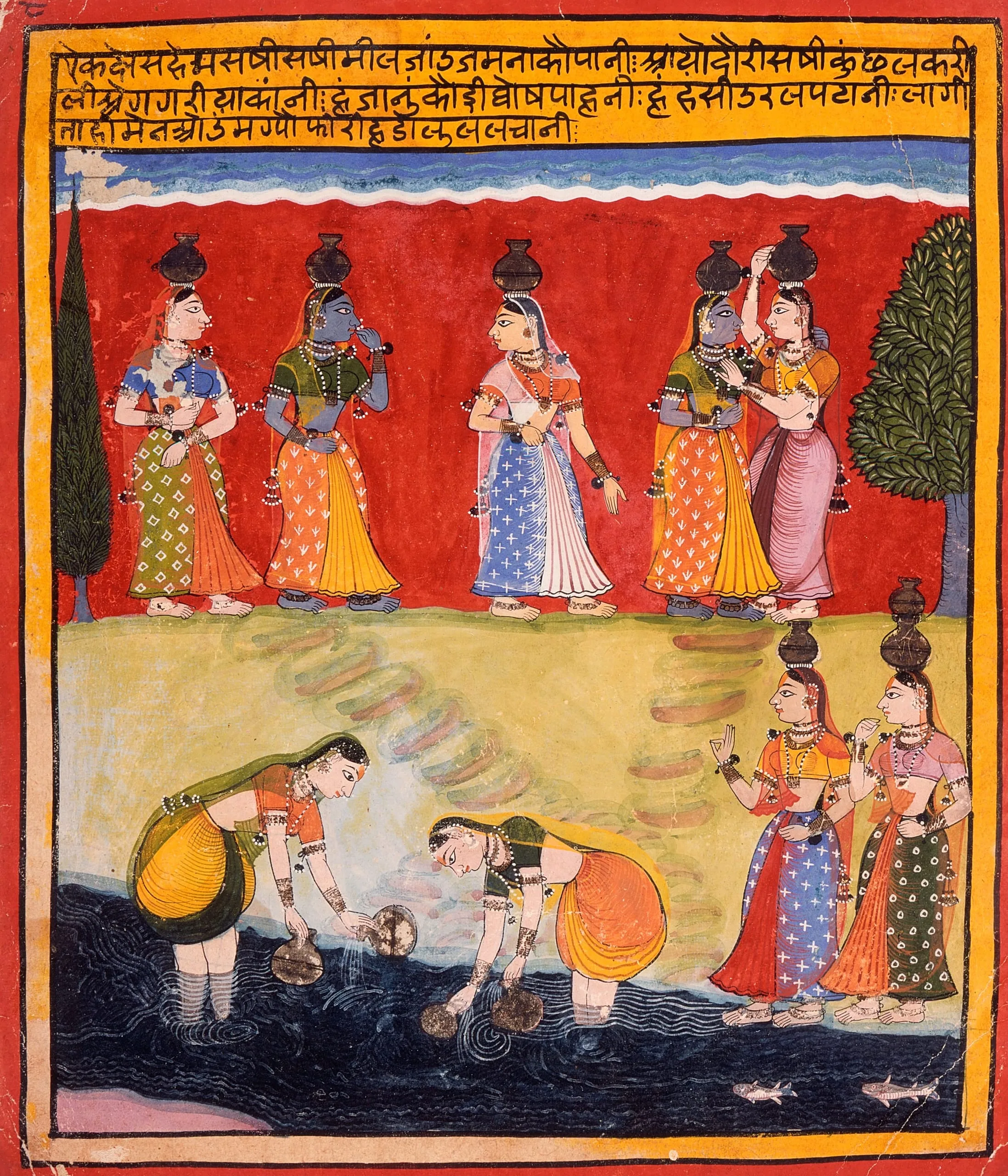
This folio illustrates a traditional bucolic genre scene of the cowherdesses (gopis) of Vrindavan fetching water from the Yamuna River. The elegantly attired women balance their water pots on their heads as they walk to the river (see M.2006.167.2). Paths lead down to the water’s edge where the women fill their pots.
The header is inscribed with Braj-Bhasha verses describing their communal quest and the sudden emotional stirring akin to a search for a hidden lover, perhaps Krishna. The poetic verses read,
One or two sakhis (maidens) together, went to the river Jamna [Yamuna]. Suddenly another sakhi comes running with a leaking water pot. Realizing that none was around, and amused by the leaking water pot, I laughed and laughed holding my breath. (Translation by Shridhar Andhare.)
The analogous verses on a series mate of this dispersed manuscript now in the Harvard Art Museums, Cambridge (1995.75) are ascribed to the Vaishnava poet-saint and mystic, Bhagat Parmanand Das (1483–1574 or 1493–1584). He was born to a Brahmin family in Kannauj, Uttar Pradesh. See Elizabeth Finch, ed., Rajasthani Miniatures: The Welch Collection from the Arthur M. Sackler Museum (New York: The Drawing Center, 1997), p. 15. Possible additional series mates are in the Bharat Kala Bhavan, Varanasi (421, 811, 1348, 1438). See Andrew Topsfield, Court Painting at Udaipur (Zürich: Museum Rietberg, 2001), pp. 89, 103, n. 31.