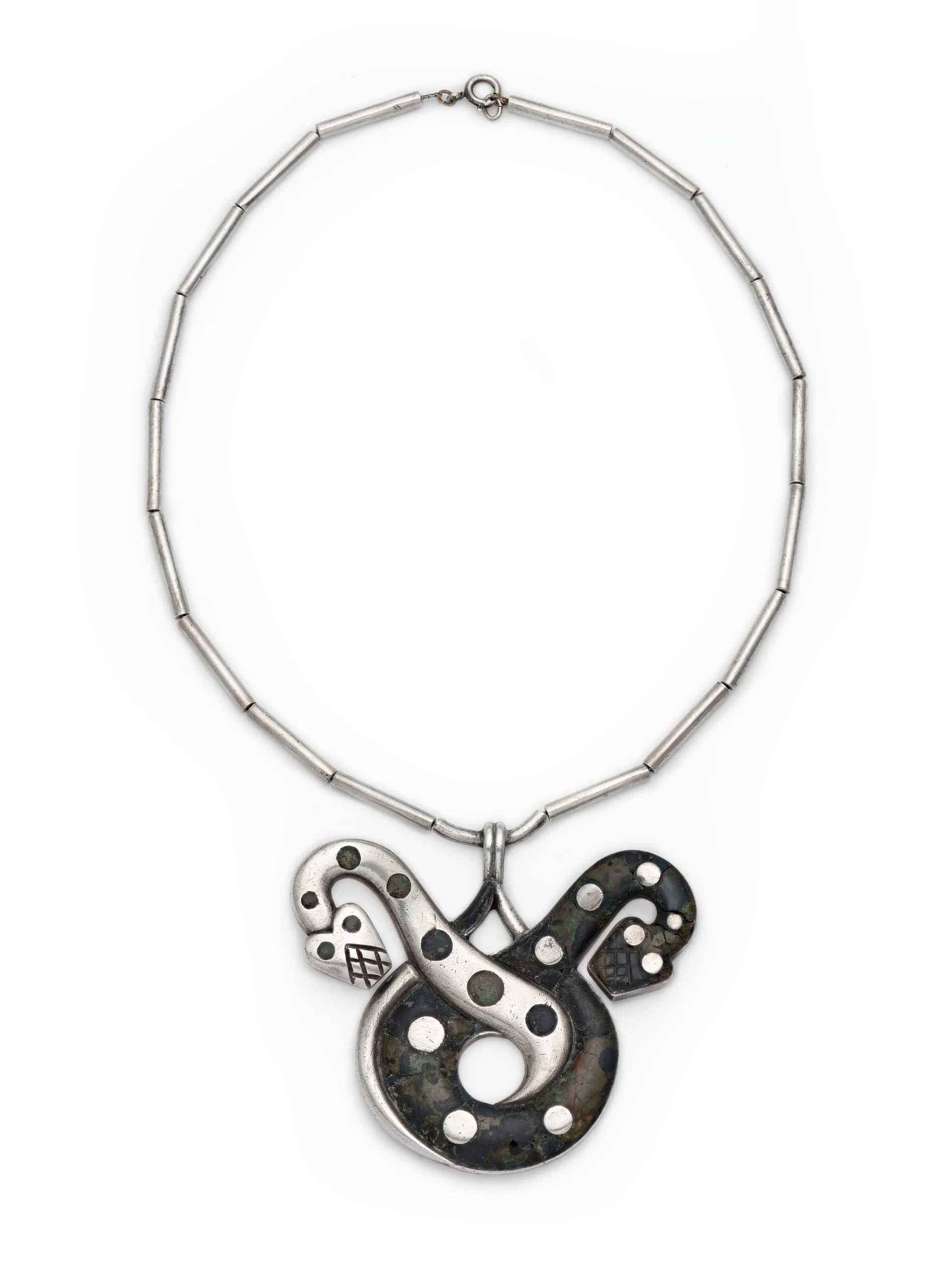
William Spratling studied Mesoamerican art and frequently adapted its motifs in his silver designs. Serpents were among the most important animals in Mesoamerica. They symbolized rebirth and transformation, and were some of the most represented deities. The Nahuatl word coatl means both serpent and twin, perhaps a reference for this entwined variation that recalls ancient examples (see, e.g., M.86.296.170 and M.2023.61.255). Spratling emphasized the motif’s duality through the contrasting use of bright silver and the deep blue-green of azurite and malachite.
Trained as an architect, Spratling moved from New Orleans to Taxco, Mexico, where he established his first silver workshop in 1931. Working alongside master silversmiths and local apprentices, in 1935 he opened his famed Taller de Las Delicias, which attracted a cohort of international artists, intellectuals, and Hollywood celebrities. Spratling’s emphasis on craftsmanship and his experimentation with different sources, including Mesoamerican art, Art Deco, and modernism, contributed to his great success and helped revitalize the Mexican silver industry.
Rachel Kaplan
2025