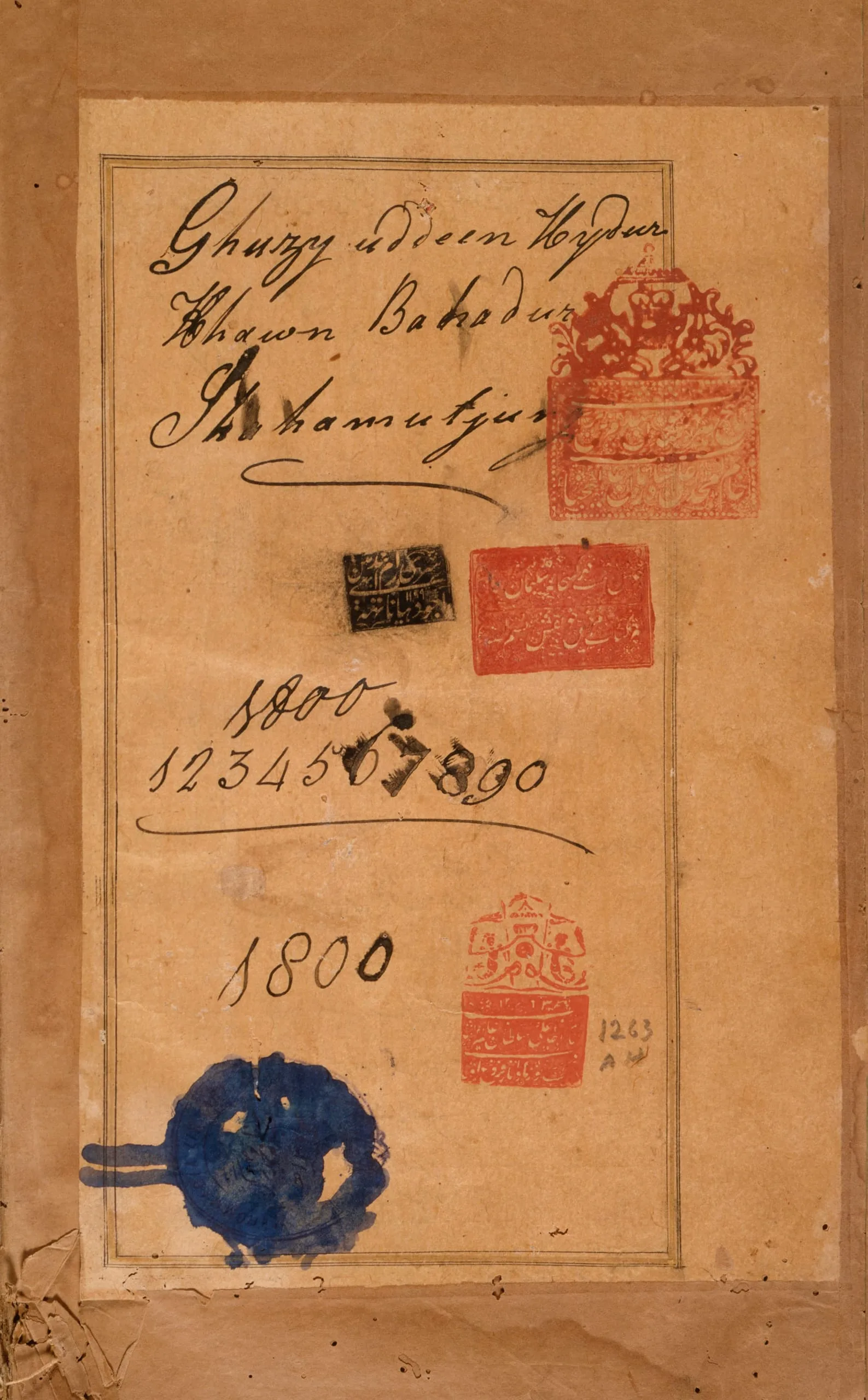
The Qutb Shahi dynasty (or the Golconda Sultanate, 1518–1687) ruled from Golconda Fort and, after 1591, nearby Hyderabad, Telangana. It was founded in 1518 when Sultan Quli Qutb Shah (or Sultan Quli Qutb al-Mulk, r. 1496-1543) declared his independence from the Bahmani Sultanate (1347-1527), which splintered into the independent sultanates of Ahmadnagar, Bijapur, and Berar in 1490; Golconda in 1518; and Bidar in 1528. This illuminated manuscript consists of 450 pages with five illustrations. Its colophon states it was copied by the scribe Habibullah Gilani in 1610-1611 (AH 1019) during the reign of Sultan Muhammad Quli Qutb Shah (r. 1580-1612). There are at least a dozen later ownership seal-stamps and numerous marginal notes by librarians documenting subsequent owners, as well as poetry and aphorisms. Subsequent inscribed dates include 1711-1712 (AH 1123) and 1784-1785 (AH 1199). The large handwritten name at the top of this page reads, Ghazy uddeen Heydur Khawn Bahadur (Ghazi al-Din Haider Khan Bahadur), who was the Nawab (Governor) and then King of Lucknow (r. 1814-1827). The five portraits of the Qutb Shahi Sultans were likely added in circa 1700. The manuscript was rebound with its current tooled leather binding probably in the 19th century.