- Title
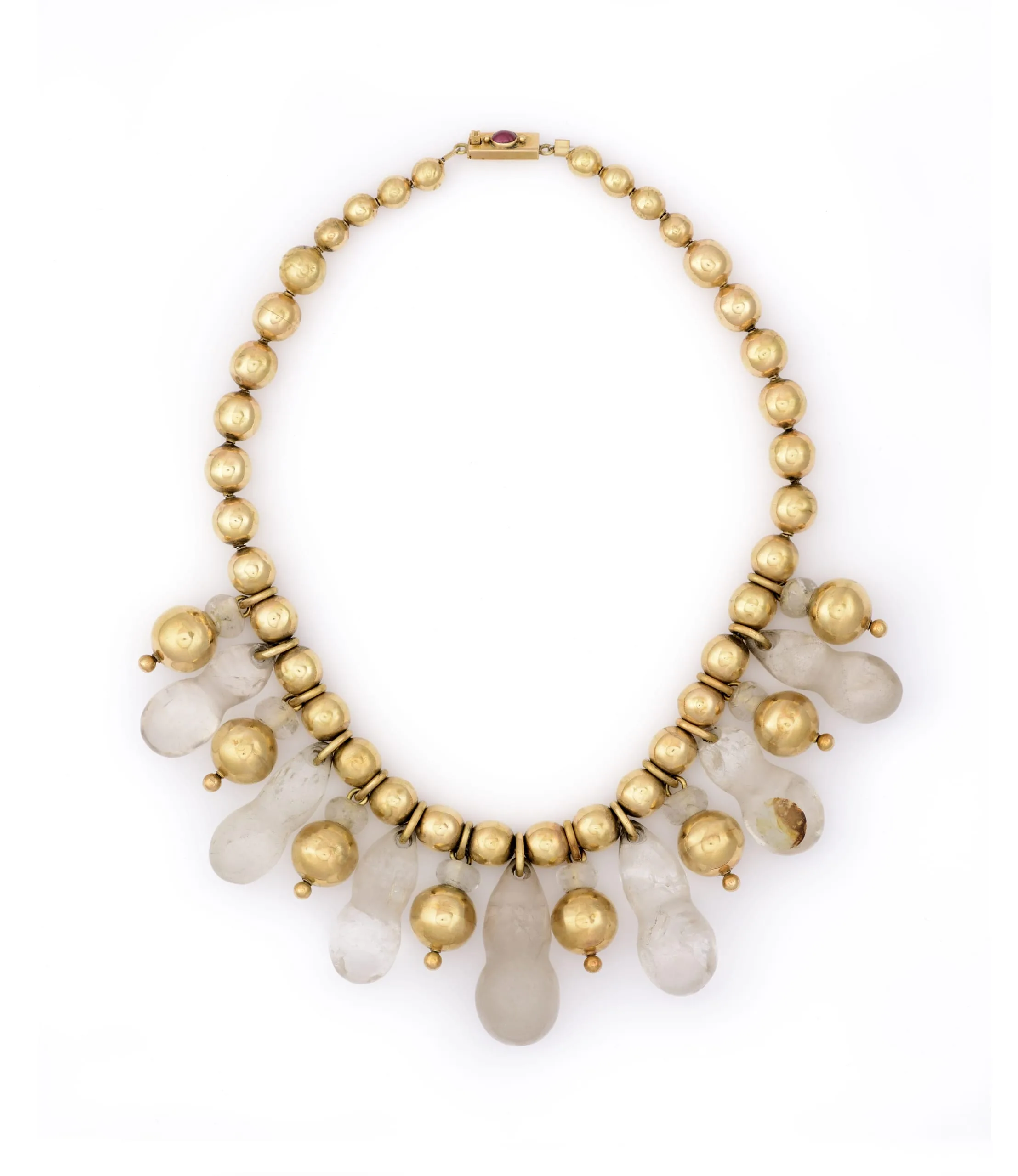
- Ancient-Style Necklace (owned by Millard and Mary Baskerville Sheets)
- Date Made
- circa 1965
- Medium
- Gold, crystal, ruby
- Dimensions
- 7 1/4 × 6 3/4 × 5/8 in. (18.42 × 17.15 × 1.59 cm)
- Accession Number
- M.2018.68.62
- Curatorial Notes
The Southern California-based painter Millard Sheets (1907–1989) purchased this necklace for his wife Mary Baskerville Sheets (1909–2000) from the celebrated silver designer William Spratling. The two men met in Taxco, where Spratling operated a highly successful silver workshop. The necklace draws inspiration from Mixtec jewelry and incorporates gold and rock crystal, which were considered precious in ancient times. Both Spratling and Sheets shared a fascination with Mesoamerican art and avidly collected objects from Mexican excavations. Sheets owned two other Spratling works that are now in LACMA’s collection—a second necklace (M.2018.68.63) and a pitcher (M.2015.249.12)—underscoring the close ties between the two artists and their commitment to incorporating Pre-Columbian aesthetic values into modern life.
Trained as an architect, Spratling moved from New Orleans to Taxco, Mexico, where he established his first silver workshop in 1931. Working alongside master silversmiths and local apprentices, in 1935 he opened his famed Taller de Las Delicias, which attracted a cohort of international artists, intellectuals, and Hollywood celebrities. Spratling’s emphasis on craftsmanship and his experimentation with different sources, including Mesoamerican art, Art Deco, and modernism, contributed to his great success and helped revitalize the Mexican silver industry.
Rachel Kaplan
2024