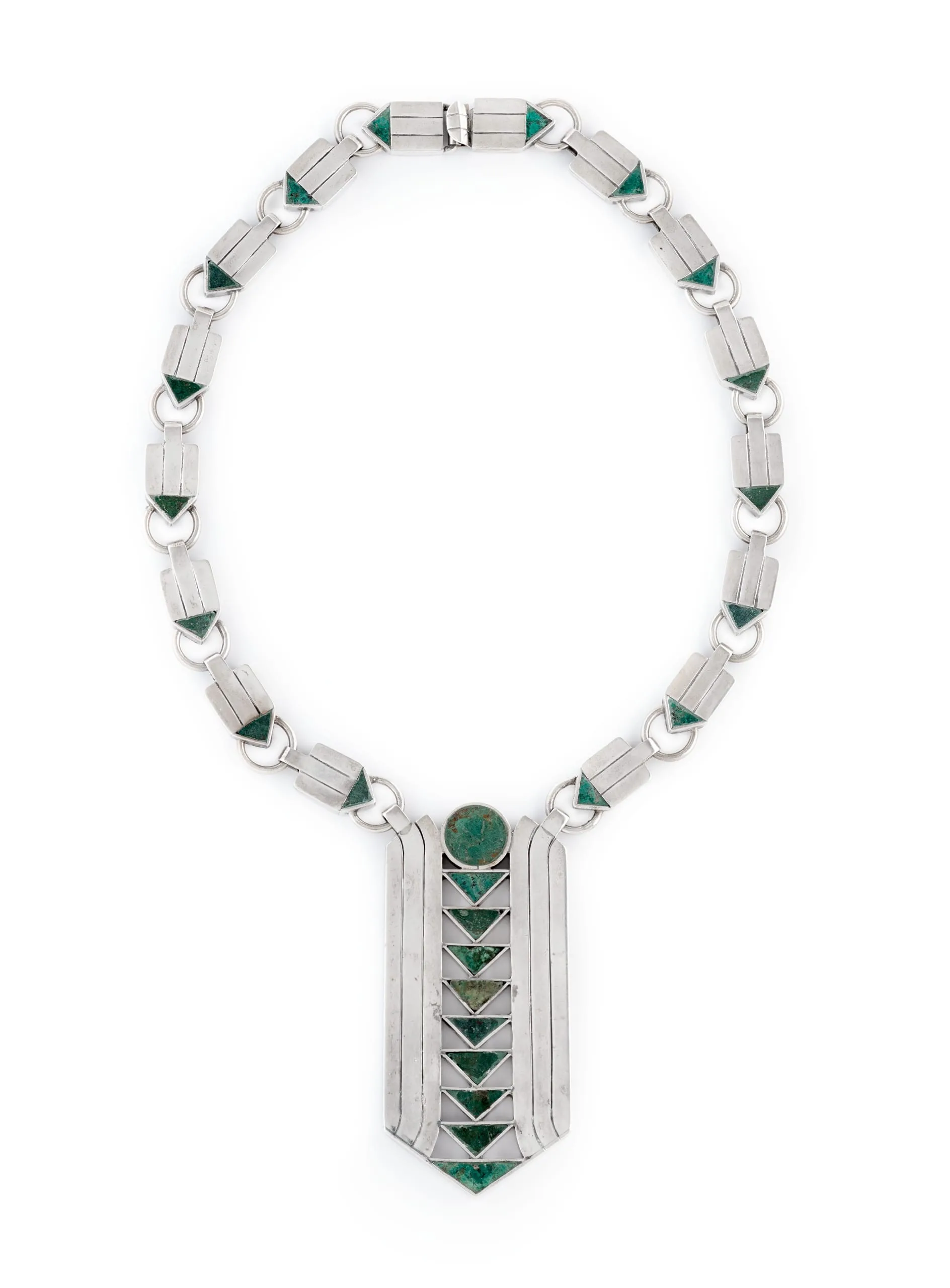
William Spratling labeled a drawing of this necklace “Cascada” (Waterfall), reinterpreting a flowing, natural phenomenon into a simple geometric design. The arrows are placed dynamically around the chain and merge into the central pendant. The blue-green of the azurite and malachite, which evokes water and nature, contrasts with the luminous silver material—a hallmark of Spratling’s designs.
Trained as an architect, Spratling moved from New Orleans to Taxco, Mexico, where he established his first silver workshop in 1931. Working alongside master silversmiths and local apprentices, in 1935 he opened his famed Taller de Las Delicias, which attracted a cohort of international artists, intellectuals, and Hollywood celebrities. Following his successes in Mexico, Spratling presented a plan to the U.S. Indian Arts and Crafts Board to launch a similar initiative in Alaska. He visited in August 1945 at the invitation of his friend, Ernest Gruening, the territory’s governor. In 1949, seven Alaskan World War II veterans arrived in Taxco to train at Spratling’s workshop. Spratling created 200 prototypes that could be reproduced by Native artisans for the growing tourist market in Alaska (see M.2013.5.1). Although the Alaska project was ultimately abandoned due to lack of support from government agencies, many of Spratling’s subsequent designs demonstrate the impact of the Alaskan models, including the extensive use of triangles in this bold necklace.
Rachel Kaplan
2024